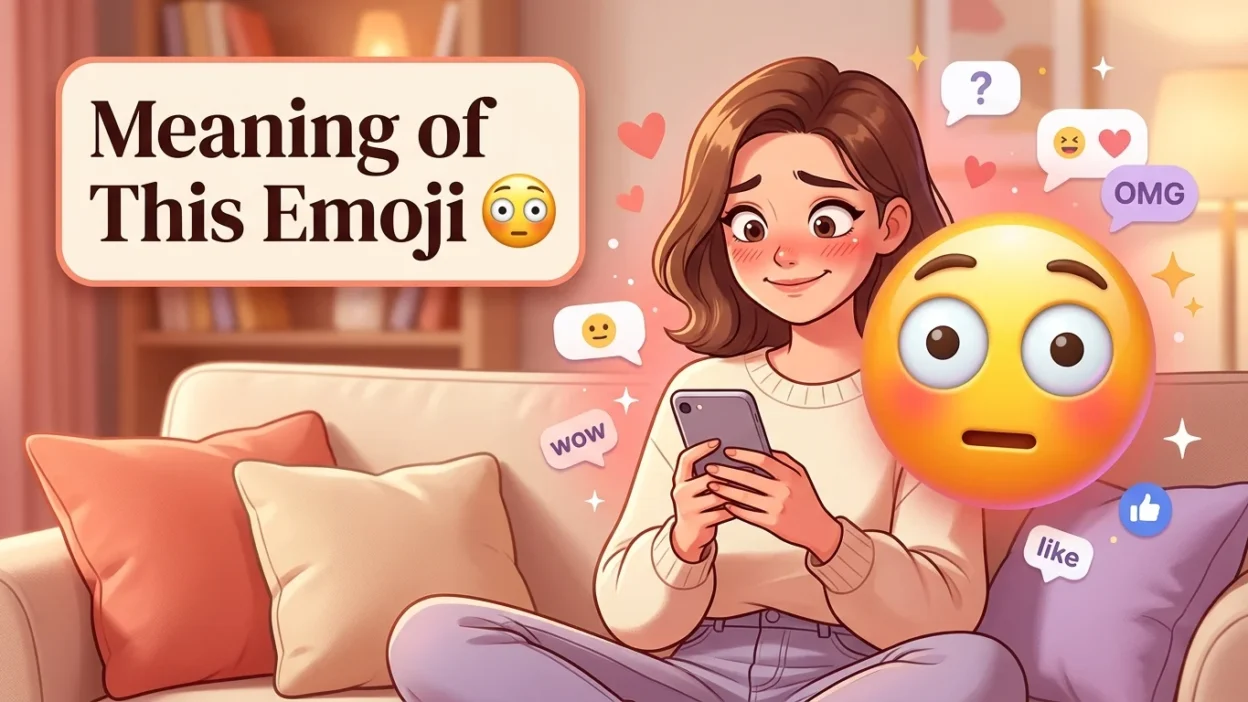
Have you ever received 😳 in a message and wondered what the sender meant? The 😳 Meaning of This Emoji is commonly associated with embarrassment, surprise, awkwardness, shyness, or feeling caught off guard. It can communicate a strong reaction without needing a long explanation.
The meaning of 😳 can change based on the conversation. Someone might use it after receiving a compliment, hearing something unexpected, or finding a situation awkward. In texting, it can also create a shy, flustered, or slightly flirty tone, especially when the message has a romantic context.
Whether you saw 😳 in a text, social media comment, caption, or private chat, the surrounding words usually reveal the sender’s intention. In this guide, we’ll explain the Meaning of This Emoji 😳, its common uses, different interpretations, and real texting examples to help you understand it clearly.
Quick Answer : Meaning of This Emoji 😳
The 😳 emoji usually means embarrassment, shyness, surprise, awkwardness, disbelief, or being impressed. It can also show attraction or excitement when the conversation has a romantic or playful tone. The exact meaning depends on the surrounding message and context.
For example:
“You look really good today 😳”
Here, 😳 may show shyness, attraction, or feeling flattered.
But:
“You actually won the lottery? 😳”
Here, it means shock or disbelief.
What Does “meaning of this emoji 😳” Mean?
The meaning of this emoji 😳 is usually connected to a sudden or strong emotional reaction. The emoji is officially called Flushed Face, and its design shows a face with wide eyes, raised eyebrows, and visibly red cheeks. Unicode associates it with embarrassment, while everyday online use gives it several related meanings.
In simple English, 😳 can mean:
- “I’m embarrassed.”
- “Wow, I didn’t expect that.”
- “You caught me.”
- “That’s awkward.”
- “I’m shy.”
- “I can’t believe that.”
- “That’s impressive.”
- “You’re making me blush.”
- “I’m surprised.”
- “That was intense.”
The red cheeks are especially important. They make the emoji different from a simple shocked or surprised face. The person may not only be surprised but also emotionally affected by what happened.
The Literal Meaning of 😳
There is no literal sentence hidden inside an emoji. Instead, 😳 visually represents a facial reaction.
The face looks flushed or red, as if someone has become embarrassed, nervous, shy, or overwhelmed. Its wide eyes can also suggest surprise or disbelief.
That combination gives 😳 its broad emotional range.
The Most Common Meaning of 😳
The most common interpretation is embarrassment or feeling awkward.
For example:
“I accidentally called my teacher ‘Mom’ 😳”
The emoji adds a feeling of embarrassment. It tells the reader that the person knows the situation was awkward.
However, embarrassment is not the only meaning. Emojipedia explains that 😳 can also express surprise, disbelief, amazement, excitement, affection, shyness, and attraction.
Meaning of 😳 in Different Contexts
The same emoji can communicate different emotions depending on where and how someone uses it. Context is especially important with 😳 because surprise, embarrassment, shyness, and attraction can look very similar in a short text.
😳 in Everyday Conversation
In everyday conversation, 😳 often shows a strong reaction.
Someone might send it after hearing unexpected news or discovering something surprising.
For example:
“Wait, you met Taylor Swift? 😳”
Here, the emoji shows amazement and surprise.
It can also make a normal statement sound more emotional:
“I forgot everyone could see my presentation 😳”
Here, it means embarrassment.
😳 in Text Messages
In text messages, 😳 often replaces the facial expression that would normally accompany spoken words.
Because texting does not include voice tone or facial expressions, emojis help explain the emotional meaning behind a sentence.
For example:
“You really said that to him? 😳”
This could mean:
“Wow, I can’t believe you said that.”
Another example:
“You’re actually very cute 😳”
This could suggest:
“I’m shy because I just complimented you.”
😳 on Social Media
On social media, people often use 😳 as a quick reaction to something surprising, impressive, awkward, or unexpected.
For example, someone might comment:
“That transformation 😳”
The meaning could be:
“Wow, that looks amazing.”
It can also appear under dramatic posts, unexpected announcements, funny situations, or attractive photos.
😳 on WhatsApp
On WhatsApp, 😳 can have a very personal meaning because it is often used in one-to-one chats.
A friend may use it after an embarrassing story:
“I waved back at someone who wasn’t waving at me 😳”
A romantic interest might use it after a compliment:
“Stop saying things like that 😳”
In the second example, the emoji may communicate shyness, blushing, or attraction rather than actual embarrassment.
😳 on Snapchat
Snapchat conversations are often casual and playful, so 😳 can be used to show surprise, awkwardness, or flirtation.
For example:
“You saw that snap? 😳”
This can suggest:
“Oh no, you saw that!”
In a playful conversation, it can also mean:
“I’m shy about what you just said.”
😳 on Instagram
Instagram users often use 😳 in comments and direct messages.
A person might comment:
“Okayyy 😳”
This can be a reaction to an impressive appearance, attractive photo, unexpected announcement, or bold statement.
The meaning becomes especially dependent on the surrounding words. A single 😳 under a photo may feel more like “Wow, you look good” than “I am embarrassed.”
😳 on TikTok
On TikTok, 😳 is frequently used as a reaction to surprising, impressive, awkward, or unexpected content.
For example:
“That ending 😳”
This can mean:
“I did not see that coming.”
Another person might comment:
“Bro really did that 😳”
Here, it expresses shock, disbelief, or amazement.
😳 in Gaming
Gamers may use 😳 after an unexpected play, unbelievable win, difficult move, or surprising event.
For example:
“You won with one HP left 😳”
The emoji means something like:
“That was unbelievably close!”
It can also appear after an embarrassing mistake:
“I walked straight into the trap 😳”
Here, it communicates embarrassment.
😳 in Professional Communication
Be careful with 😳 in professional messages.
It can make sense in a relaxed workplace chat, especially among coworkers who regularly use emojis. However, it may look too informal in a formal email, job application, business proposal, or communication with someone you do not know well.
For example, instead of writing:
“I accidentally sent the wrong file 😳”
in a formal email, a clearer sentence would be:
“I apologize. I accidentally sent the wrong file.”
The emoji is not automatically inappropriate, but professional communication usually benefits from clear words rather than emotional emoji reactions.
Examples of “meaning of this emoji 😳”
Here are several realistic examples showing how the meaning of 😳 changes with context.
Example 1: Embarrassment
Sentence:
“I called my boss ‘Dad’ today 😳”
Meaning:
The person feels embarrassed about making an awkward mistake.
Situation:
They accidentally used the wrong name in front of someone.
Example 2: Surprise
Sentence:
“You finished the whole project in one day? 😳”
Meaning:
The emoji expresses surprise and amazement.
Situation:
The speaker did not expect the other person to finish so quickly.
Example 3: Shyness
Sentence:
“You really think I’m pretty? 😳”
Meaning:
Here, 😳 can show that the person feels shy or flattered by the compliment.
Situation:
Someone receives a personal compliment and does not know how to respond confidently.
Example 4: Attraction
Sentence:
“Okay, that outfit looks really good on you 😳”
Meaning:
The emoji may suggest attraction, admiration, or playful shyness.
Situation:
Someone is complimenting another person’s appearance in a slightly flirty way.
Example 5: Disbelief
Sentence:
“He bought a new car with his first paycheck 😳”
Meaning:
The emoji means something like “Seriously?” or “I can’t believe it.”
Situation:
The speaker has heard unexpected news.
Example 6: Awkwardness
Sentence:
“Everyone went silent after my joke 😳”
Meaning:
The emoji highlights the uncomfortable or awkward moment.
Situation:
The speaker realizes that the joke did not get the reaction they expected.
Example 7: Being Impressed
Sentence:
“You can solve that puzzle in two minutes? 😳”
Meaning:
The emoji expresses admiration and surprise.
Situation:
Someone has demonstrated an unexpectedly impressive skill.
When Do People Use 😳?
People use 😳 when words alone do not fully express their reaction.
It is particularly useful when someone wants to communicate a mixture of emotions. For example, a person can feel surprised and embarrassed at the same time. They can feel attracted and shy at the same time. 😳 can cover these combinations without requiring a long explanation.
When Someone Is Embarrassed
This is one of the clearest uses.
“I sent the private message to the group chat 😳”
The emoji tells the reader that the person feels embarrassed about what happened.
When Someone Feels Shy
Someone may use 😳 when receiving a compliment or attention.
“You remembered my birthday? 😳”
The emoji can make the response feel softer and more bashful.
When Something Is Unexpected
It can also mean:
“Wait, what?”
For example:
“She quit her job yesterday 😳”
The emoji shows that the news was unexpected.
When Someone Is Flattered
A compliment may cause someone to respond with 😳.
“You’re the funniest person here.”
“Stoppp 😳”
This does not necessarily mean the person is literally embarrassed. It may simply show that they are flattered and shy.
When Someone Is Flirting
In romantic conversations, 😳 can sometimes have a flirtatious meaning.
For example:
“You looked really good tonight 😳”
The emoji may communicate attraction or playful embarrassment.
However, you should not automatically assume that 😳 means romantic interest. The surrounding conversation matters.
Appropriate vs. Inappropriate Use
😳 works well in:
- Casual texting
- Friendly conversations
- Social media comments
- Memes
- Playful chats
- Romantic conversations
- Informal group chats
Use more caution in:
- Formal business emails
- Job applications
- Academic writing
- Legal documents
- Official complaints
- Serious professional communication
Different Meanings of 😳
Although 😳 has one official name, people use it in several ways online.
😳 Meaning: Embarrassed
Definition:
Feeling uncomfortable because of something awkward, personal, or embarrassing.
Context:
Someone makes a mistake or becomes the center of attention.
Example:
“I tripped in front of everyone 😳”
Here, 😳 clearly communicates embarrassment.
😳 Meaning: Shy
Definition:
Feeling bashful or nervous because someone is giving you attention.
Context:
Compliments, romantic conversations, or personal questions.
Example:
“You really noticed my new haircut? 😳”
The emoji makes the message sound shy and slightly playful.
😳 Meaning: Surprised
Definition:
Reacting to something unexpected.
Context:
Unexpected news, events, results, or statements.
Example:
“You got tickets for the concert? 😳”
The emoji shows genuine surprise.
😳 Meaning: Shocked
Definition:
Having a strong reaction to something difficult to believe.
Context:
Unexpected information or dramatic events.
Example:
“He actually said that in front of everyone 😳”
The emoji adds a sense of shock.
😳 Meaning: Disbelief
Definition:
Finding something difficult to believe.
Context:
Someone shares an unbelievable story or result.
Example:
“You finished the entire book overnight? 😳”
Here, the emoji means something close to “Seriously?”
😳 Meaning: Flattered
Definition:
Feeling pleased or shy because someone has complimented you.
Context:
Personal praise or positive attention.
Example:
“You think my singing is good? 😳”
The emoji can show that the compliment made the person blush.
😳 Meaning: Attraction
Definition:
Showing that someone feels attracted, impressed, or romantically interested.
Context:
Usually a compliment, photo, flirtatious message, or romantic conversation.
Example:
“You look amazing in that picture 😳”
This can carry a stronger emotional or flirtatious tone.
😳 Meaning: Awkward
Definition:
Reacting to an uncomfortable social situation.
Context:
Silence, mistakes, misunderstandings, or embarrassing moments.
Example:
“Nobody laughed at my joke 😳”
The emoji emphasizes the awkwardness.
😳 Meaning: Amazement
Definition:
Showing that something is extremely impressive or unexpected.
Context:
Skills, achievements, performances, or surprising results.
Example:
“She painted that entire picture in one hour 😳”
Here, 😳 communicates admiration and amazement.
😳 Meaning From a Guy
When a guy sends 😳, the meaning depends on the conversation.
It may mean:
- He feels embarrassed.
- He is surprised.
- He feels shy.
- He is impressed.
- He is reacting to a bold statement.
- He may be flirting.
- He may feel attracted.
- He thinks something is unexpectedly funny or awkward.
For example:
“You look really cute today 😳”
This can sound shy or flirtatious.
But:
“You actually did that? 😳”
is more likely to express surprise.
So, 😳 from a guy does not automatically mean he likes you. Look at his words, the topic, and the overall tone of the conversation.
😳 Meaning From a Girl
When a girl sends 😳, it can also have several meanings.
She may use it to express:
- Shyness
- Embarrassment
- Surprise
- Attraction
- Admiration
- Awkwardness
- Flattered feelings
- Disbelief
For example:
“You’re making me blush 😳”
This strongly suggests shyness or embarrassment.
However:
“You paid $500 for that? 😳”
probably expresses surprise rather than romance.
The emoji itself cannot tell you exactly what someone feels. Context gives you the missing information.
😳 Meaning From a Crush
When your crush sends 😳, it can feel exciting because the emoji sometimes appears in flirtatious conversations.
For example:
“I wish you were here right now 😳”
That combination may have a romantic or flirtatious tone.
Similarly:
“You looked so good yesterday 😳”
may suggest attraction or bashfulness.
But one emoji is not enough evidence to determine someone’s feelings. Consider the complete conversation, how they normally communicate, and what they actually say.
😳 Meaning in a Flirty Text
In a flirty conversation, 😳 often means:
“You’re making me blush.”
It can also suggest:
“That was attractive.”
“I’m shy about what you just said.”
“I like what I’m hearing.”
For example:
“You know I was thinking about you today 😳”
The emoji adds a shy, playful feeling.
Without the emoji, the message may sound more direct. With 😳, it can sound more bashful.
What Does 😳 Mean From a Boyfriend or Girlfriend?
When a romantic partner uses 😳, the emoji may show playful embarrassment, attraction, excitement, or being flattered.
For example:
“You look so good tonight 😳”
A partner might use it to show admiration.
Or:
“You really remembered that little thing I told you? 😳”
Here, it could express surprise and affection.
The relationship context makes the emotional meaning easier to understand.
What Does 😳 Mean in a Reply?
A standalone 😳 can be harder to interpret.
If someone sends only:
😳
after you tell them surprising news, it probably means “Wow!”, “What?”, or “I can’t believe it.”
If they send it after a compliment, it may mean:
“You’re making me blush.”
If they send it after a romantic message, it may mean:
“I’m shy, but I like that.”
A single emoji is therefore highly dependent on what came immediately before it.
😳 vs 😲
These emojis look similar, but they often create different emotional impressions.
😳 Flushed Face usually combines surprise with embarrassment, shyness, awkwardness, or blushing.
😲 Astonished Face is more directly associated with strong surprise or amazement.
Compare:
“You won the competition? 😲”
This sounds like pure amazement.
“You actually said that to him? 😳”
This can sound surprised and embarrassed or uncomfortable.
Unicode officially identifies 😲 as Astonished Face and 😳 as Flushed Face.
😳 vs 😯
😯 is Hushed Face, while 😳 is Flushed Face.
😯 often suggests being quietly surprised, speechless, or startled.
😳 adds the visual idea of blushing or emotional discomfort.
Compare:
“The final result was completely different 😯”
This sounds surprised.
“I accidentally posted that publicly 😳”
This sounds embarrassed.
😳 vs 😱
😱 is Face Screaming in Fear. It usually communicates much stronger fear, horror, or panic.
😳 is generally softer.
For example:
“I saw the biggest spider ever 😱”
The speaker may be genuinely frightened.
But:
“That spider was huge 😳”
could simply mean the speaker was surprised or impressed by its size.
😳 vs 🥰
🥰 is Smiling Face with Hearts and usually has a warmer emotional tone.
It commonly communicates affection, love, appreciation, or feeling touched.
😳 is more about blushing, shyness, surprise, embarrassment, or being overwhelmed.
They can also appear together:
“You’re so sweet 🥰😳”
This combination can communicate affection plus shyness.
Common Mistakes With 😳
Understanding the meaning of this emoji 😳 becomes easier when you know what not to assume.
Mistake 1: Assuming It Always Means Embarrassment
Embarrassment is an important meaning, but it is not the only one.
Someone may use 😳 to express surprise, attraction, admiration, or disbelief.
Mistake 2: Assuming It Always Means Flirting
A person can send 😳 without any romantic intention.
For example:
“You paid $1,000 for that phone? 😳”
That is probably surprise, not flirting.
Mistake 3: Ignoring the Message Before It
The sentence before the emoji often provides the strongest clue.
Compare:
“You look beautiful 😳”
with:
“You actually ate the whole pizza? 😳”
The first may be flirtatious or shy. The second is more likely surprised or amused.
Mistake 4: Treating Every Emoji as Having One Fixed Meaning
Emoji meanings are flexible. Unicode gives standardized names and annotations, but actual online use can be broader. Unicode itself notes that an emoji’s character name does not necessarily define every possible meaning or use.
Mistake 5: Confusing 😳 With 😲
The two faces can both show surprise, but 😳 includes the important idea of being flushed or emotionally exposed.
If you see red cheeks, think about blushing, embarrassment, shyness, or strong emotional reaction.
Origin of 😳
The emoji 😳 is officially called Flushed Face and has the Unicode code point U+1F633. It was included in Unicode 6.0, which helped standardize emoji across different devices and platforms.
However, the story goes back further than modern smartphone emoji.
Emojipedia reports that an early version appeared on Japanese mobile phones around 2000, including a SoftBank design that showed a reddish-orange flush across the face. This reflects the influence of Japanese mobile emoji and visual conventions from manga and anime.
The appearance has changed across platforms over the years. Older versions from companies such as Samsung, Google, and Microsoft did not always look exactly alike. Modern designs have generally converged around the familiar wide eyes, raised eyebrows, small mouth, and flushed cheeks.
Today, the emoji is supported across major platforms. Its exact visual appearance can still vary slightly depending on the operating system or app. For example, Apple and Google have their own platform-specific artwork.
It is also worth remembering that the official name does not cover every way people use an emoji. Unicode specifically explains that character names are identifiers rather than complete definitions of emoji meaning.
Similar Words and Alternatives
Depending on the context, several words and phrases can express the same feeling as 😳.
Embarrassed
Use embarrassed when someone feels uncomfortable because of a mistake, awkward situation, or unwanted attention.
“I’m so embarrassed 😳”
Shy
Use shy when someone feels bashful or uncomfortable receiving attention.
“Stop complimenting me 😳”
Flustered
Flustered is especially close to the feeling represented by 😳. It describes being emotionally confused, nervous, excited, or embarrassed.
“You caught me off guard 😳”
Surprised
Use surprised when something happens unexpectedly.
“You came all the way here? 😳”
Shocked
Shocked is stronger than ordinary surprise.
“He actually quit his job 😳”
Awkward
Use awkward when the situation feels uncomfortable or socially strange.
“That conversation got awkward 😳”
Blushing
Blushing focuses on the physical or emotional reaction associated with embarrassment, shyness, or attraction.
“You’re making me blush 😳”
Amazed
Use amazed when something is impressive or unexpected.
“You did all that yourself? 😳”
How to Understand 😳 Correctly
If you receive 😳 and cannot tell what it means, use a simple three-step approach.
Look at the Previous Message
Start with what you said or what happened immediately before the emoji.
Was it a compliment? A joke? Bad news? A surprising fact?
The previous message usually gives you the first clue.
Consider Your Relationship
A close friend may use 😳 differently from a coworker.
A romantic partner may use it playfully, while a stranger may use it simply to express surprise.
Look at Other Emojis and Words
Other emojis can change the tone.
For example:
😳❤️ may suggest affection or attraction.
😳😂 may show that something is embarrassing but funny.
😳😱 can intensify surprise or fear.
😳🙈 may emphasize shyness or embarrassment.
Do not interpret 😳 in isolation when other clues are available.
Frequently Asked Questions
What does 😳 mean in texting?
In texting, 😳 usually means embarrassed, shy, surprised, awkward, or shocked. It can also suggest attraction or being flattered, especially after a compliment.
Does 😳 mean embarrassed?
Yes, embarrassment is one of the main meanings of 😳. Unicode specifically associates the emoji with “embarrassed.” However, people also use it for surprise, shyness, disbelief, amazement, and other strong reactions.
Does 😳 mean flirting?
It can. In a romantic or playful conversation, 😳 may communicate shyness, attraction, or “you’re making me blush.” However, the emoji alone does not prove that someone is flirting.
What does 😳 mean from a guy?
A guy may use 😳 to show embarrassment, surprise, shyness, admiration, attraction, or disbelief. The meaning depends on the message and situation rather than simply the sender’s gender.
What does 😳 mean from a girl?
A girl may use 😳 to express embarrassment, shyness, surprise, admiration, attraction, or awkwardness. Look at the surrounding conversation before deciding what she means.
What does 😳 mean from your crush?
When a crush sends 😳, it can have a shy or flirtatious tone, especially after a compliment or romantic message. Still, one emoji is not enough to determine someone’s feelings.
What is the difference between 😳 and 😲?
😳 is Flushed Face, while 😲 is Astonished Face. 😳 often adds embarrassment, shyness, blushing, or emotional vulnerability to surprise. 😲 is more directly focused on astonishment.
Conclusion
The meaning of this emoji 😳 can change depending on the situation, but its main ideas include embarrassment, shyness, surprise, awkwardness, disbelief, amazement, and feeling flattered. Its official name is Flushed Face, and Unicode associates it with embarrassment.
In texting and social media, people often use 😳 when something makes them blush, catches them off guard, or creates a strong emotional reaction. In romantic conversations, it can sometimes suggest attraction or playful shyness. However, it does not automatically mean flirting.