Have you ever received an emoji and wondered what the sender was really trying to say? Emojis have become an essential part of digital communication, helping people express feelings, reactions, and ideas without writing long messages.
An Emoji Symbols Meaning List makes it easier to understand these small but powerful symbols, whether you see them in WhatsApp chats, Instagram comments, Snapchat messages, or TikTok posts.
From smiling faces and colorful hearts to hand gestures, animals, and mysterious symbols, each emoji can communicate something different. However, emoji meanings are not always as straightforward as they seem.
Quick Answer:
An emoji symbols meaning list is a guide that explains what common emoji symbols represent in digital communication.
| Emoji | Common Meaning |
| ❤️ | Love, affection, care |
| 🧡 | Warmth, friendship, support |
| 💛 | Happiness, friendship, positivity |
| 💚 | Care, nature, support, jealousy in some contexts |
| 💙 | Trust, loyalty, calmness |
| 💜 | Affection, support, compassion |
| 🖤 | Deep emotion, sadness, dark humor, style |
| 🤍 | Peace, purity, sympathy, affection |
| 👍 | Agreement, approval, okay |
| 👎 | Disapproval or disagreement |
| 😂 | Strong laughter |
| 🤣 | Extreme laughter |
| 😊 | Happiness or friendly warmth |
| 😍 | Strong admiration or love |
| 🥰 | Affection, warmth, feeling loved |
| 😭 | Crying, sadness, or sometimes intense laughter |
| 🔥 | Excellent, exciting, impressive, trending |
| ✨ | Sparkle, excitement, emphasis, beauty |
| 🎉 | Celebration |
| 🙏 | Thanks, prayer, hope, or request |
| 👀 | Looking, interest, curiosity, attention |
| 💀 | “That is hilarious,” shock, or figurative death |
| 💯 | Completely true, excellent, perfect |
| ⚠️ | Warning or caution |
| ❌ | No, wrong, rejected |
| ✅ | Correct, approved, completed |
| ❗ | Strong emphasis or importance |
| ❓ | Question, confusion, uncertainty |
These are common interpretations, not fixed definitions. Unicode notes that emoji meanings can vary with language, culture, and context, and people may repurpose symbols over time.
What Does “Emoji Symbols Meaning List” Mean?
An emoji symbols meaning list is a collection of emoji characters and their commonly understood meanings.
In simple words, it tells you what symbols such as ❤️, 😂, 👍, 🔥, 👀, ✨, and 🙏 usually communicate when people use them online.
The word emoji refers to pictographic symbols that are commonly displayed in colorful forms and used within written communication. The Unicode Consortium maintains the technical standards that allow emoji characters and sequences to work across digital systems.
The important thing to remember is that an emoji does not always have only one meaning. Unicode specifically explains that emoji are encoded primarily according to their general appearance rather than one fixed intended meaning. Their interpretation can change according to context, culture, language, and changing online usage.
For example, 😂 normally represents laughter. But if someone says:
“I forgot my own password again 😂”
the emoji adds a feeling of amusement and self-mockery.
Similarly, ❤️ usually expresses love or affection, but it can also simply show appreciation or friendly support.
Common Emoji Symbols by Category
Emoji symbols cover many areas of communication. Common categories include:
- Smileys: 😀 😃 😂 😍 😭 🤔
- Hearts: ❤️ 🧡 💛 💚 💙 💜 🖤 🤍
- Hand gestures: 👍 👎 👌 🙌 👏 🙏
- People: 🧑 👩 👨 🧒
- Animals: 🐶 🐱 🦊 🐻
- Food and drinks: 🍕 🍔 🍎 ☕
- Objects: 📱 💻 🎁 🔑
- Weather and nature: ☀️ 🌙 🌈 🌸
- Symbols: ❤️ ✨ 💯 ❌ ✅ ⚠️
- Travel and places: ✈️ 🚗 🏠 🗺️
- Activities: ⚽ 🎮 🎵 🎉
- Flags: 🇺🇸 🇬🇧 🇵🇰 🇨🇦
Unicode’s current emoji charts organize emoji characters and sequences and provide official names and annotations.
Emoji Symbols Meaning List by Category
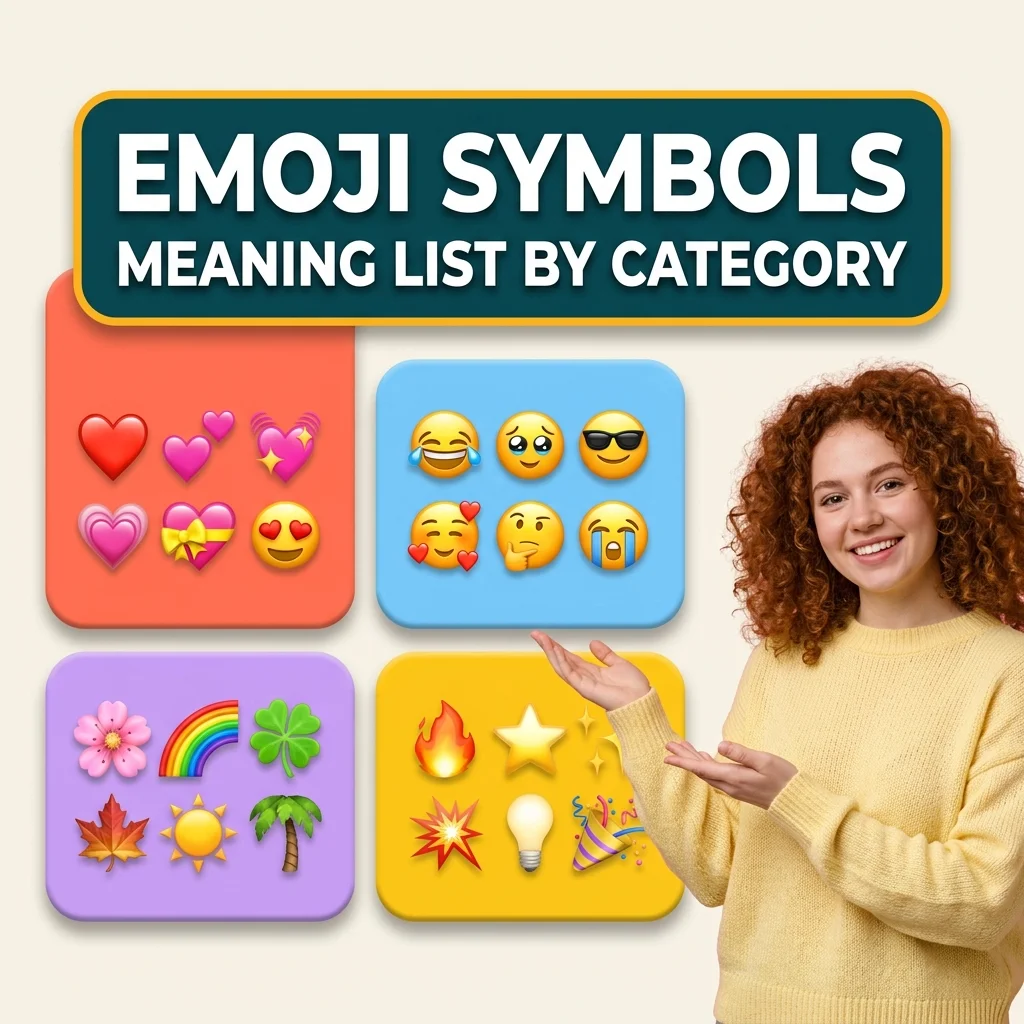
There are thousands of emoji characters and sequences, so organizing them by meaning makes them easier to understand. Here are some of the most useful groups.
Heart Emoji Symbols
Heart symbols are among the most commonly searched emoji meanings because different colors can suggest different emotions.
❤️ Red Heart: Usually represents love, romance, affection, or strong care.
🧡 Orange Heart: Often expresses warmth, friendship, encouragement, or emotional support.
💛 Yellow Heart: Commonly represents happiness, friendship, positivity, and warm feelings.
💚 Green Heart: Can represent nature, health, support, affection, or jealousy depending on context.
💙 Blue Heart: Often communicates trust, loyalty, calmness, friendship, or support.
💜 Purple Heart: Can express affection, compassion, support, admiration, or a special emotional connection.
🖤 Black Heart: May represent deep emotion, sadness, dark humor, grief, or a particular aesthetic.
🤍 White Heart: Often represents pure affection, peace, sympathy, kindness, or emotional support.
🤎 Brown Heart: Can communicate warmth, comfort, solidarity, or appreciation.
🩷 Pink Heart: Often suggests affection, sweetness, care, or romantic feelings.
🩵 Light Blue Heart: Can express calmness, tenderness, support, or affection.
🩶 Grey Heart: May represent neutrality, maturity, sympathy, or subdued emotion.
The exact interpretation depends on the conversation. A heart from a close friend may simply show affection, while the same heart in a romantic conversation may carry stronger meaning.
Face Emoji Symbols
Face emoji often communicate emotional tone.
😀 Grinning Face: Happiness, friendliness, or excitement.
😃 Grinning Face with Big Eyes: Cheerfulness and positive energy.
😂 Face with Tears of Joy: Something is very funny or amusing.
🤣 Rolling on the Floor Laughing: Extreme laughter.
😊 Smiling Face with Smiling Eyes: Warmth, happiness, friendliness, or gentle affection.
😍 Smiling Face with Heart-Eyes: Strong admiration, attraction, or love.
🥰 Smiling Face with Hearts: Affection, warmth, feeling loved, or romantic sweetness.
😘 Face Blowing a Kiss: A kiss, affection, flirtation, or friendly warmth.
😉 Winking Face: Playfulness, joking, teasing, or sometimes flirting.
😎 Smiling Face with Sunglasses: Confidence, coolness, relaxation, or success.
🤔 Thinking Face: Thinking, questioning, uncertainty, or doubt.
😢 Crying Face: Sadness, disappointment, or emotional pain.
😭 Loudly Crying Face: Strong sadness, emotional overwhelm, or exaggerated reaction. In some online communities, it can also express extreme laughter or amusement.
💀 Skull: Literally a skull, but online it is often used figuratively to say that something is extremely funny, shocking, or overwhelming.
Hand Gesture Symbols
Hand emoji can replace short phrases.
👍 Thumbs Up: Agreement, approval, confirmation, or “okay.”
👎 Thumbs Down: Disapproval, rejection, or disagreement.
👌 OK Hand: “Okay,” agreement, or something being acceptable.
👏 Clapping Hands: Applause, praise, celebration, or encouragement.
🙌 Raising Hands: Celebration, excitement, praise, or enthusiasm.
🙏 Folded Hands: Prayer, thanks, hope, respect, or a polite request. The meaning depends heavily on context.
🤝 Handshake: Agreement, cooperation, partnership, or greeting.
👋 Waving Hand: Hello, goodbye, or a friendly greeting.
✌️ Victory Hand: Victory, peace, or casual positivity.
🤞 Crossed Fingers: Hope, luck, or wishing for a positive result.
Symbol Emoji
Symbol emoji are especially useful because many have meanings beyond emotion.
🔥 Fire: Something is excellent, exciting, attractive, impressive, popular, or “hot.”
✨ Sparkles: Excitement, beauty, emphasis, magic, or something special.
💯 Hundred Points: Perfection, complete agreement, authenticity, or strong approval.
✅ Check Mark Button: Correct, completed, accepted, or approved.
❌ Cross Mark: Wrong, no, rejected, canceled, or incorrect.
⚠️ Warning: Caution, danger, or something requiring attention.
🚫 Prohibited: Not allowed or forbidden.
❗ Exclamation Mark: Strong emphasis, urgency, or importance.
❓ Question Mark: A question, confusion, or uncertainty.
‼️ Double Exclamation Mark: Strong emphasis or surprise.
⁉️ Exclamation Question Mark: A combination of surprise and questioning.
♻️ Recycling Symbol: Recycling, environmental awareness, or sustainability.
☮️ Peace Symbol: Peace, nonviolence, or a peace-related idea.
⭐ Star: Achievement, quality, importance, or something special.
🌟 Glowing Star: Excitement, excellence, beauty, or something remarkable.
Emojipedia’s symbol category includes hearts, shapes, emotions, warning signs, arrows, identity symbols, alphanumeric symbols, and other symbols. Its emoji names are based on official Unicode or CLDR names.
Animal Emoji Symbols
Animal emoji can represent actual animals, personality traits, situations, or playful reactions.
🐶 Dog Face: Dogs, loyalty, friendliness, or something cute.
🐱 Cat Face: Cats, cuteness, independence, or playful behavior.
🦊 Fox: Cleverness, beauty, playfulness, or an actual fox.
🐻 Bear: Strength, warmth, cuteness, or an actual bear.
🐼 Panda: Cuteness, calmness, or affection.
🐸 Frog: A frog, humor, internet culture, or a playful mood.
🦋 Butterfly: Beauty, change, transformation, or freedom.
🐝 Honeybee: Bees, nature, hard work, or sometimes affectionate nicknames.
Food and Drink Emoji Symbols
Food emoji are often literal, but they can also become part of jokes or expressions.
🍕 Pizza: Pizza, food, casual eating, or a fun meal.
🍔 Hamburger: Fast food, hunger, or a meal.
🍎 Red Apple: Apple, health, school, or education.
🍓 Strawberry: Fruit, sweetness, summer, or attractiveness in some contexts.
☕ Hot Beverage: Coffee, tea, relaxation, or taking a break.
🍰 Shortcake: Cake, dessert, celebration, or birthday-related messages.
🍿 Popcorn: Movies, entertainment, or watching drama unfold.
Object Emoji Symbols
Object emoji help people describe things quickly.
📱 Mobile Phone: Phone, texting, calling, technology, or mobile communication.
💻 Laptop: Work, school, technology, or online activity.
🎁 Wrapped Gift: Present, surprise, giving, or celebration.
🔑 Key: Access, solution, security, or a literal key.
💡 Light Bulb: Idea, inspiration, understanding, or a solution.
📚 Books: Reading, school, studying, knowledge, or education.
🎧 Headphones: Music, listening, gaming, or focusing privately.
Nature and Weather Emoji
Nature symbols often communicate the environment or a mood.
☀️ Sun: Sunshine, daytime, warmth, happiness, or positivity.
🌙 Crescent Moon: Night, sleep, evening, dreams, or calmness.
🌈 Rainbow: Rainbows, hope, beauty, celebration, or other cultural meanings depending on context.
🌸 Cherry Blossom: Spring, beauty, renewal, or Japanese cultural references.
🌹 Rose: Love, romance, beauty, appreciation, or a gift.
🌊 Water Wave: Ocean, water, travel, surfing, or emotional imagery.
Meaning in Different Contexts
An emoji’s meaning can change significantly depending on where it appears. This is one of the most important things to understand when reading an emoji symbols meaning list.
Everyday Conversation
In ordinary conversations, emoji usually make messages friendlier and more expressive.
For example:
“Thanks for helping me! 😊”
Here, 😊 adds warmth to the sentence.
Without the emoji, “Thanks for helping me” may sound neutral. With the emoji, the message feels more openly friendly.
Text Messages
Text messages often use emoji to replace facial expressions or gestures that would normally be visible during a face-to-face conversation.
For example:
“Are you coming tonight? 👀”
The 👀 can suggest curiosity, interest, or playful anticipation.
Similarly:
“Okay 👍”
usually means agreement or acknowledgment.
Social Media
On social media, emoji often appear in captions, comments, replies, and reactions.
A person might write:
“This outfit is 🔥”
Here, 🔥 usually means impressive, stylish, attractive, or excellent rather than literal fire.
Emoji can also make posts easier to scan because they visually separate ideas.
WhatsApp users commonly use emoji in private chats, group conversations, status updates, and reactions.
A simple ❤️ can show appreciation. 😂 can make a joke feel stronger. 👍 can confirm that someone has received or understood information.
However, context matters. A short response such as “Okay 👍” can feel completely neutral to one person and slightly dismissive to another, depending on the relationship and conversation.
Snapchat
Snapchat conversations often use emoji alongside short messages, photos, and videos. Emoji can communicate reactions without requiring a full sentence.
For example, 🔥 might react to an impressive photo, while 😂 may show that a Snap was funny.
Some Snapchat-specific emoji can also represent relationship or interaction information within the app. Those platform-specific meanings should not automatically be applied to emoji used elsewhere.
Instagram users frequently place emoji in captions and comments.
For example:
“Beach day 🌊☀️✨”
The symbols create a visual mood rather than replacing a complete sentence.
❤️, 🔥, 😍, ✨, and 😂 are also common in comments, although their exact meaning depends on what is being discussed.
TikTok
TikTok has developed many creative ways of using emoji. People may use familiar symbols literally, emotionally, humorously, or as part of internet slang.
For example, 💀 can mean that something is extremely funny rather than referring to death.
Because online meanings change quickly, a symbol’s current meaning may not always match its original or literal meaning.
Gaming
Gamers often use emoji as quick reactions during fast conversations.
🎮 can refer to gaming itself. 🔥 may mean an impressive play. 💀 may describe a defeat or humorously react to a mistake. GG means “good game,” although it is text slang rather than an emoji.
Professional Communication
Emoji can work in professional communication when the workplace culture allows them.
For example:
“Great work on the presentation! 👍”
or:
“Thanks for the quick update! 😊”
However, highly formal documents, legal writing, official reports, and serious business communication may call for plain language instead.
The safest approach is to consider the audience, workplace culture, relationship, and purpose of the message.
Internet Slang
Emoji are frequently combined with internet slang.
For example:
“That was wild 💀”
Here, 💀 often means “I found that extremely funny” or “I cannot believe what I just saw.”
Likewise:
“This song is 🔥”
usually means the song is excellent or exciting.
Internet culture can give an emoji a figurative meaning that differs from its literal appearance.
Examples of “Emoji Symbols Meaning List”
Here are some realistic examples showing how emoji symbols work in everyday communication.
Example 1: ❤️
Sentence: “I really appreciate you ❤️”
Meaning: Love, care, or strong affection.
Situation: Someone sends this to a close friend, family member, or romantic partner to make the message warmer.
Example 2: 👍
Sentence: “I’ll send the file tonight 👍”
Meaning: Okay, agreed, or understood.
Situation: The sender confirms that they understand or accept the plan.
Example 3: 😂
Sentence: “You actually believed that 😂”
Meaning: The person finds the situation very funny.
Situation: A friend is teasing another friend after a humorous moment.
Example 4: 👀
Sentence: “So you two are finally going on a date? 👀”
Meaning: Interest, curiosity, or playful attention.
Situation: Someone notices potentially interesting information and wants to tease or ask for more details.
Example 5: 🔥
Sentence: “Your new profile picture is 🔥”
Meaning: Very impressive, attractive, stylish, or excellent.
Situation: A friend compliments someone’s photo.
Example 6: 🙏
Sentence: “Thank you so much for helping me 🙏”
Meaning: Gratitude, appreciation, or sincere thanks.
Situation: Someone wants to make their thanks feel more heartfelt.
Example 7: ✨
Sentence: “New year, new goals ✨”
Meaning: Excitement, positivity, freshness, or emphasis.
Situation: Someone is expressing enthusiasm about a new beginning.
Example 8: 💀
Sentence: “That video was so unexpected 💀”
Meaning: The speaker found the video extremely funny, shocking, or overwhelming.
Situation: A friend reacts to an absurd or hilarious online video.
When Do People Use Emoji Symbols?
People use emoji when they want to add something that plain text may not communicate easily.
To Show Emotion
A message such as:
“I’m happy for you 😊”
has a warmer emotional tone than the same sentence without an emoji.
To Make Messages Friendlier
Short replies can sometimes sound cold in text. An emoji can soften the message.
For example:
“Sure 😊”
may feel warmer than simply:
“Sure.”
To Show Reactions
Emoji are useful when someone wants to react quickly.
😂 can show laughter. 😍 can show admiration. 😢 can show sadness. 😮 can show surprise.
To Add Humor
Emoji can make jokes and playful comments easier to understand.
For example:
“I studied for five minutes and now I’m basically a professor 🤓”
The emoji reinforces the joke.
To Emphasize a Point
Symbols such as ❗, 🔥, 💯, and ✨ can make a particular idea stand out.
To Replace Words
Sometimes an emoji can communicate an entire reaction.
A person may respond to good news with:
“🎉🎉🎉”
No words are necessary because the symbols communicate celebration.
Different Meanings of Emoji Symbols
Emoji do not have one universal interpretation. Their meanings generally fall into several groups.
Literal Meaning
Some emoji are used exactly as they appear.
For example:
“I’m drinking coffee ☕.”
Here, ☕ literally refers to a hot beverage.
Emotional Meaning
Some emoji primarily communicate feelings.
For example:
“I miss you 🥺”
The emoji adds an emotional, pleading, or vulnerable tone.
Figurative Meaning
Some symbols have developed figurative meanings online.
For example:
“That joke killed me 💀”
The person is not literally dead. 💀 is being used as an exaggerated reaction.
Cultural Meaning
The interpretation of an emoji can change across cultures and communities.
Unicode explains that emoji meanings can vary according to language and culture.
Relationship-Based Meaning
The same emoji may communicate different things between different people.
For example, ❤️ from a romantic partner may suggest romantic affection. The same symbol from a family member may simply communicate love and care.
Platform-Based Meaning
Emoji designs can look different across Apple, Google, Microsoft, Samsung, and other platforms. These design differences can sometimes affect how people interpret a symbol.
This is one reason it is useful to check the actual emoji name and description rather than relying only on how an emoji looks on your own device.
Origin of Emoji Symbols
The history of emoji is closely connected to Japan and mobile communication.
The word emoji comes from Japanese, where it combines ideas represented by “picture” and “character.” Unicode’s documentation describes emoji as pictographs, and many early emoji came from character sets used by Japanese mobile phone carriers.
Emoji became especially important because they allowed people to add visual expression to short digital messages.
Unicode later played a major role in standardizing emoji so that characters and sequences could be represented consistently across computer systems and mobile devices.
Today, emoji are not simply decorative pictures. They are encoded as Unicode characters or sequences, allowing communication systems to process and display them. Unicode Technical Standard #51 defines the structure and behavior of emoji characters and sequences.
The emoji collection continues to develop. Unicode reviews proposals for new emoji, and accepted additions become part of future emoji releases.
The current Unicode Emoji 18.0 documentation includes emoji characters and sequences, along with official names and annotations.
It is also worth remembering that not every emoji meaning was invented by Unicode. Unicode provides the technical framework and official character information, while real-world users create, adapt, and popularize many meanings.
Similar Words and Alternatives
People sometimes use several terms when talking about emoji symbols. Although these terms are related, they are not always identical.
Emoji
Emoji are pictographic characters used in digital communication.
Example:
“I love this ❤️”
Emoticon
An emoticon uses ordinary keyboard characters to represent an expression.
Examples include:
- 🙂
- 🙁
- 😉
- 😀
Unicode distinguishes emoticons from emoji. Emoticons originally developed as combinations of characters, while emoji are pictographic characters and sequences.
Symbol
A symbol is a visual sign that represents an idea, instruction, object, or concept.
Examples include:
- %
- $
- =
- ⚠️
- ♻️
Not every symbol is an emoji, although many symbols can have an emoji-style presentation.
Pictograph
A pictograph is a visual representation of an object, idea, or concept.
Emoji are commonly described as pictographic symbols.
Icon
An icon is a visual representation used to identify an action, feature, object, or idea. Icons are common in software interfaces, websites, and apps.
Reaction
A reaction is a response to content. Emoji are frequently used as reactions to messages, posts, photos, and videos.
Common Mistakes When Understanding Emoji
Even experienced internet users can misunderstand emoji. Here are some common problems.
Assuming Every Emoji Has One Meaning
This is probably the biggest mistake.
For example, 🙏 may represent prayer, thanks, hope, respect, or a request. You need to consider the sentence around it.
Taking Figurative Emoji Literally
Someone writing:
“I’m dead 💀”
is usually not making a literal statement.
Online communities frequently use emoji figuratively.
Ignoring the Conversation
An emoji should rarely be interpreted by itself when context is available.
Consider:
“Nice job 👍”
and:
“Nice job 👍”
The same words and emoji can have different emotional tones depending on what happened before them.
Assuming the Sender’s Intent
It is easy to overinterpret an emoji, especially in romantic conversations.
For example, ❤️ can express romantic love, but it can also express friendship, family affection, appreciation, or general support.
Confusing Emoji With Emoticons
A symbol such as 😂 is an emoji. A combination such as 🙂 is an emoticon.
They are related forms of digital expression, but they are technically different.
Ignoring Cultural Differences
A gesture or symbol may have a different association in another culture.
When communicating with an international audience, avoid assuming that everyone will interpret an emoji exactly as you do.
Focusing Only on Appearance
Emoji designs can differ across platforms. Instead of judging only by appearance, check the official emoji name and trusted references when the meaning matters.
How to Understand an Emoji Correctly
When you receive an unfamiliar emoji, use a simple process.
First, look at the surrounding words. The sentence often gives you the strongest clue.
Second, consider the relationship. A message from your best friend may have a different tone from a message from your manager.
Third, consider the platform. Snapchat, Instagram, WhatsApp, TikTok, and other services may use symbols or reactions in different ways.
Fourth, think about the literal and figurative meanings. An emoji can represent an object while also carrying a slang meaning.
Finally, check a reliable emoji reference if you are still unsure. Emojipedia researches emoji meanings using factors such as historical origins, intended meanings, common real-world usage, cultural differences, and platform designs.
For technical information, the Unicode Consortium’s emoji charts and Unicode Technical Standard #51 are useful authority sources.
Emoji Symbols Meaning List for Quick Reference
Here is another quick-reference list for common symbols.
| Emoji | Common Meaning | Common Use |
| 😀 | Happiness | Friendly messages |
| 😂 | Laughter | Funny situations |
| 🤣 | Extreme laughter | Very funny moments |
| 😊 | Warm happiness | Friendly replies |
| 😍 | Admiration or love | Romantic or enthusiastic reactions |
| 🥰 | Affection | Loving messages |
| 😎 | Coolness or confidence | Casual conversations |
| 🤔 | Thinking or doubt | Questions and uncertainty |
| 😭 | Strong sadness or exaggerated emotion | Emotional reactions |
| 💀 | Hilarious, shocking, overwhelmed | Internet slang |
| ❤️ | Love and affection | Relationships and support |
| 💛 | Friendship and positivity | Friendly messages |
| 💙 | Trust and loyalty | Supportive messages |
| 💜 | Affection and compassion | Caring messages |
| 🖤 | Deep emotion or dark humor | Emotional or stylistic posts |
| 🤍 | Peace and pure affection | Sympathy and support |
| 👍 | Approval | Confirmation |
| 👎 | Disapproval | Rejection |
| 👌 | Okay | Agreement |
| 👏 | Applause | Praise |
| 🙌 | Celebration | Excitement |
| 🙏 | Thanks, prayer, or request | Gratitude |
| 👀 | Curiosity or attention | Interesting news |
| 🔥 | Excellent or impressive | Compliments |
| ✨ | Excitement or emphasis | Captions |
| 💯 | Perfect or completely true | Agreement |
| 🎉 | Celebration | Parties and achievements |
| 🌟 | Something special | Praise |
| ⚠️ | Warning | Caution |
| ❌ | No or incorrect | Rejection |
| ✅ | Correct or complete | Approval |
| ❗ | Strong emphasis | Important information |
| ❓ | Question or confusion | Asking |
| 🚫 | Not allowed | Rules and restrictions |
| ♻️ | Recycling | Environmental topics |
Frequently Asked Questions
What is the meaning of emoji symbols?
Emoji symbols are pictographic characters used in digital communication to express emotions, objects, actions, ideas, reactions, and concepts. Their meaning depends on the emoji, context, culture, and conversation.
Do emoji have official meanings?
Emoji have official Unicode names and technical definitions, but their everyday meanings are not always limited to those names. People often develop additional figurative, cultural, or slang meanings.
Unicode specifically notes that emoji meanings can vary by language, culture, context, and changing usage.
What is the most commonly used emoji symbol?
There is no single permanent answer for every platform, country, and time period. Emoji popularity changes as online communication trends change.
It is better to distinguish popular emoji from common meanings, because an emoji can be widely used for several different purposes.
What does ❤️ mean in a text?
❤️ usually represents love, affection, care, or strong positive feelings. However, it does not automatically mean romantic love. Friends, family members, and other people may use it to show appreciation or support.
What does 💀 mean in texting?
In modern internet conversations, 💀 often means that something is extremely funny, shocking, absurd, or overwhelming. It is frequently used figuratively rather than literally.
For example:
“That video was so funny 💀”
The sender usually means that the video was hilarious.
Why can the same emoji mean different things?
Emoji meanings change because people interpret visual symbols through context, culture, relationships, online communities, and language. Unicode itself explains that emoji can be repurposed and can develop different meanings over time.
Where can I find a complete emoji symbols meaning list?
For technical and official information, the Unicode Consortium’s emoji charts provide the current Unicode emoji list, names, annotations, and sequences.
For practical explanations of individual emoji meanings, Emojipedia provides a searchable reference organized into categories such as Smileys, People, Animals & Nature, Food & Drink, Symbols, and Flags.
Conclusion
An emoji symbols meaning list makes digital communication easier to understand by explaining the common meanings behind faces, hearts, hand gestures, objects, animals, symbols, and other emoji. Symbols such as ❤️, 😂, 👍, 🔥, 👀, ✨, and 🙏 can communicate feelings and reactions quickly, but their meanings are not always fixed.
The most important rule is to look at context. Consider the words around the emoji, the relationship between the people, the platform being used, and the culture or online community involved. A heart can show romantic love, friendship, appreciation, or support. A skull can represent something literal or simply mean that something was extremely funny.