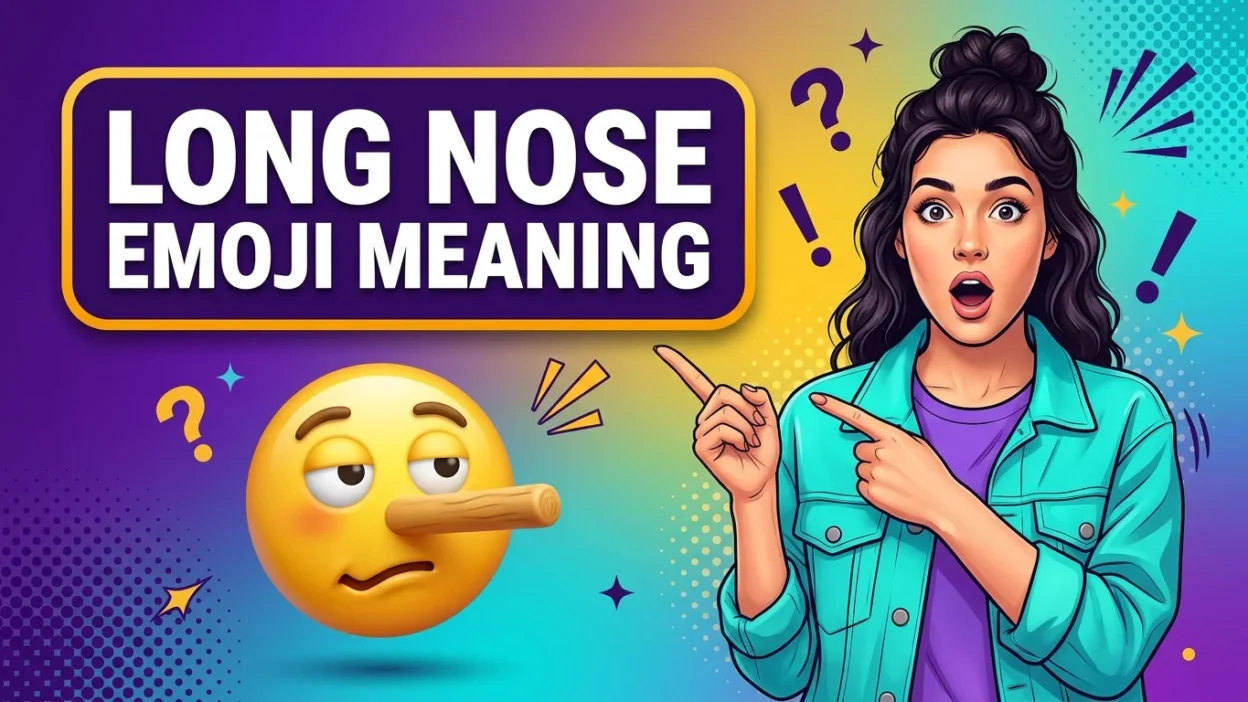
Have you ever received the 🤥 emoji in a text and wondered whether someone was joking, lying, or calling you out? The long nose emoji 🤥 usually represents lying, dishonesty, or telling a fib.
Its design features a face with a noticeably long nose, inspired by the famous fictional character Pinocchio, whose nose grows whenever he lies. People use this emoji in text messages, social media comments, and online conversations to suggest that someone isn’t telling the truth.
However, its meaning can change depending on the situation. A friend might send 🤥 after making an obviously exaggerated claim, while someone else might use it to tease you playfully.
Quick Answer: What Does the Long Nose Emoji 🤥 Mean?
The long nose emoji 🤥 usually means lying, telling a lie, dishonesty, or pretending something is true when it is not. Its long nose refers to Pinocchio, whose nose famously grows when he lies.
Depending on the context, 🤥 can also mean:
- “I’m lying.”
- “That’s a lie.”
- “You’re not telling the truth.”
- “I’m joking.”
- “I’m exaggerating.”
- “Yeah, right!”
- “I got caught lying.”
- “I don’t believe you.”
The exact meaning depends on who sent it, what they said, and the tone of the conversation.
What Does “long nose emoji meaning” Mean?
The phrase long nose emoji meaning usually refers to the meaning of the 🤥 emoji, officially known as Lying Face.
The emoji shows a yellow face with raised eyebrows, large eyes, and a long nose. That long nose is the key clue. It resembles the growing nose associated with Pinocchio, making the emoji a visual symbol for lying or dishonesty. Emojipedia describes it as representing lying, a liar, deceit, and dishonesty.
The simple meaning of 🤥
In everyday texting, 🤥 most often means:
“I’m lying” or “That isn’t true.”
For example:
“I didn’t eat the last slice of pizza 🤥”
The sender probably means that they actually did eat it.
Another example is:
“I can run 20 miles without stopping 🤥”
Here, the emoji suggests that the statement is exaggerated or untrue.
Why does it have a long nose?
The long nose is a reference to Pinocchio, the wooden puppet from the classic story whose nose becomes longer when he lies.
This connection is also reflected in Unicode’s emoji keywords. The Unicode emoji list associates 🤥 with terms such as face, liar, lie, lying, and Pinocchio.
So, when someone calls it the long nose emoji, they are describing its appearance rather than using its official Unicode name.
Is “long nose emoji” the official name?
No.
The official short name is Lying Face. Unicode identifies the character as U+1F925, while “long nose emoji” is a common descriptive search phrase people use because of the emoji’s appearance.
Meaning of 🤥 in Different Contexts
The 🤥 emoji meaning can shift depending on the situation. It does not always accuse someone of serious dishonesty.
Sometimes it is a playful joke. Other times, it can sound like a direct accusation.
Everyday Conversation
In everyday conversation, 🤥 usually points to a lie or exaggerated statement.
For example:
“I never eat chocolate 🤥”
If the person loves chocolate, the emoji makes the statement clearly playful.
It can also be used when someone admits that they are joking:
“Of course I finished all my homework 🤥”
The emoji tells the reader that the speaker probably did not finish it.
Text Messages
In text messages, 🤥 often acts like a quick way to say:
“I’m not telling the truth.”
It can also be directed at another person:
“You said you were going to sleep two hours ago 🤥”
Here, the sender may be teasing the other person for staying online.
Because text messages do not contain facial expressions or voice tone, emojis can help show whether a statement is playful, sarcastic, or serious.
Social Media
On social media, 🤥 can appear in captions, comments, replies, and memes.
Someone might post:
“Me saying I’ll only watch one episode 🤥”
The emoji suggests that the person knows they will probably watch several episodes.
It is especially useful when someone wants to make an obviously exaggerated statement funny.
On WhatsApp, 🤥 can have several meanings depending on the conversation.
For example:
Friend: “Did you really wake up at 5 AM?”
You: “Yes 🤥”
Here, you are jokingly admitting that you did not.
If a friend sends:
“I’m not hungry 🤥”
they may be joking if they immediately ask for some of your food.
Snapchat
On Snapchat, 🤥 can be used in captions, chats, or replies when someone wants to show that they are joking, exaggerating, or lying.
For example:
“I’m definitely not checking your story 🤥”
The emoji makes the statement playful.
Snapchat conversations are often informal, so the emoji can work more like a humorous expression than a serious accusation.
On Instagram, the 🤥 emoji can appear in comments and captions.
For example:
“I don’t need another pair of shoes 🤥”
This could jokingly suggest that the person knows they probably want another pair.
Someone may also comment 🤥 under a friend’s exaggerated claim. In that case, it can mean:
“You’re lying!”
or
“I don’t believe you.”
TikTok
TikTok users may use 🤥 in captions, comments, and replies to highlight exaggeration or irony.
For example:
“Me: I’m going to save money this month 🤥”
The emoji shows that the person expects the opposite to happen.
It can work especially well with jokes about habits, shopping, relationships, school, work, or everyday life.
Gaming
In gaming conversations, 🤥 can suggest that someone is lying about their skills, score, rank, or actions.
For example:
“I wasn’t camping at all 🤥”
If the player clearly was camping, the emoji makes the statement humorous.
A friend might also respond:
“I got no help from anyone 🤥”
when everyone knows the player received plenty of assistance.
Professional Communication
The 🤥 emoji is generally not appropriate for formal professional communication.
It can make a message sound sarcastic, childish, accusatory, or overly casual.
For example, avoid using it in a formal work email such as:
“The report was definitely completed yesterday 🤥.”
If you need to discuss inaccurate information at work, use clear and professional language instead.
Examples of “long nose emoji”
Here are several realistic examples showing how people may use 🤥 in everyday messages.
Example 1: Admitting a Small Lie
Sentence:
“I only had one cookie 🤥”
Meaning:
The person is jokingly admitting that they probably ate more than one cookie.
Situation:
A friend asks how many cookies you ate.
Example 2: Calling Someone Out
Sentence:
“You said you were already home 🤥”
Meaning:
The sender thinks the other person is lying.
Situation:
Someone claims they arrived home, but their location or another message suggests otherwise.
Example 3: Exaggerating
Sentence:
“I can finish this whole project in ten minutes 🤥”
Meaning:
The person is exaggerating and knows the project will take longer.
Situation:
Someone makes a funny claim about completing a difficult task quickly.
Example 4: Playful Relationship Text
Sentence:
“I don’t miss you at all 🤥❤️”
Meaning:
The person probably does miss the other person but is pretending they do not.
Situation:
Two people are teasing each other during a conversation.
Example 5: Food Joke
Sentence:
“I’m not hungry. I just want one bite 🤥”
Meaning:
The person may actually want much more than one bite.
Situation:
A friend is eating something delicious.
Example 6: School or Work
Sentence:
“I definitely started my assignment early 🤥”
Meaning:
The person is joking that they actually started it at the last minute.
Situation:
A student jokes about procrastination.
Example 7: Social Media
Sentence:
“I’m deleting Instagram for a month 🤥”
Meaning:
The person probably knows they will continue using Instagram.
Situation:
Someone makes a humorous post about spending too much time on social media.
Example 8: Gaming
Sentence:
“I wasn’t using a hidden strategy 🤥”
Meaning:
The player is jokingly suggesting that they were using one.
Situation:
Friends are teasing each other after a competitive game.
When Do People Use the Long Nose Emoji?
People generally use 🤥 when they want to connect a message with lying, exaggeration, disbelief, or playful dishonesty.
When someone admits they are lying
A person might write:
“I didn’t eat your fries 🤥”
The emoji gives away the joke.
When teasing a friend
Friends often use 🤥 to tease each other without making the conversation too serious.
“You said you were going to bed at 10 🤥”
This can be a playful reminder that the friend stayed awake much later.
When exaggerating
The emoji can signal that a statement is deliberately exaggerated.
“I have only bought five pairs of shoes this year 🤥.”
The person may be joking about buying many more.
When expressing disbelief
Someone may simply reply:
“🤥”
after hearing an unbelievable claim.
In this situation, the emoji can mean:
“I don’t believe you.”
When admitting embarrassment
A person who has been caught in a small lie may use 🤥 to acknowledge it without giving a serious explanation.
For example:
“Okay, you caught me 🤥.”
The tone is usually lighthearted.
Different Meanings of the Long Nose Emoji
Although the primary meaning of 🤥 is related to lying, the emoji can communicate several closely related ideas.
1. Lying
The most direct meaning is telling a lie.
Example:
“I never ate your cake 🤥”
The person is probably admitting that the statement is false.
2. Calling Someone a Liar
You can send 🤥 to another person when you think they are lying.
Example:
“You didn’t finish the whole pizza 🤥”
Here, the emoji works almost like saying:
“You’re lying.”
However, this can sound accusatory if the relationship is not close.
3. Dishonesty
The emoji can represent dishonesty more generally.
For example:
“He wasn’t completely honest about what happened 🤥.”
This usage is more serious than a playful joke.
4. Exaggeration
Not every use means an intentional lie.
Sometimes 🤥 means someone is stretching the truth.
Example:
“I only need five more minutes 🤥.”
If the person usually takes an hour, the emoji suggests exaggeration.
5. Sarcasm
🤥 can also support a sarcastic statement.
Example:
“Sure, I’m totally going to wake up at 6 AM tomorrow 🤥.”
The emoji signals that the speaker does not seriously expect that to happen.
6. “Yeah, Right!”
A person may use 🤥 as a reaction to something they do not believe.
Example:
Friend: “I never look at your profile.”
You: “🤥”
Here, the emoji means something like:
“Yeah, right!”
7. Being Caught
The emoji can represent the feeling of getting caught in a lie.
Example:
“Okay, okay, you caught me 🤥.”
This is usually playful.
What Does 🤥 Mean From a Guy?
When a guy sends 🤥, the meaning depends on the conversation rather than his gender.
He may use it to say that he is joking, exaggerating, lying playfully, or admitting that something he said was not true.
For example:
“I don’t care if you talk to other guys 🤥”
In a romantic conversation, he may be jokingly suggesting that he actually does care.
Another example:
“I wasn’t waiting for your message 🤥.”
The emoji can make the statement sound like playful denial.
However, you should not automatically interpret 🤥 as flirting. Look at the surrounding words and the existing relationship.
What Does 🤥 Mean From a Girl?
When a girl sends 🤥, it can similarly mean lying, joking, exaggerating, or not believing something.
For example:
“I’m not jealous 🤥.”
The emoji could suggest that she is jokingly denying jealousy.
Another example:
“I don’t want any dessert 🤥.”
She may simply be joking because she actually wants dessert.
Again, the emoji itself does not prove romantic interest. Context matters more than the sender’s gender.
What Does 🤥 Mean From a Guy to a Girl?
If a guy sends 🤥 to a girl, it could have a playful or teasing meaning.
For example:
“I don’t miss you 🤥.”
If they are close or romantically involved, this could be playful denial.
But it could also simply mean:
“I’m joking.”
You should look at the rest of the conversation before interpreting it as flirting.
What Does 🤥 Mean From a Girl to a Guy?
A girl may use 🤥 to tease a guy, call out a small exaggeration, or jokingly admit that she is not telling the truth.
For example:
“You weren’t looking at my story 🤥.”
This could mean:
“I know you were looking.”
The tone can be playful, sarcastic, or mildly accusing depending on the relationship.
🤥 Meaning in a Relationship
In relationships, the long nose emoji can have a playful meaning.
Partners may use it when pretending not to care, denying something obvious, or teasing each other.
For example:
“I don’t miss you 🤥❤️”
The emoji changes the tone. Without it, the sentence might sound cold. With 🤥, the speaker signals that the statement is probably not meant literally.
Another example:
“I’m not jealous 🤥.”
This could be playful denial.
Still, context matters. If a serious argument is happening, 🤥 could be interpreted as an accusation of lying rather than a joke.
🤥 Meaning in Friendship
Friends often use the emoji casually.
For example:
“You said you were going to study all weekend 🤥.”
The sender may be teasing their friend because they know the friend spent the weekend watching movies.
A single 🤥 can also be enough to challenge a friend’s claim:
Friend: “I didn’t finish the snacks.”
You: “🤥”
That simple reply means:
“I don’t believe you.”
🤥 vs 🤥❤️
Adding a heart can change the emotional tone.
🤥
Usually focuses on:
- lying
- teasing
- disbelief
- exaggeration
- joking
🤥❤️
Can make the message feel:
- playful
- affectionate
- romantic
- teasing
For example:
“I don’t miss you 🤥❤️”
The heart suggests affection, while 🤥 suggests that the speaker is pretending.
However, the combination does not automatically mean romance. Friends can also use affectionate emoji combinations.
🤥 vs 🤥😂
Adding 😂 usually makes the joke clearer.
“I definitely didn’t eat the cake 🤥😂”
The combination suggests obvious humor.
The sender is less likely to be making a serious accusation or statement.
🤥 vs 🤭
These emojis can overlap but are not identical.
🤥 Lying Face focuses on lying, dishonesty, exaggeration, or disbelief.
🤭 Face with Hand Over Mouth is more commonly associated with giggling, embarrassment, surprise, or hiding a reaction.
For example:
“I didn’t read your message 🤥”
→ “I’m lying.”
“Oops, I read your message 🤭”
→ “I’m embarrassed or amused that I did.”
🤥 vs 🤫
These emojis also have different meanings.
🤥 = lying or not telling the truth.
🤫 = be quiet, keep a secret, or don’t tell anyone.
For example:
“I didn’t take the last cookie 🤥.”
→ The speaker is lying.
“Don’t tell anyone 🤫.”
→ The speaker wants secrecy.
Origin of the Long Nose Emoji
The long nose emoji is officially known as Lying Face and has the Unicode code point U+1F925. Unicode accepted it as a candidate for Unicode 9.0 in 2015, and it was included when Unicode 9.0 was released in 2016.
It was also added to Emoji 3.0 in 2016, according to Emojipedia.
The Pinocchio connection
The emoji’s long nose is a clear visual reference to Pinocchio, the fictional wooden puppet whose nose grows when he lies.
Unicode’s current emoji information includes “pinocchio” among the keywords associated with the lying face.
The connection is also visible in some platform designs. For example, Emojipedia notes that Facebook’s design has used a wooden nose to emphasize the Pinocchio reference.
Why people call it the “long nose emoji”
The official name is not “long nose emoji.”
People commonly use descriptive phrases such as:
- long nose emoji
- long nose face emoji
- Pinocchio emoji
- lying emoji
- liar emoji
- lie emoji
These phrases generally refer to the same character: 🤥.
Similar Words and Alternatives
Several words and emojis can express ideas related to 🤥.
Lying
Lying means deliberately saying something that is not true.
Example:
“He was lying about where he went.”
This is the closest literal meaning of 🤥.
Liar
A liar is someone who tells lies.
Example:
“He is being a liar.”
Calling someone a liar can sound much more serious than simply sending 🤥.
Dishonest
Dishonest describes someone or something that is not truthful or fair.
Example:
“That was a dishonest answer.”
Exaggerating
Exaggerating means making something seem bigger, better, worse, or more extreme than it really is.
Example:
“I have a million things to do.”
If you do not literally have a million tasks, you are exaggerating.
Fibbing
Fibbing is a softer and often more playful word for telling a small lie.
Example:
“Are you fibbing?”
This can be closer in tone to a playful 🤥.
“Not true”
This is a direct alternative.
“That’s not true.”
It is clearer and more serious than an emoji.
“Yeah, right”
This phrase can express disbelief.
“Yeah, right. 🤥”
It may sound sarcastic depending on the tone.
Common Mistakes About the Long Nose Emoji
The long nose emoji meaning is fairly straightforward, but people sometimes misunderstand it.
Mistake 1: Thinking it means a physical nose
The long nose is not usually meant to discuss someone’s actual nose.
It is symbolic. It points toward lying and Pinocchio.
Mistake 2: Assuming every use is serious
Not every 🤥 means that someone is seriously accusing another person of lying.
Friends often use it for harmless jokes.
“I didn’t eat the chocolate 🤥.”
This could be nothing more than playful teasing.
Mistake 3: Assuming it always means “you are a liar”
The emoji can be self-directed.
“I didn’t buy anything today 🤥.”
Here, the sender is admitting that they are lying or exaggerating.
Mistake 4: Assuming it always means flirting
🤥 can appear in romantic conversations, but it is not inherently a romantic emoji.
Its basic meaning remains connected to lying, exaggeration, and disbelief.
Mistake 5: Ignoring the surrounding message
An emoji should not be interpreted completely on its own.
Compare:
“I didn’t take your money 🤥”
with:
“I didn’t take your money 🤥😂”
The second version is more obviously playful because 😂 adds laughter.
Mistake 6: Using it in serious professional messages
A workplace conversation requires clearer language.
If you need to correct inaccurate information, write:
“That information is incorrect.”
instead of simply sending 🤥.
How to Understand 🤥 Correctly
When someone sends you 🤥, use these simple steps.
Look at the words
Read the sentence before deciding what the emoji means.
“I never eat sweets 🤥.”
The emoji suggests the person is not being truthful.
Look at the relationship
A close friend may use 🤥 as a joke.
A stranger or coworker may use it more literally.
Look for other emojis
Other emojis can provide important clues.
🤥😂 usually feels playful.
🤥😒 may feel more skeptical or annoyed.
🤥❤️ may feel affectionate or teasing.
Consider the topic
If the conversation is about a serious accusation, 🤥 can sound confrontational.
If the conversation is about food, movies, shopping, or daily habits, it may simply be a joke.
Is the Long Nose Emoji Rude?
It can be, depending on how you use it.
Sending 🤥 to someone after they make a claim can imply:
“You’re lying.”
If the person is not joking, they may find that insulting.
However, among close friends, it can be harmless teasing.
For example:
“You said you wouldn’t buy another game 🤥😂.”
This is likely playful.
In contrast:
“You are telling a lie 🤥.”
during a serious argument sounds much more confrontational.
Can 🤥 Mean “I’m Joking”?
Yes.
In casual texting, 🤥 can signal that a statement is not meant literally.
For example:
“I love waking up at 5 AM 🤥.”
The speaker probably means the opposite.
The emoji works as a visual signal that the statement should not be taken completely at face value.
Still, if you want to make the joke unmistakable, you can combine it with 😂, 🤣, or another clearly playful emoji.
Can 🤥 Mean “I Don’t Believe You”?
Yes.
When you send 🤥 as a response to someone’s statement, it can mean:
“I think you’re lying.”
or:
“I don’t believe that.”
For example:
Friend: “I didn’t eat the last slice.”
You: “🤥”
That response challenges the friend’s claim.
The difference between self-use and response-use is important:
“I didn’t eat it 🤥.”
→ “I’m jokingly admitting I did.”
“You didn’t eat it 🤥.”
→ “I don’t believe you.”
Is 🤥 a Pinocchio Emoji?
People often call 🤥 the Pinocchio emoji because its long nose represents the famous character.
However, its official Unicode name is Lying Face, not Pinocchio. Unicode lists pinocchio as an associated keyword.
So both descriptions can make sense:
🤥 = Lying Face
🤥 = commonly associated with Pinocchio
The second is a reference to the visual design rather than the official name.
How to Use the Long Nose Emoji in a Sentence
Here are some natural examples:
- “I didn’t eat your fries 🤥.”
- “I’m going to sleep early tonight 🤥.”
- “You definitely didn’t forget my birthday 🤥.”
- “I don’t want another slice of pizza 🤥.”
- “I wasn’t checking your profile 🤥.”
- “I can finish this in five minutes 🤥.”
- “I never procrastinate 🤥.”
- “I don’t miss you at all 🤥❤️.”
- “You said you weren’t going to buy anything 🤥.”
- “Okay, you caught me 🤥.”
These examples show why the emoji is so flexible. The central idea remains truth versus something that is not completely true.
Long Nose Emoji Meaning in Different Situations
| Situation | Possible meaning of 🤥 |
| Friend makes an obvious lie | “You’re lying.” |
| You make a joke | “I’m not being serious.” |
| Someone exaggerates | “That’s exaggerated.” |
| Someone denies something obvious | “Yeah, right!” |
| You get caught | “Okay, I admit it.” |
| Romantic teasing | “I’m pretending.” |
| Social media joke | “This isn’t completely true.” |
| Serious argument | “I think you’re lying.” |
| Gaming | “You’re lying about that.” |
| Food joke | “I’m pretending I don’t want it.” |
The table shows why context matters. The same emoji can be playful in one conversation and confrontational in another.
Frequently Asked Questions
What does the long nose emoji 🤥 mean?
The long nose emoji 🤥 usually means lying, dishonesty, exaggeration, or not telling the truth. It is officially called Lying Face and is visually associated with Pinocchio.
What is the official name of the 🤥 emoji?
The official Unicode short name is Lying Face. Its Unicode code point is U+1F925. “Long nose emoji” and “Pinocchio emoji” are informal names people use to describe it.
Why does the lying emoji have a long nose?
The long nose refers to Pinocchio, whose nose famously grows when he lies. The Pinocchio connection is also reflected in Unicode’s associated keywords for 🤥.
Does 🤥 always mean someone is lying?
No. It can also express exaggeration, playful teasing, disbelief, sarcasm, or embarrassment after being caught. The surrounding conversation determines the exact tone.
What does 🤥 mean from a guy?
It usually means the same thing regardless of gender: lying, joking, exaggerating, or playful denial. If it appears in a romantic conversation, it may support teasing or playful flirting, but the emoji alone does not prove romantic interest.
What does 🤥 mean from a girl?
A girl may use 🤥 to joke about a lie, exaggerate something, call out a friend’s statement, or playfully deny something. Its meaning comes from the conversation rather than the sender’s gender.
Is 🤥 rude?
It can be rude if used to seriously accuse someone of lying. Between close friends, however, it is often harmless and playful. Consider the relationship and the seriousness of the conversation before using it.
Conclusion
The long nose emoji 🤥 is officially called the Lying Face emoji. Its most common meaning is lying, dishonesty, exaggeration, or pretending that something is true when it is not. The long nose connects the emoji to Pinocchio, which explains why people also call it the Pinocchio emoji.
In texting, WhatsApp, Instagram, TikTok, Snapchat, gaming, and casual conversations, 🤥 can be playful or serious. Someone may use it to admit a small lie, tease a friend, exaggerate a claim, or say, “I don’t believe you.” In romantic conversations, it can add playful denial, but it does not automatically indicate flirting.
Internal Linking Suggestions
For a website about emoji and text meanings, you can naturally link this article to related pages such as:
- What Does 🤥 Mean in Text?
- Pinocchio Emoji Meaning
- Lying Emoji Meaning
- What Does 🤭 Mean in Text?
- What Does 🤫 Mean in Text?
- Emoji Meanings in Text Messages
- Emoji Meaning From a Guy
- Emoji Meaning From a Girl
- What Does 😂 Mean in Text?
- What Does ❤️ Mean in Text?
These links can help readers move from one related emoji topic to another without forcing keywords into the content.
External Authority Sources
For factual information about the Unicode name, code point, and emoji history, the Unicode Consortium is the primary authority. Its emoji charts identify 🤥 as Lying Face, U+1F925, while Unicode’s historical materials document its inclusion in Unicode 9.0.
For practical information about emoji usage and platform variations, Emojipedia provides additional reference material on the Lying Face emoji and its Pinocchio association.