Few emojis can create a mood as quickly as the ❄️ snowflake. The Snowflake Emoji Meaning is most commonly connected with winter, cold weather, snow, ice, and freezing temperatures. However, people also use it in creative ways to describe something cool, beautiful, unique, or emotionally distant.
You might see ❄️ in messages about winter trips, snowy weather, Christmas, skiing, or simply feeling cold. On social media, it can also appear in captions and comments to add a seasonal or aesthetic touch. Depending on the conversation, someone may use it figuratively to describe a person or situation rather than talking about actual snow.
In this guide, you’ll discover the Snowflake Emoji Meaning in texting, WhatsApp, social media, friendships, and everyday conversations. We’ll explain its common interpretations and provide simple examples so you can understand what ❄️ means when someone uses it in different situations.
Quick answer: The snowflake emoji ❄️ most often means winter, cold weather, or snow. It can also show uniqueness (no two snowflakes are the same), emotional coldness, or, in slang, call someone overly sensitive. Context is everything.
What Does “Snowflake Emoji Meaning” Mean?
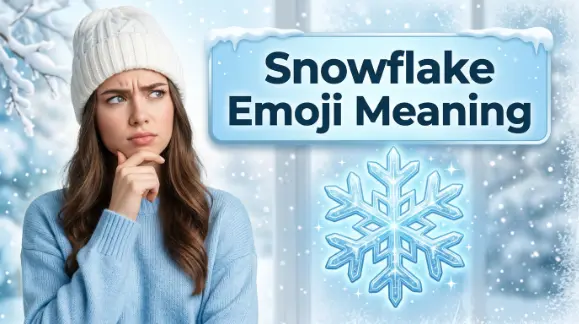
The snowflake emoji ❄️ is the official Unicode character for a snowflake. It shows a white or light blue crystal with six symmetrical arms. In plain English it stands for cold, frost, snow, and winter.
Its most common everyday meaning is simple weather talk. People add it when the temperature drops, when snow falls, or when they share winter photos. It also appears in holiday messages around Christmas or New Year because snow is part of the season for many people.
Beyond weather, the emoji borrows from a well-known fact: every snowflake has a unique shape. That idea turns the emoji into a gentle way to say someone or something is one of a kind. At the same time, the word “snowflake” grew into slang for a person who seems fragile or easily offended. The emoji sometimes carries that same sharp edge.
So the core snowflake emoji meaning starts with winter and uniqueness, then branches into slang depending on the conversation.
Meaning in Different Contexts
The same ❄️ can feel friendly, romantic, icy, or insulting. Here is how the meaning usually changes.
Everyday Conversation
In normal talk the snowflake emoji almost always points to cold weather or winter activities. Someone might text “Bundle up, it’s ❄️ outside” or “First snow of the year ❄️.” Friends use it to share excitement about skiing, hot chocolate, or a white Christmas. The tone stays light and literal.
Text Messages
In private texts the emoji keeps its weather meaning most of the time. A quick “Stay warm ❄️” feels caring. Sometimes it shifts toward emotional distance. If a person suddenly goes quiet after a disagreement, a lone ❄️ can signal “I’m cooling off” or “I’m keeping my distance.” Close friends usually understand the difference from the rest of the message.
Social Media
On general social platforms the snowflake emoji appears in winter photo captions, holiday posts, and aesthetic feeds. Users pair it with snowmen, mountains, or hot drinks. In comment sections it can turn political or sarcastic when someone wants to label another user as overly sensitive.
WhatsApp chats stay close to personal life. People use ❄️ for weather updates in family groups or travel plans. It rarely becomes an insult among people who know each other well. When it does appear after tension, it usually means emotional coldness rather than a political jab.
Snapchat
On Snapchat the emoji often sits in winter filters or streaks about cold days. Younger users sometimes drop it as a short reaction that means “cold” in both temperature and attitude. Because Snaps disappear, the emoji stays casual and rarely carries heavy slang.
Instagram favors the pretty side of the snowflake. Influencers and everyday users place ❄️ in winter fashion posts, cabin getaways, and holiday carousels. Captions like “Winter wonderland ❄️” or “Unique just like a snowflake ❄️” are common. The insult meaning appears less often in polished feeds and more in comment threads.
TikTok
TikTok mixes all the meanings. Creators use ❄️ in winter transition videos, “cold” aesthetic edits, and sound trends. In comments it frequently becomes the insult version: “You’re such a ❄️” after someone gets upset. It also shows up when people describe a partner who suddenly turned distant, “He went full ❄️ on me.”
Gaming
Gamers rarely use the snowflake emoji for deep slang. It mostly marks cold maps, winter events, or frost-based characters and powers. In chat it can simply mean “chill” in the sense of relax, though other emojis usually do that job better.
Professional Communication
In work emails or Slack the snowflake emoji is safest when it clearly means weather. A message about a snow day or delayed flights is fine. Using it as any kind of slang or emotional comment risks looking unprofessional or passive-aggressive. Most people skip it at work.
Internet Slang
Online slang gives the emoji its sharpest edges. “Snowflake” as a label for someone seen as fragile or entitled grew popular in the 2010s. The emoji often stands in for that word. It can also signal “icy” behavior, ghosting, cold replies, or emotional shutdown. A smaller group uses it in flirting, especially after a well-known celebrity story linked the emoji to “shooting your shot.”
Examples of “Snowflake Emoji Meaning”
Here are five clear, real-life style examples.
- Sentence: “Finally snowing here! ❄️”
Meaning: Literal winter weather.
Situation: A friend shares the first snowfall of the season in a group chat. - Sentence: “You’re one of a kind, just like a snowflake ❄️.”
Meaning: Compliment about uniqueness.
Situation: Birthday message or supportive comment under a personal post. - Sentence: “Calm down, it’s just a joke ❄️.”
Meaning: Calling the other person overly sensitive.
Situation: Online argument or heated reply in comments. - Sentence: “She left me on read for three days ❄️.”
Meaning: Emotional coldness or distance.
Situation: Venting to a friend about a silent treatment. - Sentence: “Hey ❄️”
Meaning: Light flirt or “shooting your shot.”
Situation: Opening a direct message after seeing someone’s winter-themed content or profile.
These examples show why the surrounding words and relationship matter so much.
When Do People Use “Snowflake Emoji”?
People reach for the snowflake emoji in a few clear situations.
Common situations include cold weather reports, winter travel photos, holiday greetings, and aesthetic posts. Friends use it to show care, “Drive safe in the snow ❄️.” Creators use it for seasonal content. In tougher moments it appears after arguments to signal distance or to mock perceived fragility.
Who uses it? Almost everyone who texts or posts. Kids and older adults mostly stick to the weather meaning. Teens and young adults mix in the slang more freely. Political accounts and debate threads lean toward the insult version.
Why people use it: It is quick, visual, and flexible. One symbol can set a winter mood, give a compliment, or deliver a sharp reaction without typing extra words.
Appropriate times: Weather talk, friendly winter wishes, uniqueness compliments among people who know each other, and light aesthetic posts. Inappropriate times: Work messages with unclear intent, serious emotional conversations where the insult meaning could hurt, or any situation where the other person might read it as mockery. When in doubt, add words that make the meaning obvious.
Different Meanings of “Snowflake Emoji”
The emoji carries several distinct meanings. Here they are one by one.
Winter and cold weather
Definition: Snow, frost, low temperatures, or the winter season.
Context: Weather chats, holiday posts, travel updates.
Example: “Bundle up, it’s ❄️ out there.”
Uniqueness and individuality
Definition: Something or someone rare and special because no two snowflakes match.
Context: Compliments, motivational posts, personal captions.
Example: “Stay true to yourself, you’re a unique snowflake ❄️.”
Emotional coldness or distance
Definition: Icy attitude, ghosting, or cooling off in a relationship.
Context: Private texts after tension, TikTok vents, relationship talk.
Example: “Everything was fine and then suddenly ❄️.”
Slang insult for sensitivity
Definition: Label for a person seen as too easily offended or fragile.
Context: Online arguments, political comments, sarcastic replies.
Example: “Triggered already? Classic ❄️.”
Flirting signal
Definition: A playful way to show interest or “break the ice.”
Context: Direct messages, especially after a celebrity trend linked the emoji to starting a conversation.
Example: Opening a chat with just “❄️” after liking someone’s winter photo.
Each meaning stays separate until the rest of the message or the relationship blends them.
Origin of “Snowflake Emoji”
The snowflake symbol itself is ancient in design. Real snowflakes form in clouds when water freezes around tiny particles and grow into six-sided crystals. People have drawn them for centuries.
In digital form the character entered Unicode in 1993 as part of the Dingbats block (code point U+2744). It became a full-color emoji later and appears in most modern keyboards. Apple, Google, and other platforms each give it a slightly different artistic style, but the six-point shape stays consistent.
The slang meaning of the word “snowflake” has a longer and more complicated path. In the 1860s in Missouri the term referred to people who opposed ending slavery, playing on the idea of “white.” In the 1970s it sometimes described Black people accused of “acting white.” The modern insult version took off after the 1996 novel Fight Club by Chuck Palahniuk, which contains the line telling people they are not “beautiful and unique snowflakes.” By the 2010s the phrase “special snowflake” and “snowflake generation” spread widely in political talk, especially around 2015–2016 university debates and elections. The emoji simply borrowed that existing slang.
The Disney film Frozen also boosted the emoji’s popularity by linking snow and ice crystals to strong visual storytelling. No single inventor created the emoji’s many meanings; they grew naturally as people used the symbol in new ways.
Similar Words and Alternatives
Several words and emojis sit close to the snowflake emoji meaning.
Synonyms for the weather sense: snow, frost, ice, winter. Related emojis include 🌨️ (cloud with snow), ☃️ (snowman), ⛄ (snowman without snow), 🧊 (ice cube), and 🥶 (cold face).
For uniqueness people sometimes say “one of a kind,” “rare,” or “unique.” For the insult sense the closest terms are “special snowflake,” “triggered,” or simply “sensitive.” Alternatives for emotional coldness include “icy,” “distant,” “ghosting,” or the cold face emoji 🥶.
Differences are small but useful. The cloud-with-snow emoji focuses more on active snowfall. The ice cube feels more about freezing drinks or solid ice. The cold face shows a person shivering. Choosing the right one keeps the message clear.
Common Mistakes
The biggest mistake is assuming the emoji always means the same thing. Sending ❄️ after a serious conversation can look like mockery even if you only meant “it’s cold outside.” Another error is using the insult version with people who do not share that slang, they may feel attacked without understanding why.
Correct usage starts with context. Add a few words that lock in the meaning. In professional settings stick to clear weather references or skip the emoji. When reading a message, look at the full conversation and the relationship before deciding what ❄️ intends.
A simple tip: if the emoji stands alone after tension, treat it as possible distance or sarcasm until proven otherwise. If it sits next to weather words or winter photos, trust the literal meaning.
Frequently Asked Questions
What does the snowflake emoji mean in text messages?
In most texts it means cold weather or winter. Sometimes it signals emotional distance if the conversation feels tense.
Is the snowflake emoji an insult?
It can be. When people use it as slang for “special snowflake,” they are calling someone overly sensitive. The rest of the message usually makes that clear.
What does ❄️ mean on TikTok?
On TikTok it often points to emotional coldness or the insult meaning. Creators also use it for winter aesthetics and trends.
Can the snowflake emoji be used for flirting?
Yes. Some people send it as a light way to start a conversation or show interest, especially after a public story linked it to “shooting your shot.”
Why do people say “no two snowflakes are alike” with the emoji?
Because real snowflakes form unique patterns. The emoji borrows that idea to compliment individuality.
Is the snowflake emoji appropriate at work?
Only when it clearly means weather, snow days, travel delays, or winter events. Avoid any slang use in professional messages.
Where did the snowflake emoji come from?
The character entered Unicode in 1993. The modern insult slang grew from the word “snowflake” in the 1990s and 2010s, and the emoji followed that usage.
Conclusion
The snowflake emoji meaning begins with winter, cold, and snow. From there it spreads into uniqueness, emotional distance, light flirting, and a well-known slang insult. Every interpretation depends on the words around it, the platform, and the relationship between the people talking.
You now know the simple definition, the main contexts, clear examples, the right times to use it, the different layers of meaning, its digital and cultural origin, close alternatives, and the mistakes that cause confusion. The next time you see or send ❄️, pause for a second and check the full picture. That small habit keeps messages friendly, clear, and free of accidental hurt. Context is the real key to reading any emoji well, and the snowflake is no exception.