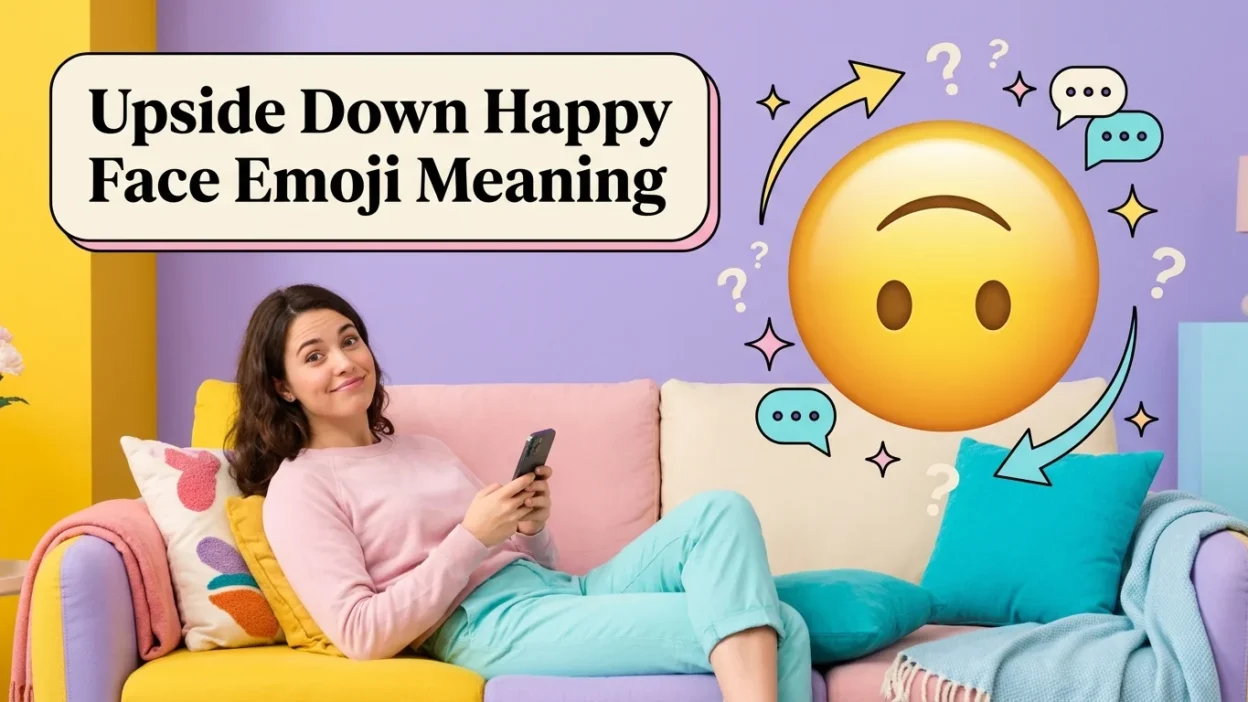
What does it really mean when someone sends a smiley face turned upside down? The upside down happy face emoji meaning is often more playful and complex than a regular smile.
The 🙃 emoji can express sarcasm, irony, awkwardness, silliness, or a sense of pretending that everything is fine when the situation is actually frustrating or strange.
People frequently use this emoji in texting when they want to soften an awkward comment, react to an unexpected situation, or make a joke without sounding too serious.
Quick Answer: 🙃 Upside Down Happy Face Emoji Mean?
The 🙃 upside down happy face emoji usually expresses sarcasm, irony, silliness, awkwardness, playful frustration, or a “well, what can you do?” attitude. It can show that someone is smiling on the outside while a situation feels strange, annoying, or funny underneath.
For example:
“I forgot my keys again 🙃”
Here, 🙃 probably means, “Yep, I did something silly again, and I’m laughing at myself.”
The emoji does not have one fixed emotional meaning. Context matters.
What Does “upside down happy face emoji meaning” Mean?
The phrase upside down happy face emoji meaning refers to the meaning and emotional tone communicated by the 🙃 emoji.
The emoji looks like a normal smiley face that has been rotated 180 degrees. Because the face is smiling while being upside down, it creates a strange contrast between a positive facial expression and an unusual position.
That contrast is the key to understanding 🙃.
The most common meaning of 🙃
The most common uses of 🙃 include:
- Sarcasm
- Irony
- Silliness
- Playful humor
- Awkwardness
- Mild frustration
- Resignation
- Self-deprecating humor
- “Oh well” feelings
- Pretending everything is fine
Emojipedia describes the emoji as commonly being used for irony, sarcasm, joking, and goofiness or silliness. It can also communicate awkwardness, frustration, ambivalence, or bemused resignation.
Does 🙃 mean happy?
Not necessarily.
Although the emoji has a smile, it is usually more complicated than simply saying “I’m happy.”
Compare these:
“I got the job! 😊”
This sounds genuinely happy.
“I got the job after six months of interviews 🙃”
Here, 🙃 may suggest exhaustion, disbelief, irony, or relief mixed with humor.
So, when you see 🙃, do not automatically translate it as “happy.”
Meaning of 🙃 in Different Contexts
The meaning of the upside down happy face emoji changes depending on the conversation.
The words, relationship between the people, and situation all matter. One person might use 🙃 to be silly, while another might use it to show that something is going badly but they are trying to laugh about it.
🙃 in Everyday Conversation
In everyday conversation, 🙃 often makes a statement sound playful or ironic.
For example:
“I cleaned my room and somehow made it messier 🙃.”
The person probably finds the situation funny rather than genuinely upsetting.
It can also soften a complaint. Instead of saying, “This is so annoying,” someone may write:
“My internet stopped working again 🙃.”
The emoji adds a humorous “of course this happened” feeling.
🙃 in Text Messages
In text messages, 🙃 is especially useful because written words do not always show tone.
For example:
“You were supposed to remind me about the meeting 🙃.”
Depending on the relationship, this could be a playful complaint rather than serious anger.
It can also show self-directed humor:
“I studied the wrong chapter for two hours 🙃.”
The person is probably laughing at their own mistake.
🙃 on Social Media
On social media, 🙃 is often used in captions, comments, replies, and posts about relatable situations.
For example:
“When you check your bank account after shopping 🙃.”
Here, the emoji adds a humorous sense of regret or disbelief.
It is also common when people describe everyday problems that are frustrating but not serious.
🙃 on WhatsApp
On WhatsApp, the meaning depends heavily on who sends it and what came before it.
A friend might write:
“I told you I wouldn’t eat the cake… then I ate half of it 🙃.”
That sounds playful.
Someone might also say:
“Great, another Monday 🙃.”
This probably communicates mild dislike, tiredness, or sarcastic humor rather than actual anger.
🙃 on Snapchat
On Snapchat, 🙃 can appear in captions, messages, or replies.
It can make a message feel less serious.
For example:
“I accidentally sent that screenshot to the person I was talking about 🙃.”
The emoji suggests embarrassment mixed with humor.
🙃 on Instagram
On Instagram, people may use 🙃 in captions and comments to express irony or relatable frustration.
For example:
“Spent all morning getting ready just to cancel my plans 🙃.”
The emoji emphasizes the contradiction in the situation.
🙃 on TikTok
TikTok users may use 🙃 when reacting to awkward, absurd, embarrassing, or frustrating situations.
For example:
“Me pretending I understand the homework 🙃.”
The emoji supports the joke and communicates that the person knows the situation is ridiculous.
🙃 in Gaming
Gamers may use 🙃 after a funny mistake, unlucky result, or frustrating game moment.
For example:
“Lost the match because I forgot to reload 🙃.”
The emoji can mean:
“I can’t believe I just did that.”
It usually makes the statement humorous instead of overly serious.
🙃 in Professional Communication
Be careful with 🙃 at work.
It may be acceptable in a casual team chat where emojis are normal, but it can sound sarcastic or passive-aggressive in formal communication.
For example:
“The report was changed for the third time 🙃.”
A coworker may interpret this as frustration or criticism.
In a formal email, a straightforward sentence is usually clearer.
Examples of the Upside Down Happy Face Emoji
Here are some realistic examples that show how the upside down happy face emoji meaning can change with context.
Example 1: Making a Mistake
Sentence:
“I sent the email to the wrong person 🙃.”
Meaning:
The person is embarrassed but making light of the mistake.
Situation:
A friend is telling you about an awkward mistake.
Example 2: Mild Frustration
Sentence:
“My phone died right before I needed directions 🙃.”
Meaning:
The situation is annoying, but the person is expressing the frustration humorously.
Situation:
Someone has experienced an inconvenient problem.
Example 3: Sarcasm
Sentence:
“Sure, because waiting two hours is exactly what I wanted today 🙃.”
Meaning:
The person probably does not actually enjoy waiting. The emoji makes the sarcasm clearer.
Situation:
Someone has been waiting for a long time.
Example 4: Self-Deprecating Humor
Sentence:
“I forgot my own password again 🙃.”
Meaning:
The person is laughing at themselves.
Situation:
They made a small, silly mistake.
Example 5: Awkward Situation
Sentence:
“I waved back at someone who wasn’t waving at me 🙃.”
Meaning:
The person feels awkward and embarrassed but finds the situation funny.
Situation:
They misunderstood someone’s gesture.
Example 6: “Oh Well”
Sentence:
“The restaurant is closed. Guess we’re eating somewhere else 🙃.”
Meaning:
The person accepts the situation with a slightly amused or resigned attitude.
Situation:
Plans did not work out.
Example 7: Pretending Everything Is Fine
Sentence:
“My computer crashed before I saved the project 🙃.”
Meaning:
The person is probably frustrated, but the emoji adds humor to an unpleasant situation.
Situation:
A frustrating technology problem happened.
Example 8: Playful Humor
Sentence:
“I said I would eat healthy today. Then I ordered pizza 🙃.”
Meaning:
The person is joking about breaking their own plan.
Situation:
Someone is making fun of their own behavior.
When Do People Use the 🙃 Emoji?
People generally use 🙃 when they want their message to carry an emotional tone that words alone may not communicate.
When something is awkward
The emoji works well after an embarrassing or uncomfortable situation.
“That conversation went really well 🙃.”
Depending on context, this could actually mean the conversation went terribly.
When something is ironic
🙃 is useful when reality is different from what someone expected.
“I bought a waterproof phone case and then dropped my phone in the sink 🙃.”
The contradiction creates the humor.
When making fun of yourself
People often use 🙃 after admitting a small mistake.
“I forgot why I opened the fridge 🙃.”
The emoji makes the confession feel playful.
When mildly frustrated
It can communicate annoyance without sounding extremely angry.
“The bus left one minute before I arrived 🙃.”
The message basically says, “Of course that happened.”
When joking about a difficult situation
Someone may use 🙃 to laugh through an unpleasant moment.
“Three exams this week. Love that for me 🙃.”
Here, the emoji suggests sarcastic acceptance.
Different Meanings of the Upside Down Happy Face Emoji
The 🙃 emoji does not have one universal emotional translation. Here are some of its most common meanings.
1. Sarcasm
Definition: Saying something that means the opposite of the literal words or deliberately giving a statement an ironic tone.
Context: Someone experiences an inconvenient or ridiculous situation.
Example:
“Another five-hour meeting. Amazing 🙃.”
The person probably does not mean that the meeting is amazing.
2. Irony
Definition: Highlighting a strange contrast between expectations and reality.
Context: Something happens in an unexpected or contradictory way.
Example:
“I went to the gym to avoid being lazy, then spent 30 minutes sitting in the sauna 🙃.”
3. Silliness
Definition: Showing that something is goofy, playful, or not meant to be taken too seriously.
Context: Friends are joking with one another.
Example:
“I just tried to open the door while holding my keys in my other hand 🙃.”
4. Awkwardness
Definition: Showing embarrassment or discomfort about a social situation.
Context: Someone has done something embarrassing.
Example:
“I called my teacher ‘Mom’ today 🙃.”
5. Mild Frustration
Definition: Showing annoyance without expressing serious anger.
Context: Something irritating has happened.
Example:
“My Wi-Fi stopped working during the presentation 🙃.”
6. Resignation
Definition: Accepting an unwanted situation with an “oh well” attitude.
Context: Something cannot easily be changed.
Example:
“Looks like our flight is delayed again 🙃.”
7. Emotional Contradiction
Sometimes 🙃 communicates two feelings at once.
A person can be amused and annoyed, happy and uncomfortable, or calm on the outside while frustrated inside.
That emotional mixture is one reason the emoji is so useful online. Emojipedia has described it as having an underlying sense of irony and a broad emotional range.
What Does 🙃 Mean From a Guy?
If a guy sends 🙃, the meaning depends on the conversation.
It can mean he is:
- joking
- being sarcastic
- embarrassed
- teasing
- expressing mild frustration
- making fun of himself
- trying to keep a conversation playful
For example:
“I was totally not nervous before our date 🙃.”
Here, he may be joking about actually feeling nervous.
However, the emoji alone does not prove that someone is flirting or expressing romantic interest. Look at the surrounding words and the overall conversation.
What Does 🙃 Mean From a Girl?
If a girl sends 🙃, it can similarly express sarcasm, awkwardness, humor, frustration, or playful teasing.
For example:
“I definitely didn’t spend three hours online shopping 🙃.”
This likely means she is joking about what she just admitted.
The emoji does not automatically have a special romantic meaning when a girl sends it. Context is more important than gender.
Does 🙃 Mean Flirting?
Sometimes 🙃 can appear in a flirty conversation, but it is not specifically a flirting emoji.
For example:
“Maybe I missed you a little 🙃.”
In a romantic conversation, this might sound playful or teasing.
But:
“I forgot my homework again 🙃.”
has nothing to do with flirting.
Therefore, you should not interpret 🙃 as romantic unless the surrounding conversation provides that meaning.
Is 🙃 a Sarcastic Emoji?
Yes. Sarcasm is one of the most common uses of 🙃.
It can help show that the writer’s literal words should not be taken completely at face value.
For example:
“Perfect. My laptop updated five minutes before my meeting 🙃.”
The word “perfect” sounds positive, but 🙃 signals that the speaker probably means the opposite.
Still, not every use of 🙃 is sarcastic. It can also communicate silliness, awkwardness, resignation, or simple humor.
Is 🙃 a Negative Emoji?
Not exactly.
The emoji has a smiling face, but its meaning often carries a negative or mixed emotional undertone.
It may express:
- mild annoyance
- embarrassment
- awkwardness
- frustration
- disappointment
- irony
However, these feelings are often presented in a humorous or lighthearted way.
Think of 🙃 as a smile that says, “Well… this is happening.”
🙃 vs 🙂: What’s the Difference?
These two emojis look similar, but their emotional tone can be very different.
🙂 Slightly Smiling Face generally communicates a simple smile, friendliness, politeness, or mild positivity.
🙃 Upside-Down Face often adds irony, sarcasm, awkwardness, silliness, or resignation.
Compare:
“Thanks for helping me 🙂.”
This sounds friendly and appreciative.
“Thanks for helping me 🙃.”
Depending on context, this could sound sarcastic or suggest that the help was not exactly helpful.
The upside-down orientation changes the emotional signal.
🙃 vs 😏: What’s the Difference?
The 😏 Smirking Face often suggests confidence, teasing, smugness, flirtation, or a knowing attitude.
The 🙃 Upside-Down Face is more commonly associated with irony, awkward humor, silliness, sarcasm, or mild frustration.
For example:
“I know something you don’t 😏.”
This can sound teasing or suggestive.
“I forgot the answer again 🙃.”
This sounds more self-deprecating or humorous.
🙃 vs 😂: What’s the Difference?
😂 usually shows strong laughter or that something is very funny.
🙃 is subtler.
For example:
“That video was hilarious 😂.”
The person is clearly laughing.
“I just walked into the wrong classroom 🙃.”
The person may not find the situation extremely funny. They are simply using humor to deal with embarrassment.
🙃 vs 🫠: What’s the Difference?
The 🫠 Melting Face emoji often expresses embarrassment, emotional overload, awkwardness, heat, exhaustion, or feeling overwhelmed.
🙃 can also express awkwardness, but its meaning is usually more connected to irony, sarcasm, silliness, and “oh well” humor.
For example:
“I forgot her name five seconds after meeting her 🙃.”
This focuses on awkward self-humor.
“Everyone is looking at me and I want to disappear 🫠.”
This emphasizes embarrassment or emotional overwhelm.
What Does 🙃 Mean in a Relationship?
In a relationship, 🙃 can have several meanings.
A partner might use it to tease you:
“You said you weren’t hungry and then ate my fries 🙃.”
It could also soften a complaint:
“You forgot our anniversary reminder again 🙃.”
Or it could simply be playful:
“Fine, you win 🙃.”
Do not interpret the emoji by itself. The relationship, previous messages, and tone of the conversation all matter.
What Does 🙃 Mean in a Text From Your Crush?
If your crush sends 🙃, it may simply mean they are joking, being awkward, or teasing you.
For example:
“Maybe I was waiting for you to text first 🙃.”
That can sound playful or slightly flirty because of the surrounding words.
But the emoji itself is not a guaranteed romantic signal.
The safest way to understand it is to read the entire message rather than assigning a fixed meaning to the emoji.
Origin of the Upside Down Happy Face Emoji
The official name of 🙃 is Upside-Down Face, not “upside down happy face.”
Unicode lists the character as U+1F643 and includes it among the smileys and emotion emoji.
The emoji was approved in Unicode 8.0 in 2015 and added to Emoji 1.0 in 2015.
However, the idea did not suddenly appear in 2015. Emojipedia’s historical research notes that an upside-down smiley had appeared in Google’s Gmail emoji set as early as 2008. Those early designs were connected to Japanese mobile emoji traditions and kaomoji.
Emojipedia also discusses the Japanese concept 逆立ち (sakadachi), associated with being upside down or doing a handstand. Historical Japanese mobile pictograph databases included upside-down or inverted-face concepts before the modern Unicode emoji became standardized.
So, the modern 🙃 emoji has a relatively recent official Unicode history, but upside-down facial expressions have older roots in Japanese digital communication.
Why was the emoji created?
The exact emotional meaning of 🙃 is intentionally broad.
Unlike a word such as “happy,” an emoji can communicate tone without fitting into one strict definition.
Unicode standardizes the character so devices can exchange it consistently. Individual users and communities then develop different ways of using it.
That is why 🙃 can mean sarcasm in one message and silly humor in another.
Does the emoji literally mean a person is upside down?
Not usually.
The visual design is literal: the face is upside down.
But in conversation, the emoji is normally figurative. The upside-down position helps communicate that something is unusual, ironic, awkward, or emotionally complicated.
How 🙃 Evolved in Internet Communication
Digital communication removed many of the signals people normally use when speaking face to face.
When someone says, “Great,” their voice can tell you whether they are genuinely pleased or being sarcastic. In text, that tone can disappear.
Emojis help fill part of that gap.
The 🙃 emoji became useful because it can add a small signal that says:
“Don’t read this completely literally.”
It can turn an ordinary sentence into a joke, soften frustration, or highlight an awkward contradiction.
Modern online communication has therefore given 🙃 a broad emotional role rather than one strict definition.
Similar Words and Alternatives to 🙃
Several emojis and expressions can communicate related ideas, but they are not identical.
🙂 Slightly Smiling Face
Usually more straightforwardly positive or friendly.
Example:
“Thanks for your help 🙂.”
😅 Grinning Face With Sweat
Often shows nervous laughter, relief, embarrassment, or a close call.
Example:
“I almost missed my flight 😅.”
😏 Smirking Face
Can suggest confidence, teasing, smugness, or flirtation.
Example:
“I know what you did 😏.”
😂 Face With Tears of Joy
Usually shows strong laughter.
Example:
“That video was hilarious 😂.”
🫠 Melting Face
Often represents embarrassment, awkwardness, exhaustion, emotional overload, or feeling overwhelmed.
Example:
“I have three deadlines today 🫠.”
🙄 Face With Rolling Eyes
Usually communicates annoyance, disbelief, boredom, or frustration.
Example:
“He told the same story again 🙄.”
“Oh well”
This phrase is a strong text alternative when someone accepts something they cannot change.
Example:
“The tickets are sold out. Oh well.”
“Of course”
Depending on context, this can communicate sarcastic acceptance.
Example:
“My computer crashed again. Of course.”
“Well, that happened”
This phrase is often used after an awkward or unexpected event.
Example:
“I accidentally replied to the wrong group chat. Well, that happened.”
Common Mistakes When Using 🙃
The upside down happy face emoji meaning can easily be misunderstood. Here are some common mistakes to avoid.
Mistake 1: Assuming 🙃 Always Means Happiness
The face is smiling, but the emoji is not simply a happiness symbol.
Better approach:
Look at the surrounding words.
Mistake 2: Assuming It Always Means Sarcasm
Sarcasm is common, but 🙃 can also mean silliness, awkwardness, frustration, or resignation.
Better approach:
Consider the situation before deciding what the sender means.
Mistake 3: Treating It as a Flirting Emoji
🙃 can appear during flirting, but it is not inherently romantic.
Better approach:
Look for romantic language, teasing, compliments, or other context.
Mistake 4: Using It in Every Professional Message
An emoji that feels funny among friends may sound sarcastic at work.
Better approach:
Use 🙃 only when you understand the communication style of the people involved.
Mistake 5: Ignoring the Sentence Before It
An emoji should rarely be interpreted alone.
Compare:
“I passed my exam 🙃.”
This could mean the person is joking about how stressful the experience was.
Now consider:
“I failed my exam 🙃.”
Here, the emoji may suggest frustration, embarrassment, or an attempt to laugh about the disappointment.
The words change the interpretation.
How to Understand 🙃 Correctly
When someone sends you 🙃, ask yourself a few simple questions.
What did they say?
Read the entire message.
What happened?
Think about the situation being discussed.
What is your relationship with the sender?
A close friend may use 🙃 differently from a manager, stranger, or romantic partner.
Is the statement literal?
If the words sound strangely positive after something negative happened, the emoji may signal sarcasm or irony.
What emojis came with it?
Other emojis can add clues.
For example:
“I forgot my wallet again 🙃😭.”
The combination suggests frustration or embarrassment.
“I won the game 🙃😂.”
This may suggest playful humor rather than serious sarcasm.
Frequently Asked Questions
What does 🙃 mean in texting?
In texting, 🙃 usually means sarcasm, irony, silliness, awkwardness, mild frustration, or “oh well.” The exact meaning depends on the words and situation surrounding the emoji.
Does 🙃 mean happy?
Not necessarily. Although 🙃 has a smiling face, it often communicates a mixed or ironic emotion rather than straightforward happiness. Someone may use it while feeling embarrassed, frustrated, or amused.
What does the upside down happy face emoji mean from a guy?
From a guy, 🙃 can mean joking, teasing, awkwardness, sarcasm, embarrassment, or mild frustration. It does not automatically mean flirting or romantic interest.
What does 🙃 mean from a girl?
From a girl, 🙃 can similarly express humor, irony, awkwardness, teasing, or frustration. The emoji itself does not have a special meaning based on the sender’s gender.
Is 🙃 a sarcastic emoji?
Often, yes. 🙃 is commonly used to add a sarcastic or ironic tone to a message. However, it can also communicate silliness, awkwardness, resignation, or playful humor.
Does 🙃 mean flirting?
Not by itself. Someone can use 🙃 while flirting, but the emoji is not specifically a flirting symbol. The surrounding conversation is needed to determine whether romantic or playful interest is intended.
What is the difference between 🙂 and 🙃?
🙂 usually communicates a normal, friendly, or slightly positive smile. 🙃 often adds irony, sarcasm, silliness, awkwardness, or mild frustration. The upside-down position gives 🙃 a more complicated tone.
Conclusion
The upside down happy face emoji meaning is more complex than a simple smile. The 🙃 emoji, officially called Upside-Down Face, is commonly used for sarcasm, irony, silliness, awkwardness, mild frustration, and resignation.
It can express the feeling of smiling while a situation is strange, annoying, embarrassing, or simply funny. The emoji became part of Unicode 8.0 and Emoji 1.0 in 2015, although upside-down smiley designs existed in digital communication before that.