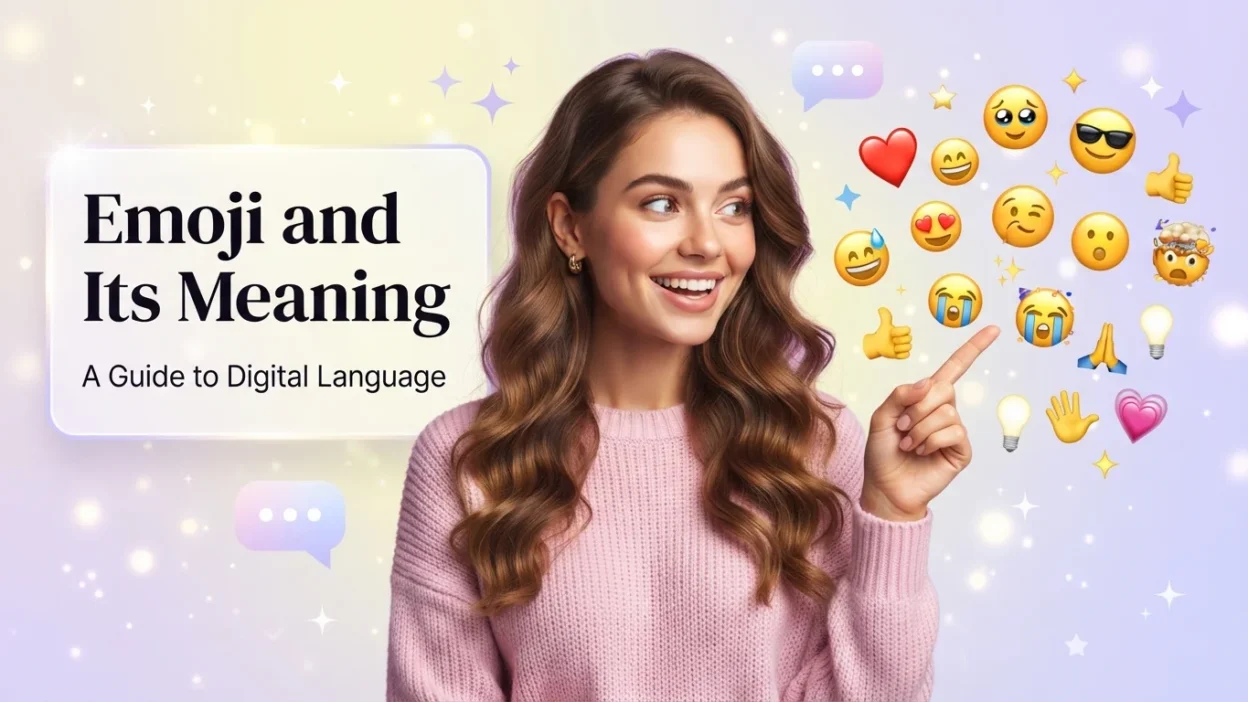
Have you ever received a message filled with colorful symbols and wondered what the sender was trying to say? Emojis have become an important part of everyday digital communication, helping people express feelings, reactions, and ideas with just a small picture.
Understanding emoji and its meaning can make your conversations clearer, more engaging, and sometimes even more fun. From smiling faces 😊 and red hearts ❤️ to crying faces 😭 and thumbs-up signs 👍, every emoji can communicate a different emotion or message.
People use emojis on WhatsApp, Instagram, Snapchat, TikTok, Facebook, and other platforms to express happiness, love, sadness, excitement, sarcasm, and appreciation. They can also make ordinary text messages feel more personal and friendly.
Quick Answer:
Emoji are pictorial symbols used in digital communication to express emotions, reactions, objects, ideas, activities, or tone. Their meaning depends on the emoji itself, the surrounding message, the relationship between people, and the context.
For example:
- 😊 = happiness, friendliness, or warmth
- 😂 = strong laughter or something being very funny
- ❤️ = love, affection, care, or support
- 👍 = approval, agreement, or acknowledgment
- 😢 = sadness or disappointment
- 🔥 = something exciting, impressive, attractive, or popular
- 🙏 = thanks, prayer, respect, or asking for something
There is no universal rule that says one emoji must always have one meaning. Unicode notes that emoji are encoded mainly according to their appearance, while their practical meaning can change with context and culture.
What Does “Emoji and Its Meaning” Mean?
The phrase emoji and its meaning refers to understanding what an emoji communicates when someone uses it in a digital conversation.
An emoji is a pictorial symbol that appears inside text. It can represent a facial expression, object, animal, food, place, activity, feeling, reaction, or idea. Unicode defines emoji as colorful pictographs that can be used inline in text.
For example, the emoji 😊 visually represents a smiling face. In everyday communication, it may suggest happiness, kindness, friendliness, gratitude, or a positive mood.
The important point is that the picture and the intended message are not always exactly the same.
Literal Meaning vs. Practical Meaning
An emoji can have a literal meaning based on what it visually represents and a practical meaning based on how people use it.
For example:
🔥 Literal meaning: Fire or flame.
🔥 Practical meaning: Something exciting, excellent, attractive, impressive, or trending.
Similarly:
🙏 Literal meaning: Folded hands.
🙏 Practical meaning: Prayer, gratitude, respect, hope, apology, or asking for help.
This difference explains why searching for an emoji’s meaning can sometimes produce several answers.
Why Context Matters
Consider this message:
“You finally finished the project! 🔥”
Here, 🔥 probably means that the person thinks the work is excellent.
Now consider:
“The kitchen is on fire 🔥”
In this sentence, the emoji is much closer to its literal meaning.
The image is the same, but the message changes its interpretation.
Meaning of Emojis in Different Contexts
The meaning of an emoji can change depending on where and how you use it. A symbol that feels friendly in a private chat might feel too casual in a professional message.
Here are some common contexts.
Emoji Meaning in Everyday Conversation
In everyday conversation, emojis often make written communication feel warmer and more expressive.
A simple sentence such as:
“Thank you 😊”
sounds friendlier than:
“Thank you.”
The words have not changed. The emoji adds emotional information.
Common everyday uses include:
- 😊 for friendliness
- 😄 for happiness
- ❤️ for affection
- 👍 for agreement
- 🙏 for thanks or appreciation
- 😂 for laughter
- 😢 for sadness
- 🎉 for celebration
People often use emojis because text alone cannot show facial expressions, gestures, or voice tone.
Emoji Meaning in Text Messages
Text messages are one of the most common places where emojis appear.
Because texting does not provide body language or vocal tone, emojis can help clarify how a sentence should be understood.
For example:
“Okay.”
can sound serious or cold.
But:
“Okay 😊”
usually feels warmer.
Likewise:
“Sure 👍”
can communicate agreement or acknowledgment.
However, the relationship between the people matters. Some people use emojis frequently, while others rarely use them. Therefore, you should consider someone’s normal texting style before interpreting one emoji too strongly.
Emoji Meaning on Social Media
On social media, emojis often communicate reactions, emotions, humor, or support.
You may see them in:
- Instagram captions
- Facebook comments
- TikTok comments
- YouTube comments
- X posts
- Snapchat messages
- profile bios
For example, someone might comment:
“This is amazing 🔥”
Here, 🔥 usually means impressive or excellent.
A person might also write:
“Congratulations! 🎉❤️”
The combination communicates celebration and affection or support.
Emoji Meaning on WhatsApp
WhatsApp users commonly use emojis to make short messages more expressive.
For example:
“Good morning ☀️😊”
can sound cheerful and friendly.
A message such as:
“I miss you ❤️”
usually expresses affection, although the exact relationship meaning depends on who sent it.
WhatsApp conversations can also contain multiple emojis together:
“Thank you so much 🙏❤️”
This can communicate gratitude combined with warmth or affection.
Emoji Meaning on Snapchat
Snapchat conversations often use emojis alongside short, casual messages.
Because Snapchat is heavily visual, emojis can function as quick emotional reactions.
For example:
“That was inexplicable 😂”
uses 😂 to reinforce laughter.
A person may also send:
“See you later 👋”
where 👋 represents waving or saying goodbye.
Emoji Meaning on Instagram
Instagram emojis are common in comments, captions, direct messages, and bios.
Some emojis also become popular because of trends and online culture.
For example:
“Your outfit looks amazing 😍🔥”
Here, 😍 may express admiration or attraction, while 🔥 suggests that the outfit looks impressive or stylish.
However, you should not automatically assume romantic interest from a single emoji. The surrounding conversation provides important clues.
Emoji Meaning on TikTok
TikTok users often use emojis in comments to react quickly to videos.
For example:
“I can’t stop laughing 😂”
or:
“This is so cute 🥹❤️”
Emojis can also become part of internet trends. Their meaning may shift as communities develop new ways to use them.
Emoji Meaning in Gaming
Gamers use emojis to express reactions without writing long messages.
For example:
“We won! 🏆🔥”
might communicate excitement and celebration.
Other examples include:
- 🎮 = gaming
- 🏆 = victory or achievement
- 💀 = something extremely funny, shocking, or absurd
- 🔥 = impressive gameplay
- 😭 = exaggerated emotional reaction
In gaming communities, some emoji meanings may differ from traditional dictionary-style meanings.
Emoji Meaning in Professional Communication
Emojis can appear in workplace messages, especially in informal teams and internal chats.
For example:
“Great job on the presentation! 👏”
The clapping hands add encouragement.
However, professional communication requires more care. A highly emotional emoji may not be appropriate in a formal email, business proposal, complaint, or serious workplace situation.
When communicating professionally, consider:
- Your relationship with the recipient
- Company culture
- The seriousness of the message
- Whether the emoji could be misunderstood
A simple 👍 or 🙂 may work in an informal team chat, while a formal business email may be clearer without emojis.
Emoji Meaning in Internet Slang
Internet communities often give emojis meanings that go beyond their literal appearance.
For example, 💀 can literally represent a skull. Online, however, it is often used to mean:
“That is so funny I can’t handle it.”
Similarly, 🔥 can mean:
“This is excellent.”
And 👀 can suggest:
“I’m watching,” “I’m interested,” or “Tell me more.”
These meanings are not necessarily fixed. Internet language changes quickly, so context remains essential.
Examples of Emoji and Its Meaning
Here are several realistic examples that show how emojis work in actual communication.
Example 1: 😊
Sentence:
“It was nice talking to you 😊”
Meaning:
The emoji adds friendliness and warmth.
Situation:
Someone may use it after a pleasant conversation to make the message feel positive.
Example 2: ❤️
Sentence:
“Thank you for always supporting me ❤️”
Meaning:
The heart can communicate love, care, gratitude, or strong affection.
Situation:
A person might send this to a partner, family member, close friend, or someone who has helped them.
Example 3: 😂
Sentence:
“That video was hilarious 😂”
Meaning:
The emoji communicates strong laughter.
Situation:
It is commonly used after something funny, especially in casual online conversations.
Example 4: 👍
Sentence:
“I’ll send the file tonight 👍”
Meaning:
The emoji can communicate agreement, acknowledgment, or confirmation.
Situation:
A person may use it to show that they understand or accept what was said.
Example 5: 🙏
Sentence:
“Thanks for helping me today 🙏”
Meaning:
Here, 🙏 most likely communicates gratitude or appreciation.
Situation:
Someone may use it when thanking another person for a favor or important help.
Example 6: 🔥
Sentence:
“Your new song is 🔥”
Meaning:
The emoji suggests that the song is excellent, exciting, or impressive.
Situation:
It is common in social media comments and casual conversations.
Example 7: 😭
Sentence:
“I watched that ending and I’m crying 😭”
Meaning:
It can literally represent crying, but online it may also exaggerate laughter, sadness, shock, or emotional overwhelm.
Situation:
The surrounding words are important for determining whether the person is actually sad.
When Do People Use Emojis?
People use emojis whenever they want to add emotional or visual information to written communication.
To Show Emotion
A sentence can feel incomplete without tone.
For example:
“I’m so happy!”
Adding 😊 or 🎉 can make the emotion even clearer.
To Show Reactions
People often respond to messages with an emoji instead of writing a full sentence.
For example:
“We got the tickets!”
Response:
“🎉”
The emoji acts as a quick emotional reaction.
To Make Messages Friendlier
A short message can sometimes sound cold.
Compare:
“Thanks.”
with:
“Thanks 😊”
The second version often feels warmer.
To Add Humor
Emojis can show that a message is playful.
For example:
“I definitely didn’t eat the last slice 😇”
The 😇 can signal joking or playful innocence.
To Emphasize a Point
People sometimes use emojis to make important words stand out.
For example:
“That deal is 🔥”
or:
“Important reminder! ⚠️”
To Replace Words
Sometimes an emoji can communicate an entire idea.
For example:
“Good night 🌙”
The moon helps communicate nighttime.
Similarly:
“Happy birthday 🎂🎉”
uses emojis to reinforce the occasion.
Different Meanings of Emoji and Its Meaning
There is no single meaning system that applies perfectly to every emoji. However, emoji meanings can generally be understood through several categories.
Emotional Emojis
These emojis represent feelings and emotional reactions.
Examples include:
- 😊 happiness
- 😢 sadness
- 😡 anger
- 😍 admiration or affection
- 😱 fear or shock
- 🥺 pleading, tenderness, or vulnerability
- 😭 crying or exaggerated emotional reaction
Their exact meaning depends heavily on the surrounding text.
Heart Emojis
Heart emojis are among the most commonly searched emoji meanings.
Examples include:
- ❤️ love, affection, care
- 🧡 warmth, friendship, support
- 💛 happiness, friendship, affection
- 💚 nature, support, affection, or jealousy depending on context
- 💙 trust, support, friendship, or affection
- 💜 affection, support, or certain cultural associations
- 🖤 dark humor, sadness, or affection
- 🤍 purity, sympathy, peace, or affection
- 🤎 warmth, comfort, or affection
A colored heart does not automatically identify a person’s romantic feelings. Context and relationship matter.
Gesture Emojis
Gesture emojis represent actions or body language.
Examples include:
- 👍 approval or agreement
- 👎 disagreement
- 👋 greeting or goodbye
- 👏 applause or praise
- 🙏 thanks, prayer, respect, or asking
- 🤝 agreement or cooperation
- ✌️ peace, victory, or a casual gesture
Object Emojis
Some emojis represent physical objects.
Examples include:
- 📱 phone
- 💻 computer
- 🎁 gift
- 📚 books
- ☕ coffee
- 🚗 car
- ✈️ airplane
These often have more literal meanings, but internet culture can give them additional uses.
Animal Emojis
Animal emojis can refer to actual animals or describe people metaphorically.
For example, 🐶 can refer to a dog.
But a person may also use an animal emoji to express cuteness, personality, humor, or affection.
Food Emojis
Food emojis are often literal.
Examples include:
- 🍕 pizza
- 🍔 burger
- 🍎 apple
- 🍰 cake
- 🍩 doughnut
- ☕ coffee
However, some food emojis can acquire slang or suggestive meanings in certain online contexts. That is another reason to interpret emojis carefully rather than relying only on their literal appearance.
Emoji vs. Emoticon: What Is the Difference?
People sometimes use emoji and emoticon as if they mean exactly the same thing. Technically, they are different.
An emoji is a pictorial symbol or encoded character, such as 😊, ❤️, or 🚗.
An emoticon is created using ordinary text characters to represent an expression.
For example:
🙂
Unicode explains that emoticons originated as sequences of text characters, while emoji are pictographic symbols.
So, the simplest distinction is:
Emoji = pictorial symbols
Emoticons = combinations of text characters
Both can communicate emotion, but they are built differently.
Why Do Emoji Meanings Change?
Emoji meanings change because language itself changes.
People constantly create new expressions, jokes, trends, and cultural associations online. A symbol can start with one common use and later develop additional meanings.
For example, 💀 traditionally represents a skull or death. In online conversations, especially among younger users, it can also express intense amusement or disbelief.
Similarly, 👀 may represent eyes literally. Online, it can suggest interest, curiosity, attention, or “I’m watching.”
Unicode specifically warns that emoji meanings may vary by language, culture, and context and can change or be repurposed over time.
This is why an emoji dictionary should be treated as a helpful guide rather than an absolute rulebook.
Does Every Emoji Have One Meaning?
No.
An emoji can have several meanings.
For example, 🙏 may represent:
- Prayer
- Gratitude
- Respect
- Asking for help
- Hope
- Appreciation
The sentence surrounding it helps determine which interpretation makes the most sense.
Unicode also states that the official Unicode character name does not necessarily define every possible meaning of an emoji.
This is particularly important when interpreting emojis in relationships, texting, or social media conversations.
Emoji Meanings From a Guy or Girl
People often search for phrases such as emoji meaning from a guy or emoji meaning from a girl.
There is no universal rule that says an emoji has a completely different definition depending on the sender’s gender.
For example, ❤️ from a guy can express romantic love, friendship, appreciation, family affection, or general support. The same emoji from a girl can have similar possibilities.
Instead of focusing only on whether the sender is a man or woman, look at:
- The words around the emoji
- Your relationship with the person
- How they normally text
- Whether they use the emoji with everyone
- Whether the conversation is romantic or friendly
- Whether they combine it with other emojis
For example:
“Good luck tomorrow ❤️”
could show care or encouragement.
But:
“I love you ❤️”
has a much clearer romantic or deeply affectionate meaning.
The words provide important context.
Emoji Meanings in Relationships
Emojis can become especially meaningful in romantic conversations.
Someone may use ❤️, 😘, 🥰, 😍, or 💕 to show affection. However, one emoji alone usually cannot prove someone’s feelings.
For example:
“Good night 😘”
can sound romantic or affectionate.
But:
“Good night 😊”
may simply sound warm and friendly.
The best interpretation comes from the complete conversation rather than one symbol.
Emoji Meanings in Friendships
Friends also use emojis to show support and affection.
For example:
“You did it! 🎉❤️”
could simply be a friend’s celebration.
Likewise:
“Proud of you 👏”
shows encouragement without necessarily having romantic meaning.
This is why people should avoid automatically treating every heart or affectionate emoji as romantic.
Emoji Meanings in Different Cultures
Emoji communication can also vary across cultures.
A gesture that seems obvious in one country may carry a different association somewhere else. Religious, social, historical, and cultural factors can influence interpretation.
Even the same emoji may have different emotional associations between communities.
Unicode therefore treats emoji as pictographs whose meaning can vary with language and culture.
If you are communicating with someone from another country, consider the broader context instead of assuming that your interpretation is universal.
Origin of Emoji
The history of emoji begins in Japan.
The word emoji comes from Japanese:
- 絵 (e) = picture
- 文字 (moji) = character
So, the word can be understood roughly as picture character. Unicode confirms this Japanese origin.
Emoji became available on Japanese mobile phones in 1999. Different Japanese mobile phone carriers developed their own sets, which created compatibility problems between devices.
The Unicode Consortium later worked toward standardizing emoji so they could be represented consistently across computer systems and phones.
Unicode’s history shows that emoji encoding developed through several stages. Emoji-related characters entered Unicode in different releases, with major additions in Unicode 6.0 and later releases. Emoji 1.0 was released in 2015, and the standard has continued to expand.
As of Unicode Emoji 18.0, the standard continues to define emoji characters and sequences, along with information used to support their display and interpretation across platforms.
How Emoji Work Technically
Although emojis look like small pictures, many are represented digitally as Unicode characters or sequences of Unicode characters.
Unicode provides a common standard that allows text and symbols to be represented across different computer systems.
An emoji may consist of:
- A single Unicode character
- Multiple Unicode characters
- A sequence involving modifiers
- A sequence involving a zero-width joiner
- A flag sequence
This technical structure explains why some emojis behave differently from others.
For example, some visible emoji are actually combinations of multiple encoded characters. Unicode’s technical standard documents these emoji sequences and how they should be handled.
Why Do Emojis Look Different on iPhone and Android?
You may notice that the same emoji looks different on different devices.
That happens because Unicode standardizes the underlying character or sequence, not one identical artwork that every company must use.
Apple, Google, Microsoft, Samsung, and other platforms can create their own visual designs.
The meaning is generally intended to remain recognizable, but the appearance can differ.
This is why one person’s emoji may look slightly different from yours.
Common Emoji Mistakes
Understanding emoji and its meaning is useful, but people often make mistakes when interpreting or using them.
Mistake 1: Assuming One Emoji Has Only One Meaning
This is probably the biggest mistake.
For example, 😂 generally communicates laughter, but people may use it simply to show that something is amusing.
Likewise, 🙏 can represent several different ideas.
Better approach: Read the entire message before deciding what an emoji means.
Mistake 2: Assuming Every Heart Is Romantic
A ❤️ does not automatically mean romantic love.
Someone may send it to a friend, parent, sibling, colleague, or community.
Better approach: Consider the relationship and surrounding words.
Mistake 3: Ignoring Internet Slang
Some emojis develop meanings that are different from their literal appearance.
💀 is a good example.
Better approach: Consider whether the conversation is formal, casual, humorous, or part of a particular online community.
Mistake 4: Overanalyzing One Emoji
It is easy to spend too much time wondering why someone used 😊 instead of 🙂.
Usually, the whole conversation matters more than a tiny difference between two similar emojis.
Better approach: Look at patterns rather than one isolated symbol.
Mistake 5: Using Very Casual Emojis in Formal Messages
Some emojis can feel too informal in professional communication.
Better approach: Match your emoji choice to the audience and situation.
Mistake 6: Forgetting That Platforms Look Different
The same emoji can have a slightly different design on different devices.
Better approach: Focus on the general concept rather than tiny visual differences.
How to Understand an Emoji Correctly
If you are unsure what an emoji means, use this simple process.
Look at the Words
First, read the complete message.
“Your presentation was 🔥”
Here, the words strongly suggest that 🔥 is positive.
Consider the Relationship
Ask yourself whether the sender is:
- A close friend
- A romantic partner
- A family member
- A colleague
- Someone you barely know
The relationship can change the interpretation.
Look at Previous Messages
If someone regularly uses ❤️ with all their friends, you should not automatically interpret it as romantic.
Their usual communication style provides useful context.
Check Other Emojis
Emoji combinations can provide additional clues.
For example:
“Miss you 🥺❤️”
is more emotionally expressive than:
“Miss you 🙂”
Consider the Platform
A phrase used on TikTok may have a different internet-culture meaning than the same emoji in a formal email.
Consider Culture
If the sender comes from a different cultural background, remember that emoji interpretation may not be identical everywhere.
Similar Words and Alternatives
Several terms are related to emoji and its meaning.
Emoji
A pictorial symbol used in digital communication.
Example:
😊 ❤️ 😂
Emoticon
A facial expression made using text characters.
Example:
🙂
Sticker
A larger graphic or animated image often used in messaging apps.
Stickers can communicate emotions in a more detailed visual format than standard emoji.
GIF
A short animated image commonly used to express reactions, humor, or emotions.
For example, someone may send a laughing GIF instead of 😂.
Symbol
A broader term for something that represents an idea, object, or concept.
Not every symbol is an emoji.
Reaction
A digital response to another person’s message or content.
An emoji can function as a reaction, but reactions can also use other interface elements.
Frequently Asked Questions
What is the meaning of an emoji?
An emoji is a pictorial symbol used in digital communication to express emotions, objects, reactions, ideas, or activities. Its exact meaning depends on context, culture, and the surrounding message.
Do emojis have official meanings?
Emoji have Unicode names, annotations, and technical definitions, but these do not completely control how people use them. Unicode explains that an emoji’s practical meaning can vary by context and culture.
Can one emoji have multiple meanings?
Yes. Many emojis have several possible meanings. For example, 🙏 can represent prayer, gratitude, respect, or asking for help depending on the conversation.
What is the difference between emoji and emoticons?
Emoji are pictorial symbols such as 😊 and ❤️. Emoticons are combinations of text characters such as 🙂 and :-(. Unicode recognizes this distinction.
Why do people use emojis in texting?
People use emojis to communicate emotion, tone, reactions, humor, affection, and visual ideas. They can make short written messages feel clearer or warmer.
Why can the same emoji mean different things?
The meaning can change because of context, culture, relationship, internet trends, and surrounding words. Unicode specifically notes that emoji meanings can change or be repurposed over time.
Where did emojis come from?
Modern emoji originated with Japanese mobile phone systems. They became available on Japanese mobile phones in 1999, and later became standardized through Unicode so they could be used more consistently across platforms.
Conclusion
Understanding emoji and its meaning is not simply about memorizing a list of definitions. Emojis are visual parts of language, and their meaning can change depending on the words around them, the relationship between people, online culture, and the situation.
A ❤️ can communicate romantic love, friendship, support, or appreciation. A 🔥 can describe an actual flame or mean that something is impressive. A 🙏 can express prayer, gratitude, respect, or a request. The same emoji can therefore communicate different ideas in different conversations.