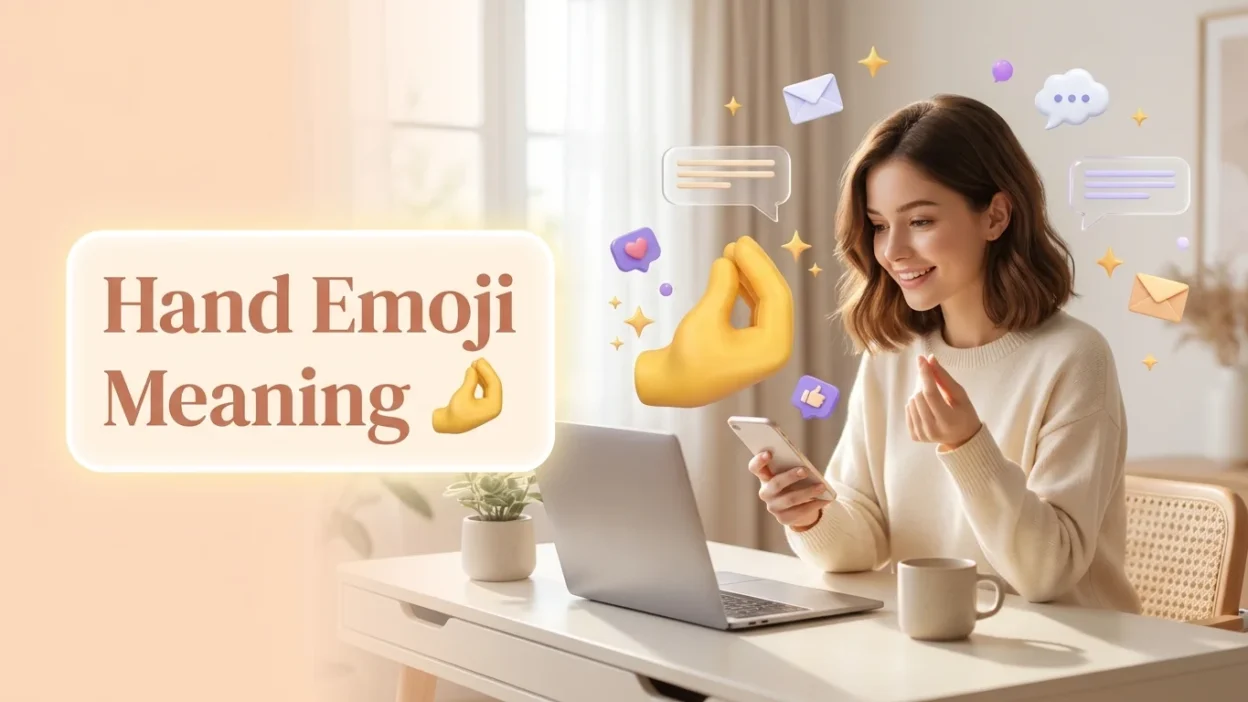
A hand gesture can completely change the tone of a message, and the 🤌 emoji is one of the most expressive examples. The Hand Emoji Meaning 🤌 often relates to emphasis, frustration, questioning, approval, or a dramatic way of saying “What are you talking about?”
Depending on the context, people may use this emoji to express a strong opinion, make a playful Italian-style gesture, or show that something is perfect and satisfying. In texting and social media, 🤌 can also add humor, attitude, or personality to an otherwise simple message.
Its meaning can shift depending on the words around it, the relationship between the people chatting, and the situation itself. For example, someone may send 🤌 after tasting amazing food, making a sarcastic comment, or emphasizing an important point.
Quick Answer: What Does 🤌 Mean?
🤌 means “What do you want?”, “What are you saying?”, disbelief, frustration, emphasis, or a dramatic Italian-style reaction. Its exact meaning depends on the conversation and cultural context.
The emoji is officially called Pinched Fingers. It is commonly associated with the Italian gesture often described as ma che vuoi?, meaning roughly “What do you want?” or “What are you saying?” In Italy, the gesture can communicate disagreement, frustration, or disbelief.
In casual online conversations, however, 🤌 can simply make a message sound more expressive or dramatic.
Example:
“Bro, what are you even talking about 🤌”
Here, 🤌 can add a playful sense of “What are you saying?” rather than expressing serious anger.
What Does “hand emoji meaning 🤌” Mean?
The hand emoji meaning 🤌 usually refers to the meaning and use of the Pinched Fingers emoji.
The gesture shows several fingers brought together at the tips while the hand points upward. Unicode lists its official short name as pinched fingers, while Emojipedia describes it as a gesture often associated with the Italian hand movement known for questioning or challenging what someone has said.
In simple English, 🤌 can communicate ideas such as:
- “What do you want?”
- “What are you talking about?”
- “What are you saying?”
- “Seriously?”
- “Come on!”
- “Wait.”
- “Hold on.”
- “Be patient.”
- “That is exactly my point.”
- A dramatic or exaggerated reaction
The meaning changes based on the words around it.
The Most Common Meaning of 🤌
One of the best-known meanings comes from Italian gesture culture. In this context, 🤌 may express a question, disagreement, frustration, disbelief, or confusion.
For example:
“You ate the whole pizza? 🤌”
The emoji could make the sentence sound like a dramatic “What are you doing?” reaction.
Another example:
“What are you talking about 🤌”
Here, it reinforces the questioning tone.
The Literal Meaning of 🤌
Literally, the emoji represents fingers held together in a pinched position. It does not contain a word or sentence by itself.
This is important because emojis do not have one fixed meaning in every situation. Unicode explains that emoji meanings can vary according to language, culture, context, and changing online usage.
So, when someone sends 🤌, look at the surrounding message before deciding what they mean.
Meaning of 🤌 in Different Contexts
The same emoji can feel completely different depending on where you see it. A friend may use 🤌 as a joke, while someone from a culture familiar with the physical gesture may use it more literally.
Here are some of the most common contexts.
🤌 in Everyday Conversation
In everyday conversation, 🤌 often works like a visual hand gesture.
Someone might use it when they want to show:
- disbelief
- frustration
- confusion
- emphasis
- dramatic questioning
- playful disagreement
For example:
“You seriously forgot your keys again 🤌”
The emoji adds a dramatic “Come on!” feeling.
It can also imitate the way someone moves their hands while speaking. In this sense, the emoji does not necessarily add a new meaning. Instead, it makes the written conversation feel more expressive.
🤌 in Text Messages
In text messages, 🤌 is often playful.
Friends may use it after a question or statement to make the message more dramatic:
“And what exactly are you doing 🤌”
“You call that cooking 🤌😂”
The emoji can make the message sound theatrical rather than completely serious.
Tone matters here. A sentence with 🤌 can be teasing, annoyed, confused, or humorous depending on the relationship between the people.
🤌 on Social Media
On social media, 🤌 is frequently used to make reactions more visual.
A person may add it to a caption when they want to express strong emphasis or a dramatic reaction.
For example:
“This outfit is everything 🤌”
In this kind of post, the emoji may not mean “What do you want?” at all. Instead, it can help emphasize the person’s enthusiasm or dramatic style.
This is a good example of how internet usage can expand beyond the original cultural meaning of a gesture.
🤌 on WhatsApp
On WhatsApp, 🤌 can be used between friends, couples, family members, or groups.
Common examples include:
“Bro, explain yourself 🤌”
“Why did you do that 🤌😂”
“Wait a minute 🤌”
“This food is perfect 🤌”
The last example shows why context matters. The emoji can sometimes be used for approval or emphasis, rather than disagreement.
🤌 on Snapchat
Snapchat conversations are usually informal, so 🤌 can appear as part of jokes, reactions, captions, or quick replies.
For example:
“You really thought I wouldn’t notice 🤌”
Here, it can create a playful, dramatic tone.
Snapchat users may also combine it with emojis such as 😂, 😭, 😭😂, or 😭🤌 to make the emotional reaction stronger.
🤌 on Instagram
On Instagram, 🤌 can appear in comments, captions, Reels, Stories, and direct messages.
A person might write:
“The details 🤌”
This can suggest that the details are excellent or beautifully done.
Another person might comment:
“What is happening here 🤌”
In this case, it can communicate confusion or playful disbelief.
🤌 on TikTok
TikTok has helped many gestures and emojis develop broader internet meanings.
On TikTok, 🤌 may be used with:
- jokes
- reaction videos
- exaggerated statements
- food content
- dramatic comments
- cultural references
- sarcastic reactions
For example:
“That first bite 🤌”
In a food video, the emoji may suggest that the food is especially satisfying or excellent.
That use is different from the classic Italian “What do you want?” interpretation.
🤌 in Gaming
Gamers may use 🤌 in chats when reacting to another player’s decision or comment.
Examples include:
“You really picked that character 🤌”
“What was that move 🤌😂”
“Bro, explain that strategy 🤌”
In gaming, it usually works as an expressive reaction rather than a formal symbol with one fixed definition.
🤌 in Professional Communication
Be more careful with 🤌 in professional communication.
The emoji can be difficult to interpret if the other person does not know the gesture. It may look sarcastic, annoyed, confusing, or overly informal.
For example, instead of writing:
“Can you explain this decision 🤌”
in a formal work email, it is clearer to write:
“Could you please explain this decision?”
The emoji is generally better suited to casual conversations where both people understand each other’s communication style.
🤌 as Internet Slang
🤌 is not technically a slang abbreviation like LOL, TBH, or IDK. It is a pictographic gesture.
However, internet users often use it as a shorthand for a reaction.
Depending on the situation, it can stand for ideas such as:
“What?”, “Seriously?”, “Come on!”, “Exactly!”, or “Perfect!”
The surrounding words determine which interpretation makes sense.
Examples of “hand emoji meaning 🤌”
Seeing real examples makes the meaning much easier to understand.
Example 1: “What Are You Saying?”
Message:
“What are you even talking about 🤌”
Meaning:
The sender is questioning or challenging what the other person said.
Situation:
A friend makes a strange claim, and you respond in a playful but dramatic way.
Example 2: “What Do You Want?”
Message:
“Okay, what do you want from me 🤌”
Meaning:
The emoji can reinforce a “What do you want?” reaction.
Situation:
Someone keeps asking you for something, and you respond with exaggerated frustration.
This connects closely with the well-known Italian gesture associated with questioning someone’s request or statement.
Example 3: “Seriously?”
Message:
“You forgot my birthday again 🤌”
Meaning:
The emoji adds disbelief or frustration.
Situation:
A friend repeatedly forgets something important.
The sender may be annoyed, but the emoji can also make the complaint playful.
Example 4: “This Is Perfect”
Message:
“That pasta looks amazing 🤌”
Meaning:
Here, 🤌 can express strong appreciation or dramatic approval.
Situation:
Someone posts delicious-looking food, and you want to emphasize how good it looks.
This demonstrates why you should not assume that 🤌 always means “What do you want?”
Example 5: “Hold On”
Message:
“Wait, wait 🤌 I need to understand this.”
Meaning:
The emoji can reinforce the idea of stopping for a moment.
Situation:
Someone explains something quickly, and you want them to pause.
In some cultural uses of the physical gesture, 🤌 is associated with ideas such as “hold on,” “relax,” or “be patient.”
Example 6: “You Have a Point”
Message:
“Okay, that argument actually makes sense 🤌”
Meaning:
The emoji emphasizes the statement.
Situation:
A friend makes a surprisingly convincing argument.
Example 7: Playful Disagreement
Message:
“No way you think that movie was good 🤌😂”
Meaning:
The sender disagrees, but the laughing emoji suggests they are being playful.
Situation:
Two friends have different opinions about a movie.
Example 8: Dramatic Reaction
Message:
“You spent all your money in one day 🤌😭”
Meaning:
The sender is shocked or playfully criticizing the other person.
Situation:
A friend makes an obviously questionable spending decision.
When Do People Use 🤌?
People usually use 🤌 when they want to add emotion, emphasis, humor, or drama to a message.
A plain sentence can sometimes feel flat:
“What are you doing?”
Adding 🤌 can make it feel more expressive:
“What are you doing 🤌”
The emoji visually imitates a hand gesture, so it can make digital communication feel closer to face-to-face conversation.
Common Situations
You may see 🤌 when someone is:
- questioning another person
- showing disbelief
- disagreeing playfully
- expressing frustration
- emphasizing a point
- asking someone to wait
- reacting dramatically
- praising food or something enjoyable
- making a cultural joke
- adding personality to a social media post
Who Uses 🤌?
There is no specific age group or gender that owns this emoji.
Teenagers, young adults, older adults, content creators, gamers, and social media users can all use it. What matters more is the person’s communication style and familiarity with the gesture.
Appropriate Situations
🤌 is usually appropriate in:
- casual texts
- group chats
- memes
- social media comments
- friendly conversations
- informal messages
- humorous conversations
Situations to Avoid
Think twice before using it in:
- formal business emails
- job applications
- official complaints
- academic writing
- serious professional communication
- conversations with people who may interpret gestures differently
The issue is not that 🤌 is inherently rude. The problem is that gesture meanings can vary between cultures.
Different Meanings of 🤌
The hand emoji meaning 🤌 can be divided into several common interpretations.
🤌 Meaning: “What Do You Want?”
This is one of the most recognizable interpretations.
Definition:
A questioning gesture asking what another person wants.
Context:
Often associated with Italian gesture culture.
Example:
“You keep calling me. What do you want 🤌?”
The emoji gives the sentence a more expressive, physical quality.
🤌 Meaning: “What Are You Saying?”
Definition:
A reaction to something confusing, unbelievable, or questionable.
Context:
Used when someone thinks another person’s statement does not make sense.
Example:
“You said winter is hotter than summer 🤌?”
Here, 🤌 strengthens the disbelief.
🤌 Meaning: Frustration
Definition:
A dramatic way of showing annoyance or impatience.
Context:
Usually appears in casual conversations.
Example:
“I explained this three times already 🤌”
The sender may be frustrated, but the tone could still be humorous.
🤌 Meaning: Disbelief
Definition:
A reaction meaning “Seriously?” or “I cannot believe this.”
Context:
Used after surprising or ridiculous information.
Example:
“He missed the bus because he was watching TikTok 🤌”
The emoji emphasizes disbelief.
🤌 Meaning: “Wait” or “Be Patient”
Definition:
A gesture suggesting that someone should pause or slow down.
Context:
This interpretation is particularly connected with some cultural uses of the physical gesture.
Example:
“Hold on 🤌 Let me check.”
The emoji supports the idea of pausing.
🤌 Meaning: Emphasis
Definition:
The emoji can emphasize an important point.
Context:
Common in social media posts and casual conversations.
Example:
“The ending was perfect 🤌”
The sender is drawing attention to how strongly they feel about the ending.
🤌 Meaning: Approval or “Perfect”
Definition:
A dramatic expression of satisfaction or appreciation.
Context:
Common in online reactions, especially around food, fashion, music, or creative work.
Example:
“That presentation was so clean 🤌”
Here, the emoji acts more like an enthusiastic reaction than a question.
What Does 🤌 Mean From a Guy?
If a guy sends you 🤌, the emoji does not automatically have a romantic meaning.
He might use it to:
- question something you said
- joke with you
- show disbelief
- emphasize a point
- tease you
- express approval
- react dramatically
For example:
“You really did that 🤌😂”
This is more likely a playful reaction than a romantic signal.
Look at the complete conversation rather than interpreting the emoji alone. His words, the topic, your relationship, and the surrounding emojis can all change the tone.
What Does 🤌 Mean From a Girl?
When a girl sends 🤌, it can have the same broad meanings.
She might use it to express:
- “What?”
- “Seriously?”
- “Come on!”
- “Explain yourself.”
- “Wait.”
- “Exactly.”
- “That is perfect.”
For example:
“You actually wore that 🤌😭”
This could be playful teasing or disbelief.
There is no universal “girl meaning” for 🤌. The context matters more than the sender’s gender.
Does 🤌 Mean Flirting?
Not by itself.
The 🤌 emoji is not universally recognized as a flirting emoji. It can appear in flirtatious conversations, but that does not mean the emoji itself automatically signals romantic interest.
For example:
“You look good today 🤌”
could be playful admiration.
But:
“What are you talking about 🤌”
is probably just a reaction to the conversation.
If you are trying to understand whether someone is flirting, consider the entire message and the broader conversation rather than relying on one emoji.
Is 🤌 an Italian Emoji?
🤌 is strongly associated with an Italian hand gesture, but it is not exclusively an Italian emoji.
The official Unicode name is Pinched Fingers, not “Italian hand emoji.”
The Italian association became especially strong because the gesture is widely recognized as a stereotypical Italian expression. In Italian usage, the gesture can communicate disagreement, frustration, disbelief, or questions such as “What do you want?” or “What are you saying?”
At the same time, the physical gesture has other meanings in other cultures. This is one reason emoji interpretation should always consider context.
🤌 vs 🤏: What Is the Difference?
People sometimes confuse 🤌 with 🤏 because both involve fingers being brought together.
However, they depict different gestures.
🤌 Pinched Fingers shows multiple fingers gathered together. It is strongly associated with the Italian-style gesture and can express questioning, frustration, disbelief, or other culturally specific meanings.
🤏 Pinching Hand shows the thumb and index finger close together. It is commonly used to indicate something small, a small amount, or sometimes precision.
Simple Comparison
| Emoji | Official name | Common idea |
| 🤌 | Pinched Fingers | What? / What do you want? / emphasis / dramatic reaction |
| 🤏 | Pinching Hand | Small / tiny amount / precision |
| 👌 | OK Hand | Okay / good / perfect, depending on culture |
| ✋ | Raised Hand | Stop / high five / wait |
| 🙏 | Folded Hands | Prayer / thanks / pleading, depending on context |
Do not automatically substitute 🤏 for 🤌. Their visual shapes and common interpretations are different.
🤌 vs 👌: Are They the Same?
No.
The 👌 emoji is officially called OK Hand, while 🤌 is officially called Pinched Fingers. Unicode lists them as separate emoji.
However, their meanings can sometimes overlap.
For example:
“This meal is amazing 👌”
and
“This meal is amazing 🤌”
Both can express approval, but they do not communicate exactly the same gesture.
👌 generally has an “okay,” “good,” or “perfect” association in many contexts. 🤌 has a more dramatic, questioning, expressive, or culturally Italian association.
Cultural differences matter with both gestures. Unicode notes that emoji meanings can vary according to culture and context.
Common Mistakes With the 🤌 Emoji
Because 🤌 has multiple interpretations, people sometimes misunderstand it.
Mistake: Assuming It Always Means “Italian”
Not every use of 🤌 is intended to represent Italy.
Someone may simply use it to express emphasis, disbelief, humor, or approval.
Better approach:
Look at the sentence before interpreting the emoji.
Mistake: Thinking 🤌 Always Means “What Do You Want?”
This is one of its famous meanings, but it is not the only one.
A person might use:
“That pizza 🤌”
to show appreciation rather than ask a question.
Better approach:
Check whether the message contains a question, criticism, praise, or joke.
Mistake: Confusing 🤌 With 🤏
These emojis look similar at first glance, but their hand shapes differ.
🤌 = Pinched Fingers
🤏 = Pinching Hand
🤏 is commonly connected with something being small or a small quantity.
Mistake: Assuming It Is Rude
🤌 can sometimes express frustration or disagreement, but that does not make every use rude.
For example:
“This pasta 🤌”
could be enthusiastic praise.
On the other hand:
“What are you saying 🤌”
could sound challenging.
The surrounding text controls the tone.
Mistake: Assuming It Is Romantic
🤌 does not have a universal romantic meaning.
A person can send it to a friend, family member, coworker, partner, or stranger.
Do not treat the emoji alone as evidence of flirting.
Cultural Meaning of 🤌
Hand gestures are closely connected to culture. A movement that seems obvious in one country may have a different meaning somewhere else.
Emojipedia notes that the physical gesture represented by 🤌 has culturally specific uses. In Italy, it is commonly associated with disagreement, frustration, disbelief, and questions such as “What do you want?” or “What are you saying?” In Israeli culture, the gesture can be used with meanings such as “hold on,” “relax,” or “be patient.”
This does not mean every Italian or Israeli person uses the gesture in exactly the same way. Cultural practices are not mathematical formulas. Personal habits, generations, situations, and online trends can all influence meaning.
Unicode’s guidance makes the broader point clearly: emoji meanings can vary by language, culture, context, and changing usage.
Origin of the 🤌 Emoji
The physical hand gesture existed long before the emoji.
The emoji itself was standardized later through Unicode. Pinched Fingers was approved as part of Unicode 13.0 and added to Emoji 13.0 in 2020.
Unicode currently lists 🤌 under the hand-fingers-partial category and identifies its CLDR short name as pinched fingers.
The Cultural Background
The gesture has a strong association with Italian communication. It has often been portrayed as a characteristic Italian hand movement, especially when someone is questioning, disagreeing, or showing frustration.
The gesture also exists in other cultural settings with different interpretations.
This is important because the emoji is not simply a digital version of one English word. It represents a physical gesture whose meaning can change across cultures.
How 🤌 Became an Internet Expression
Once 🤌 became available on phones and social platforms, users could use the physical gesture digitally.
That allowed the emoji to develop additional online uses.
People began using it in memes, comments, reaction posts, food content, jokes, and casual conversations. In some situations, it became a general symbol of emphasis or dramatic approval rather than a literal Italian gesture.
When Was 🤌 Added to Unicode?
The 🤌 emoji was added in 2020 as part of Unicode 13.0 and Emoji 13.0.
Unicode identifies it as:
U+1F90C — Pinched Fingers
This technical name is useful when you want to distinguish 🤌 from visually similar emojis such as 🤏 and 👌.
The emoji also supports different skin-tone variations. These are modifier sequences based on the Pinched Fingers emoji and a skin-tone modifier.
How 🤌 Is Used With Other Emojis
People often combine 🤌 with other emojis to make the intended emotion clearer.
🤌😂
Usually creates a playful or funny reaction.
“You really said that 🤌😂”
It can mean the person finds the situation ridiculous or funny.
🤌😭
Often suggests dramatic disbelief, frustration, or being overwhelmed.
“You spent $500 on that 🤌😭”
The exact emotion depends on the conversation.
🤌❤️
Can combine emphasis with affection or appreciation.
“This song 🤌❤️”
It may mean the person really loves the song.
🤌🔥
Can emphasize that something is impressive, exciting, or excellent.
“That performance 🤌🔥”
Here, the gesture is functioning as emphasis rather than a question.
🤌😩
Often creates an exaggerated reaction.
“Why does this always happen 🤌😩”
It can communicate frustration in a humorous way.
How to Understand 🤌 in a Text
If someone sends you 🤌 and you are unsure what they mean, use a simple three-step approach.
Look at the Words
Start with the actual sentence.
“What do you want 🤌?”
The meaning is probably connected to questioning.
But:
“That food 🤌”
probably expresses approval or appreciation.
Look at the Other Emojis
Other emojis can provide clues.
🤌😂 usually feels playful.
🤌😭 often feels dramatically frustrated or shocked.
🤌❤️ can feel appreciative or affectionate.
Look at Your Relationship
A close friend may use 🤌 as an inside joke.
A coworker may use it simply to emphasize a point.
Someone you do not know well may use it as a cultural or social-media reference.
The relationship helps you understand the intended tone.
Is 🤌 Offensive?
🤌 is not inherently offensive.
However, because it represents a culturally meaningful hand gesture, its interpretation can vary.
Using the emoji casually does not automatically mean that someone intends disrespect. Still, deliberately imitating or exaggerating cultural stereotypes can make a message feel insensitive in some situations.
If you are communicating with someone from another culture, avoid assuming that a gesture has the same meaning everywhere.
The safest interpretation is always based on context.
Similar Words and Alternatives to 🤌
If you want to express a similar idea in plain text, several phrases can work.
“What?”
Use this when you are confused or surprised.
“What? 🤌”
“What do you mean?”
Use this when you want clarification.
“What do you mean 🤌?”
“Seriously?”
Use this when you are surprised or doubtful.
“Seriously? 🤌”
“Come on!”
Use this when you are frustrated or teasing.
“Come on 🤌”
“Exactly!”
Use this when the emoji is being used for emphasis or agreement.
“Exactly 🤌”
“Perfect!”
Use this when reacting positively to food, art, fashion, music, or another enjoyable thing.
“That looks perfect 🤌”
“Hold on”
Use this when you want someone to pause.
“Hold on 🤌”
These alternatives show why 🤌 does not have one exact English translation. The correct phrase depends on what the sender is trying to communicate.
Similar Hand Emojis
Several hand emojis can appear similar or perform a similar role.
🤏 Pinching Hand
🤏 usually represents a small amount, something tiny, or the act of pinching.
Example:
“Just a little 🤏”
This is different from the usual questioning or dramatic role of 🤌.
👌 OK Hand
👌 often means “okay,” “good,” or “perfect,” although meanings can vary culturally.
Example:
“Everything is fine 👌”
✋ Raised Hand
✋ can mean “stop,” “wait,” or function as a high-five-like gesture.
Example:
“Wait ✋”
🙏 Folded Hands
🙏 can express prayer, thanks, pleading, regret, or other meanings depending on context.
Example:
“Thank you so much 🙏”
🤏 vs 🤌 vs 👌
A simple way to remember them is:
🤌 = expressive questioning or dramatic emphasis
🤏 = small or tiny
👌 = okay or good
These are general interpretations, not universal rules.
How to Reply to 🤌
Your response should depend on what the person appears to mean.
If they are asking:
“What do you want 🤌?”
You can answer directly:
“Nothing 😂 I was just checking.”
If they are joking:
“Bro, relax 😂”
If they are showing disbelief:
“I know, right? 😭”
If they are praising something:
“Exactly! 🤌🔥”
If you are unsure:
“What do you mean? 😂”
A simple clarification is better than guessing.
Is 🤌 Used Differently by Different People?
Yes.
Two people can send the exact same emoji and intend completely different things.
One person may know it mainly as an Italian gesture.
Another may know it as a meme reaction.
Someone else may use it to mean “perfect.”
Another person may simply think it looks funny.
This flexibility is normal for emoji communication. Unicode specifically explains that emoji are encoded based largely on their visual representation, while their meanings can vary and evolve over time.
Does 🤌 Mean “Chef’s Kiss”?
Sometimes people use 🤌 in contexts similar to chef’s kiss, especially when reacting to food, art, fashion, music, or something considered excellent.
For example:
“That pizza 🤌”
can mean:
“That pizza is amazing.”
However, 🤌 is not officially the “chef’s kiss” emoji.
It is officially Pinched Fingers. The chef’s-kiss interpretation is an example of how users can expand an emoji’s meaning through online culture.
So, if someone uses 🤌 after praising food, the intended message may be closer to “perfect,” “delicious,” or “excellent” than “What do you want?”
Is 🤌 a Slang Emoji?
It can function like internet shorthand, but it is not a slang word.
For example, a person might type:
“That outfit 🤌”
instead of writing:
“That outfit looks perfect.”
The emoji saves words while adding emotion.
This is one reason emojis are useful in digital communication. They can add tone that plain text sometimes struggles to convey.
Can 🤌 Be Sarcastic?
Yes.
Like many reaction emojis, 🤌 can be sarcastic.
For example:
“Wow, great idea 🤌”
Depending on the conversation, the sender might genuinely approve of the idea or be mocking it.
The words alone may not reveal the intended tone.
You need to consider:
- previous messages
- relationship
- punctuation
- other emojis
- the situation
- whether the sender normally uses sarcasm
This is especially important in text messages because facial expressions and physical gestures are missing.
Why Context Matters So Much With 🤌
The biggest lesson about the hand emoji meaning 🤌 is that context matters.
Consider this message:
“That was amazing 🤌”
The sender probably wants to emphasize approval.
Now compare:
“What are you doing 🤌”
The emoji may express questioning or frustration.
Now consider:
“Wait 🤌”
The same emoji can support a request to pause.
The visual symbol has stayed the same. The meaning changed because the words changed.
That is how many emojis work.
Frequently Asked Questions
What does 🤌 mean in texting?
In texting, 🤌 commonly expresses “What do you mean?”, “What are you saying?”, “What do you want?”, disbelief, frustration, or dramatic emphasis. It can also be used playfully or to show approval depending on the message.
What is the official name of 🤌?
The official Unicode name is Pinched Fingers. Unicode lists it as U+1F90C.
Does 🤌 mean “What do you want?”
It can. This is one of its best-known interpretations because the gesture is strongly associated with an Italian hand gesture used in questioning, disagreement, frustration, or disbelief.
What does 🤌 mean from a girl?
There is no special universal meaning when a girl sends 🤌. She may be questioning you, joking, showing disbelief, emphasizing something, or expressing approval. Read the emoji together with her words and the situation.
What does 🤌 mean from a guy?
A guy may use 🤌 to show disbelief, frustration, humor, emphasis, or approval. It does not automatically mean flirting or romantic interest.
Is 🤌 a flirting emoji?
Not generally. 🤌 does not have one universal romantic meaning. It can appear in a flirtatious conversation, but the surrounding words and relationship provide the important clues.
What is the difference between 🤌 and 🤏?
🤌 is Pinched Fingers and is commonly associated with an Italian-style questioning or expressive gesture. 🤏 is Pinching Hand and is commonly used for something small, a small amount, or precision.
Conclusion
The hand emoji meaning 🤌 is more flexible than it may first appear. Its official Unicode name is Pinched Fingers, and it is strongly associated with an Italian hand gesture that can communicate questions, disagreement, frustration, or disbelief.
In online conversations, however, 🤌 has developed broader uses. People may use it to mean “What are you saying?”, “Seriously?”, “Come on!”, “Wait,” or even “Perfect!” when reacting to food, fashion, music, or something impressive.