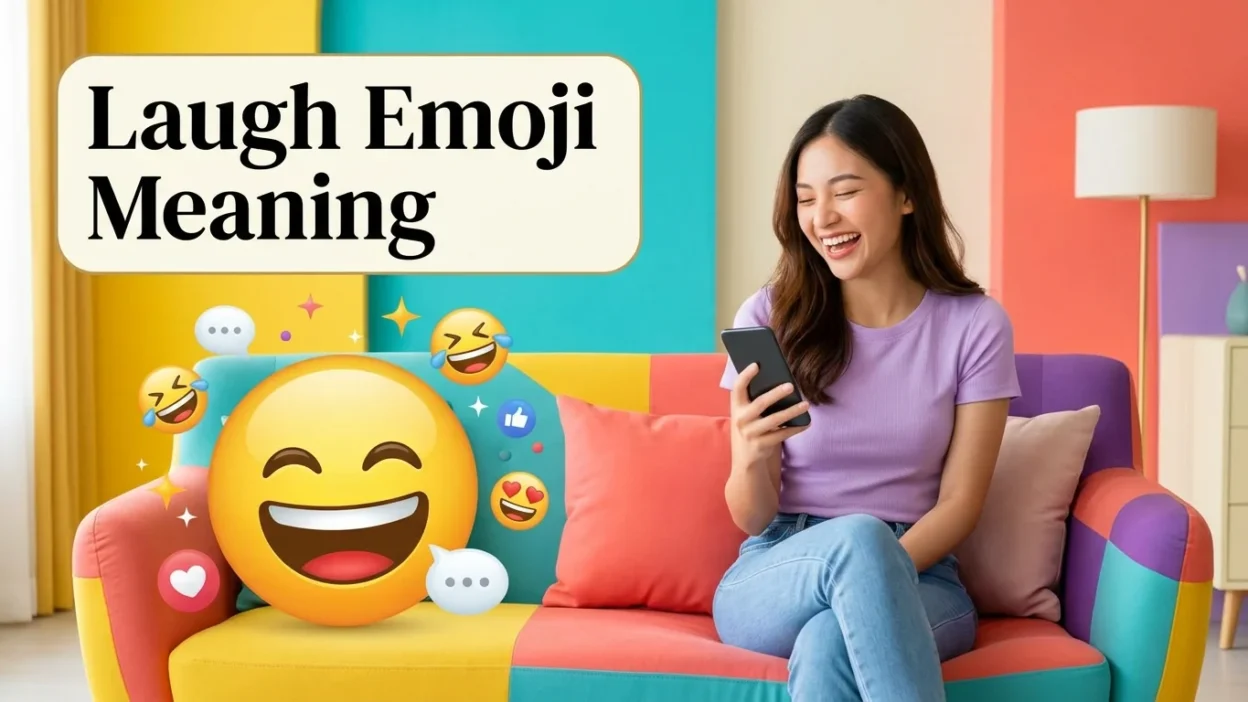
Laughter can instantly make a conversation more enjoyable, and laugh emojis help people share that feeling without typing a long response.
The Laugh Emoji Meaning usually expresses amusement, happiness, humor, or a strong reaction to something funny. Depending on the emoji, it can show anything from a small chuckle to uncontrollable laughter.
In texting, people often use laughing emojis when a joke makes them smile, a friend says something hilarious, or a situation feels unexpectedly funny. Emojis such as 😂 and 🤣 can also make a message sound more playful and energetic.
Quick Answer: What Does the Laugh Emoji Mean?
The laugh emoji usually means that someone finds something funny, amusing, silly, or entertaining. Common laughing emojis include 😂 Face with Tears of Joy, 🤣 Rolling on the Floor Laughing, 😆 Grinning Squinting Face, 😹 Cat With Tears of Joy, and 😅 Grinning Face With Sweat.
The exact meaning depends on context. For example, 😂 often means “That is really funny,” while 🤣 can mean “That is extremely funny.” 😅 may suggest nervous laughter, embarrassment, or relief rather than simple amusement.
What Does “Laugh Emoji” Mean?
“Laugh emoji” is a general phrase people use for emojis that communicate laughter, amusement, humor, or joking.
There is not just one official emoji called the “laugh emoji.” Unicode gives individual emojis their own standardized names. For example, 😂 is officially called Face with Tears of Joy, 🤣 is Rolling on the Floor Laughing, and 😆 is Grinning Squinting Face. Unicode lists these emojis under its Smileys & Emotion collection.
In everyday texting, however, people commonly call all of them laughing emojis because they are used to react to something funny.
😂 Face With Tears of Joy
😂 is one of the most recognizable laughing emojis. Its official Unicode name is Face with Tears of Joy. Unicode lists laughter-related keywords such as “funny,” “haha,” “hilarious,” “laugh,” “lol,” and “rofl” for this emoji.
It usually means:
- “That is so funny.”
- “I am laughing.”
- “You made me laugh.”
- “I cannot stop laughing.”
- “That was hilarious.”
Example:
“My cat tried to jump on the sofa and completely missed 😂”
Here, the sender is showing genuine amusement.
🤣 Rolling on the Floor Laughing
🤣 officially means Rolling on the Floor Laughing. It generally expresses stronger laughter than a normal smile or laugh.
People may use it when something is extremely funny:
“He really thought he could sing that song better than the original 🤣”
The emoji suggests that the person is laughing very hard.
Unicode includes keywords such as “funny,” “haha,” “hilarious,” “laugh,” “lmao,” “rofl,” and “roflmao” for this emoji.
😆 Grinning Squinting Face
😆 is officially called Grinning Squinting Face. It shows a wide grin with tightly closed or squinting eyes.
It can communicate:
- Happy laughter
- Excitement
- Playful amusement
- A silly reaction
- Strong enjoyment
For example:
“You actually remembered my birthday 😆”
Here, 😆 can show excited happiness rather than uncontrollable laughter.
😅 Grinning Face With Sweat
😅 looks like a smiling face with a drop of sweat. It can indicate laughter, but it often carries an additional feeling such as awkwardness, nervousness, embarrassment, stress, or relief.
For example:
“I completely forgot we had a test today 😅”
The sender is not simply laughing. They may be using the emoji to make an embarrassing situation feel lighter.
Unicode’s emoji keywords connect this face with nervousness, stress, excitement, and cold sweat.
😹 Cat With Tears of Joy
😹 is the cat version of a laughing face. It officially represents Cat with Tears of Joy and is associated with laughter, joy, and tears.
It can make a reaction feel more playful or cute:
“That video was too funny 😹”
People may choose it when they want their response to sound silly, cute, or energetic.
Meaning of Laughing Emojis in Different Contexts
The same emoji can communicate different emotions depending on where it appears. A laughing emoji after a joke is straightforward, but the meaning can become more complicated in a serious conversation.
Laugh Emoji Meaning in Everyday Conversation
In everyday conversation, laughing emojis usually show that someone is amused.
For example:
“I walked into the wrong classroom this morning 😂”
The emoji tells the reader that the person is telling the embarrassing story in a humorous way.
A laughing emoji can also make a conversation feel more relaxed. Without an emoji, a short response such as “That was funny” may sound neutral. Adding 😂 makes the emotional reaction more obvious.
Laugh Emoji Meaning in Text Messages
In texting, laughing emojis often replace phrases such as:
- “LOL”
- “That’s funny.”
- “I’m laughing.”
- “You’re hilarious.”
- “That made me laugh.”
For example:
“You really sent that message to the wrong person 😂”
The emoji adds a playful reaction to the sentence.
However, context matters. If someone says something serious and the other person replies only with 😂, the response could be interpreted as dismissive or insensitive.
Laugh Emoji Meaning on WhatsApp
On WhatsApp, laughing emojis are commonly used in private conversations, group chats, family chats, and friend groups.
A person may send 😂 after a funny message:
“Dad just asked me how to turn on the Wi-Fi again 😂”
In a family group, the emoji can show friendly amusement.
In a romantic conversation, however, the same emoji can sometimes make a message feel more playful or teasing.
Laugh Emoji Meaning on Snapchat
Snapchat conversations often have a casual and playful tone. Laughing emojis can show that the sender finds a picture, message, joke, or story entertaining.
For example:
“You looked so confused in that photo 😂”
The emoji makes the comment sound more playful.
Still, be careful with teasing. A laughing emoji does not automatically make every comment friendly. The surrounding words and relationship matter.
Laugh Emoji Meaning on Instagram
On Instagram, laughing emojis commonly appear in comments and direct messages.
Someone might comment:
“Why is this so accurate 😂”
Here, 😂 means the person relates to the content and finds it funny.
Multiple laughing emojis can increase the emotional intensity:
“😂😂😂”
This generally communicates stronger laughter than a single 😂, although the exact intensity depends on the person.
Laugh Emoji Meaning on TikTok
TikTok has a particularly flexible emoji culture. People may use 😂, 🤣, 😭, or even 💀 to express that something is extremely funny.
Emojipedia notes that 💀 Skull is often used by Gen Z, particularly on TikTok, to express the slang idea “I’m dying laughing” or “I’m dead.”
For example:
“The way he turned around at the end 💀”
Here, 💀 does not literally mean death. It can mean that the person found the situation so funny that they are “dead” from laughter.
Laugh Emoji Meaning in Gaming
Gaming communities use laughing emojis to react to funny mistakes, unexpected events, friendly teasing, or ridiculous gameplay.
For example:
“You jumped off the map again 😂”
The meaning depends heavily on the relationship between the players. Among friends, it may be playful teasing. Between strangers, it could sound mocking.
Laugh Emoji Meaning in Professional Communication
Laughing emojis can be risky in professional conversations.
A light emoji may be acceptable in an informal team chat when colleagues already communicate casually. However, 😂 or 🤣 may not be appropriate when discussing serious workplace issues, complaints, mistakes, customers, or sensitive topics.
For example, replying:
“We missed the deadline again 😂”
could make a serious situation sound careless.
In professional communication, it is usually better to choose a neutral tone unless you know that the workplace culture is highly informal.
Examples of the Laugh Emoji Meaning
Here are several realistic examples showing how laughing emojis can work in different situations.
Example 1: Genuine Amusement
Message:
“My brother tried cooking pasta and somehow burned the water 😂”
Meaning:
The sender thinks the situation is very funny.
Situation:
Two friends are sharing funny stories about their families.
Example 2: Extreme Laughter
Message:
“Did you see his reaction when the music suddenly stopped? 🤣”
Meaning:
The sender found the moment extremely funny.
Situation:
Friends are discussing a funny video.
Example 3: Nervous or Embarrassed Laughter
Message:
“I accidentally called my teacher ‘Mom’ today 😅”
Meaning:
The person feels embarrassed but is laughing about the mistake.
Situation:
Someone is sharing an awkward personal story.
Example 4: Playful Teasing
Message:
“You said you would wake up early, and now it’s noon 😂”
Meaning:
The sender is teasing the other person in a playful way.
Situation:
Two friends are joking about someone’s sleeping habits.
Example 5: Cute or Silly Reaction
Message:
“The kitten chased its own tail for five minutes 😹”
Meaning:
The sender finds the kitten’s behavior funny and cute.
Situation:
Someone is sharing a funny animal story.
Example 6: Laughing at Yourself
Message:
“I spent ten minutes looking for my phone while holding it in my hand 😂”
Meaning:
The sender is laughing at their own mistake.
Situation:
A person is telling a funny story about themselves.
Example 7: Unexpected Humor
Message:
“He walked into the room and forgot why he came in 🤣”
Meaning:
The situation was unexpectedly funny.
Situation:
Friends are joking about something that happened during the day.
Example 8: Relating to a Meme
Message:
“Me checking my bank account after online shopping 😂”
Meaning:
The sender finds the meme relatable and funny.
Situation:
Someone shares a humorous social media post.
When Do People Use Laugh Emojis?
People use laughing emojis whenever they want to communicate a humorous reaction quickly.
Common situations include:
- Responding to jokes
- Reacting to funny videos
- Commenting on memes
- Teasing friends
- Laughing at personal mistakes
- Sharing embarrassing stories
- Showing amusement
- Making casual messages feel warmer
- Reacting to unexpected situations
- Showing that a comment was not meant too seriously
The emoji can also help prevent a short message from sounding too harsh.
Compare these two messages:
“You are always late.”
and:
“You are always late 😂”
The second version may sound more playful because the emoji suggests that the speaker is joking or teasing.
However, an emoji cannot completely change the meaning of the words. If the statement is offensive or aggressive, adding 😂 does not automatically make it friendly.
Different Meanings of the Laugh Emoji
The phrase “laugh emoji” covers several different emotional meanings. Here are the most common ones.
Genuine Happiness
A laughing emoji can show that someone is genuinely happy because something funny happened.
Example:
“That joke made my whole day 😂”
The emoji supports a positive emotional reaction.
Strong Amusement
A person may use 🤣 when ordinary laughter does not feel strong enough.
Example:
“I watched that clip five times 🤣”
The person is emphasizing how funny they found it.
Playful Teasing
Laughing emojis can soften friendly teasing.
Example:
“You really thought that was a good outfit 😂”
Depending on the relationship, this may be playful rather than insulting.
Embarrassment
😅 is especially useful when someone is laughing about an uncomfortable or embarrassing situation.
Example:
“I waved back at someone who wasn’t waving at me 😅”
The emoji communicates both embarrassment and humor.
Nervousness
A laughing or smiling face can sometimes appear when someone does not know how to respond to an uncomfortable situation.
Example:
“So… everyone saw my mistake 😅”
Here, the sweat suggests nervousness rather than pure laughter.
Sarcasm
A laughing emoji may sometimes accompany sarcasm.
Example:
“Great, another two-hour meeting 😂”
The sender may not actually find the meeting funny. They could be using humor to express frustration.
Context is essential here.
Relief
A laughing emoji can follow a stressful situation that ended well.
Example:
“I thought I had lost my wallet, but it was in my jacket the whole time 😅”
The emoji helps communicate relief after worry.
Laugh Emoji vs LOL
LOL means “laughing out loud.” It is an abbreviation rather than a pictographic emoji.
For example:
“That was hilarious LOL”
and:
“That was hilarious 😂”
can have similar meanings.
However, the emotional tone can differ from person to person. Some people use LOL very casually, even when they are not literally laughing. Others use 😂 as a stronger visual reaction.
Laugh Emoji vs 😂
People sometimes search for “laugh emoji” when they specifically mean 😂.
The official name of 😂 is Face with Tears of Joy. It visually shows a face laughing so strongly that tears appear. Unicode associates it with laughter, humor, happiness, and related expressions.
So, when someone asks:
“What does the laugh emoji 😂 mean?”
the simplest answer is:
It usually means “That is really funny,” “I’m laughing,” or “You made me laugh.”
😂 vs 🤣
These two emojis are very similar, but many people use them with different levels of intensity.
| Emoji | Common Meaning | Typical Tone |
| 😂 | Laughing, very funny | Strong amusement |
| 🤣 | Extremely funny | Very strong laughter |
| 😆 | Big grin, happy laughter | Playful and energetic |
| 😅 | Nervous or awkward laughter | Embarrassed or relieved |
| 😹 | Funny and cute | Playful, silly |
These are general usage patterns rather than strict rules. Unicode specifically notes that emoji meanings can change according to context, culture, and language.
😂 vs 😭 for Laughing
One interesting change in online communication is the use of 😭 Loudly Crying Face to represent intense laughter.
At first glance, 😭 usually represents strong sadness or crying. But online communities can repurpose emojis. Emojipedia notes that 😭 is often used to show laughing so hard that the person is brought to tears, sometimes even more strongly than 😂 in certain online contexts.
For example:
“He really said that with a straight face 😭”
The sender may mean:
“That was unbelievably funny.”
This is a good example of why you should not interpret an emoji based only on its literal appearance.
😂 vs 💀 for Laughing
💀 is another popular internet reaction to something extremely funny.
It can mean:
- “I’m dead.”
- “That was hilarious.”
- “You killed me.”
- “I cannot handle this.”
For example:
“He replied ‘okay’ after writing a whole paragraph 💀”
The skull is not necessarily expressing death. It can be a humorous exaggeration meaning the situation was extremely funny. Emojipedia specifically identifies this laughing use, particularly among Gen Z and on TikTok.
Origin of Laughing Emojis
The history of laughing emojis is connected to the broader history of emoticons and emoji.
Before modern emoji became common, people used combinations of keyboard characters to express emotions. Unicode explains that emoticons came from combining “emotion” and “icon” and were used in electronic communication to represent expressions or attitudes. A classic example is 🙂 for a smile and 🙁 for a frown.
Emoji developed separately as pictographic characters, with early emoji sets associated with Japanese mobile phone carriers. Unicode later standardized emoji so that the same underlying character could be represented across different systems and devices.
The laughing faces that people use today are now part of the Unicode Standard. For example, 😂 is U+1F602, 😆 is U+1F606, and 🤣 is U+1F923. Unicode’s historical charts show these characters as part of its emoji and emoticon character collections.
This standardization helped emoji become a common part of digital communication around the world.
Why Does the Meaning Keep Changing?
Emoji are not fixed like dictionary definitions.
Unicode explains that emoji are encoded primarily based on their appearance rather than one universal intended meaning. Their interpretation can change based on culture, language, context, and how online communities use them.
That is why an emoji that originally represented one emotion may later develop additional internet meanings.
Similar Words and Alternatives
There are many words, abbreviations, and emojis that can communicate laughter.
LOL
LOL means “laughing out loud.” It is one of the most common text abbreviations for showing amusement.
Example:
“You actually did that LOL.”
LMAO
LMAO is a stronger informal expression meaning “laughing my ass off.”
It is more casual and can be considered inappropriate in formal communication.
ROFL
ROFL stands for “rolling on the floor laughing.”
It is closely related in meaning to 🤣.
Haha
“Haha” is a simple written way to show laughter.
For example:
“Haha, I didn’t expect that.”
The number of “ha” sounds can change the perceived intensity:
“Ha”
“Haha”
“Hahaha”
Hehe
“Hehe” can sound softer, playful, mischievous, shy, or slightly awkward depending on the conversation.
😂 and 🤣
These are visual alternatives to written laughter. They are especially useful when you want to communicate emotion without typing a full response.
😭
On many social platforms, 😭 can mean intense laughter in addition to its more traditional crying meaning.
💀
💀 can mean “I’m dead” from laughter in informal internet language.
Common Mistakes When Using Laugh Emojis
Understanding the laugh emoji meaning also means knowing when an emoji can create confusion.
Mistake 1: Assuming Every Laughing Emoji Means the Same Thing
😂, 🤣, 😆, and 😅 are related, but they are not identical.
For example, 😅 can suggest nervousness or embarrassment, while 🤣 usually expresses very strong amusement.
Mistake 2: Using 😂 in a Serious Situation
If someone shares bad news and you reply with a laughing emoji, they may think you are making fun of them.
Always read the full message before choosing an emoji.
Mistake 3: Thinking 💀 Literally Means Death
In internet slang, 💀 can mean that something was extremely funny.
For example:
“That comeback 💀”
may mean:
“That comeback was hilarious.”
Mistake 4: Assuming 😭 Always Means Sadness
The traditional meaning of 😭 is intense crying, but social media users may also use it for extreme laughter.
Context tells you which meaning is intended.
Mistake 5: Using Too Many Emojis
A long string such as:
😂😂😂😂😂😂😂😂😂
can be funny among close friends, but it may look excessive in other conversations.
Use the amount that fits the tone of the conversation.
Mistake 6: Using Laughing Emojis at Work Without Considering the Situation
A laughing emoji may be perfectly normal in a casual team chat. It can be inappropriate when discussing a serious complaint, error, deadline, or customer issue.
When in doubt, keep professional communication simple.
How to Understand the Laugh Emoji From Someone
If someone sends you 😂, do not look at the emoji alone. Check the message around it.
Ask yourself:
- What did they respond to?
- Was the original message funny?
- Are they normally playful?
- Is the conversation serious or casual?
- Did they use one emoji or several?
- Did they combine it with words such as “haha,” “lol,” or “seriously”?
- Is there any sarcasm in the conversation?
For example:
“I forgot my keys again 😂”
probably means the person is laughing at their own mistake.
But:
“You forgot your keys again 😂”
could be friendly teasing.
And:
“My dog passed away 😂”
would require much more context because the emoji conflicts with the serious statement.
The lesson is simple: context comes before the emoji.
Is the Laugh Emoji Flirting?
A laughing emoji does not automatically mean flirting.
Someone may use 😂 with a romantic interest simply because they find the conversation funny. However, if it appears alongside playful teasing, compliments, winks, hearts, or other romantic signals, it may contribute to a flirtatious tone.
For example:
“You really think you can beat me at this game? 😂”
could be friendly competition.
If the conversation already has romantic or teasing language, the same emoji could make the message feel more playful.
The emoji itself is not enough evidence to determine romantic interest.
What Does It Mean When Someone Sends 😂 After Your Message?
Usually, it means they found your message funny or amusing.
For example:
You:
“I woke up late and joined the meeting with my shirt inside out.”
Them:
“😂”
They are probably laughing at the situation.
If they reply:
“😂😂😂”
they may be emphasizing a stronger reaction.
If they reply:
“OMG 😂”
the combination often shows surprise plus amusement.
If they reply:
“That was not funny 😂”
the emoji may indicate sarcasm or playful disagreement.
Again, context matters more than a fixed definition.
How to Reply to a Laugh Emoji
Your reply should match the conversation.
If someone sends 😂 after your joke, you can respond with:
“I knew you’d laugh 😂”
Or:
“I’m glad you found that funny!”
If they send 🤣, you might reply:
“I’m crying 😂”
If someone is laughing at an embarrassing story, you could say:
“I know, I can’t believe I did that 😅”
You do not always need another emoji. Sometimes a simple text response feels more natural.
Laugh Emoji Meaning in Relationships
Laughing emojis are common between friends, family members, couples, and people who are getting to know each other.
With close friends, 😂 may appear frequently because the relationship already has a playful tone.
In romantic relationships, laughing emojis can help make messages feel relaxed and affectionate.
For example:
“You are impossible 😂”
could be playful affection between partners.
But the same sentence between two people who do not know each other well could be interpreted differently.
The relationship provides important context.
Laugh Emoji Meaning From a Guy
If a guy sends 😂, it generally means he found something funny, amusing, or playful.
It does not automatically mean he likes you romantically.
For example:
“You really did that 😂”
could simply mean he thinks your action was funny.
If the conversation contains other romantic signals, the laughing emoji may support a playful tone. However, you should not determine someone’s feelings from one emoji alone.
Laugh Emoji Meaning From a Girl
If a girl sends 😂, the basic meaning is also usually laughter or amusement.
For example:
“No way you actually said that 😂”
may mean she found the situation funny or surprising.
A laughing emoji alone does not prove romantic interest, friendship, sarcasm, or any other specific relationship. The complete conversation gives you the better answer.
Why Do People Use Laughing Emojis Instead of Words?
Emoji can communicate emotion quickly.
Compare:
“That is funny.”
with:
“😂”
The first tells you directly what the person thinks. The second communicates the reaction visually.
Laughing emojis are useful because online conversations do not contain facial expressions, gestures, or vocal tone. An emoji can add some of that emotional information to a text message.
However, emoji are not a perfect replacement for human expression. Different people can interpret the same symbol differently.
Are Laughing Emojis Universal?
Laughing emojis are widely recognized, but their exact meanings are not universal.
Unicode explicitly explains that emoji meanings can vary according to culture, language, and context. It also notes that meanings can change or be repurposed over time.
This matters when communicating with people from different age groups, countries, or online communities.
For example, one person may use 😂 as their default response to almost everything funny. Another person may prefer 😭 or 💀 because of current internet slang.
Neither person is necessarily using the emoji incorrectly.
Frequently Asked Questions
What is the most common laugh emoji?
😂 is one of the most commonly recognized laughing emojis. Its official Unicode name is Face with Tears of Joy, and it is widely associated with laughter, humor, and amusement.
What does 😂 mean in texting?
In texting, 😂 usually means “That is really funny,” “I’m laughing,” or “You made me laugh.” It can also make a teasing or casual message feel more playful.
What is the difference between 😂 and 🤣?
Both communicate laughter. 😂 usually expresses strong amusement, while 🤣 often suggests even more intense laughter. However, people use them differently depending on personal style and context.
What does 😅 mean?
😅 usually represents a smile or laugh combined with nervousness, embarrassment, stress, or relief. It can mean something like “That was awkward, but I’m laughing about it.”
What does 💀 mean when someone is laughing?
In informal internet language, 💀 can mean “I’m dead” from laughter. It is often used when someone finds something extremely funny. This usage is especially visible in younger online communities and on platforms such as TikTok.
Does 😂 mean someone likes you?
Not necessarily. 😂 normally means that someone finds something funny or amusing. It does not prove romantic interest. You need to consider the complete conversation and other communication signals.
Can 😭 mean laughing?
Yes. Although 😭 traditionally represents intense crying, it is also used online to express extremely strong laughter. The surrounding message and conversation usually make the intended meaning clearer.
Conclusion
The laugh emoji meaning is usually connected to laughter, humor, amusement, or a playful reaction, but the exact emotion depends on the emoji and the situation.
😂 commonly shows that something is very funny, while 🤣 often expresses stronger laughter. 😆 can show energetic amusement, and 😅 may combine laughter with embarrassment, nervousness, or relief. Other emojis such as 😭 and 💀 can also represent intense laughter in modern internet conversations.