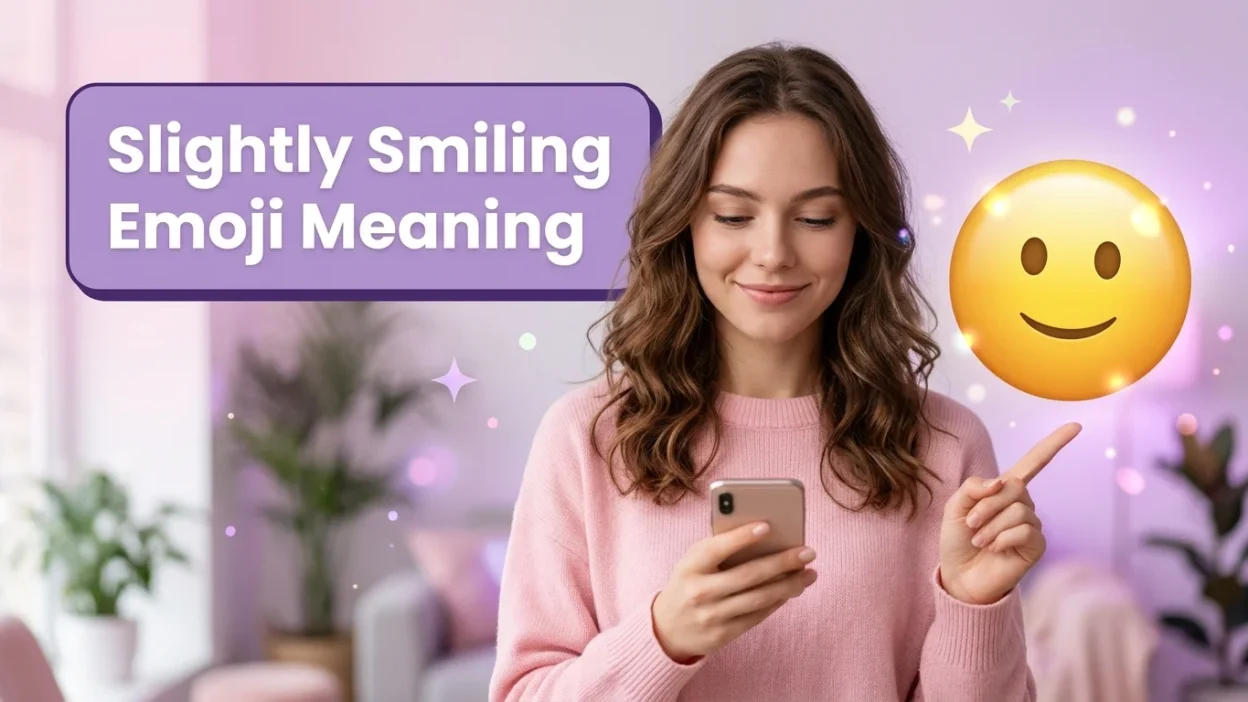
Sometimes a simple smile says more than a thousand words, but it doesn’t always mean someone feels happy. The slightly smiling emoji 🙂 features a small, closed-mouth smile that can express friendliness, politeness, quiet happiness, or subtle sarcasm.
People use it in text messages and social media conversations to acknowledge a message, keep a conversation pleasant, or respond without showing strong emotions.
However, its meaning can change depending on the situation and the relationship between the people chatting. A friend might send 🙂 to show genuine appreciation, while someone else might use it to express awkwardness, disappointment, or passive-aggressive frustration.
Quick Answer: Slightly Smiling Emoji Meaning
The slightly smiling emoji 🙂 usually means a mild smile, friendliness, politeness, calm happiness, or a positive response. Depending on the context, it can also express awkwardness, sarcasm, emotional distance, or restrained frustration.
Example:
“Thanks for helping me 🙂” usually sounds friendly and appreciative.
However, “Okay 🙂” after an argument may sound much less friendly and could suggest annoyance, awkwardness, or passive-aggressive emotion.
What Does “Slightly Smiling Emoji Meaning” Mean?
The slightly smiling emoji 🙂 represents a face with a small, closed-mouth smile. It is designed to communicate a gentle or moderate positive emotion rather than intense excitement.
In simple English, 🙂 can mean “I’m okay,” “That’s nice,” “Thank you,” “I’m being friendly,” or “I’m smiling.” The exact interpretation depends on the message around it.
The emoji is called Slightly Smiling Face in the Unicode emoji standard. It belongs to the familiar group of yellow face emojis that people use to add emotional tone to digital conversations.
The basic meaning of 🙂
At its most straightforward, 🙂 can communicate:
- Mild happiness
- Friendliness
- Politeness
- Contentment
- Appreciation
- Calmness
- Agreement
- A positive attitude
- A gentle response
For example:
“I’m glad you came 🙂”
Here, the emoji probably adds warmth to the sentence.
But the emoji can also be more complicated.
If someone sends:
“Sure 🙂”
after you have had a disagreement, the smile may not represent genuine happiness. It could instead communicate awkwardness, irritation, restraint, or emotional distance.
That is why reading the entire conversation matters more than interpreting the emoji by itself.
What Does 🙂 Mean in Texting?
In texting, 🙂 often softens a message. It can make a short reply feel less cold or formal.
For example:
“Thank you 🙂”
sounds warmer than simply:
“Thank you.”
A person may also use it to show that they are comfortable with what you said.
Common texting meanings of 🙂
Depending on the situation, 🙂 can mean:
“I’m happy.”
The person is genuinely pleased.
“I’m being friendly.”
The emoji makes the message sound warmer.
“That’s okay.”
The sender accepts something without showing strong emotion.
“Thanks.”
It can add warmth to appreciation.
“I don’t want to sound rude.”
Some people use it to soften direct statements.
“I’m hiding how I really feel.”
In tense conversations, it can sometimes mask frustration.
For example:
“You can do whatever you want 🙂”
This sentence could be perfectly calm, but it could also suggest that the person is upset. You need to look at the previous messages to understand which interpretation makes sense.
Slightly Smiling Emoji Meaning in Everyday Conversation
In everyday digital conversation, 🙂 is often used as a simple friendly smile.
Imagine a friend says:
“I finally finished my homework 🙂”
The emoji probably means they feel relieved or pleased.
Another example:
“See you tomorrow 🙂”
Here, the emoji adds friendliness and warmth.
It does not necessarily mean romantic interest. A person can use 🙂 with friends, family members, coworkers, classmates, or strangers.
Why people use 🙂
People often add 🙂 because plain text can feel emotionally flat.
Compare:
“Good job.”
with:
“Good job 🙂”
The second version usually feels a little softer and friendlier.
However, some people use the emoji so frequently that it becomes part of their normal texting style. In that case, you should not automatically attach a deep emotional meaning to it.
Slightly Smiling Emoji Meaning in WhatsApp
On WhatsApp, 🙂 is commonly used to make messages sound friendly, polite, or positive.
For example:
“Okay, I’ll let you know 🙂”
This normally sounds relaxed and friendly.
Someone might also reply:
“No problem 🙂”
to reassure you that they are not upset.
However, WhatsApp conversations can also make 🙂 sound sarcastic because users can see the entire message history.
For example:
“Don’t worry, I’m totally fine 🙂”
If the person has just complained about something, the emoji could indicate that they are not actually fine.
The important clue is the contrast between the words and the emotional situation.
Slightly Smiling Emoji Meaning on Instagram
On Instagram, 🙂 can have several meanings.
Someone may use it in a comment such as:
“This is so cute 🙂”
Here, it probably expresses mild happiness or appreciation.
A person might also reply:
“Thank you 🙂”
to acknowledge a compliment.
In a public comment section, people may choose 🙂 because it is friendly without being overly emotional.
However, context still matters. A comment like:
“Interesting choice 🙂”
could be neutral, playful, or subtly critical depending on what happened before it.
Slightly Smiling Emoji Meaning on Snapchat
On Snapchat, 🙂 can be used casually between friends or in direct messages.
It may show:
- Friendly approval
- A relaxed mood
- Mild happiness
- Appreciation
- A soft response
- Awkwardness
For example:
“That was fun 🙂”
usually suggests that the person enjoyed the experience.
But:
“Okay then 🙂”
may sound more emotionally complicated, especially if the conversation was tense.
Slightly Smiling Emoji Meaning on TikTok
On TikTok, 🙂 can appear in comments, replies, captions, and private messages.
A user might comment:
“I was not ready for that 🙂”
Here, the emoji could add humor or playful awkwardness.
Another example is:
“Well, that happened 🙂”
This could communicate an understated reaction to something surprising or embarrassing.
TikTok conversations often rely heavily on irony and humor, so the emoji may not always represent literal happiness.
Slightly Smiling Emoji Meaning in Gaming
Gamers can use 🙂 in chats to show friendliness, calmness, or playful confidence.
For example:
“Good game 🙂”
usually sounds polite and positive.
But context can completely change the tone:
“You got lucky 🙂”
could be friendly teasing, confidence, or mild sarcasm.
In competitive gaming, players sometimes use ordinary emojis ironically. Therefore, the words, relationship between players, and overall tone matter.
Slightly Smiling Emoji Meaning in Professional Communication
Using 🙂 at work depends on the workplace and the relationship between the people communicating.
A message such as:
“Thanks for the update 🙂”
may sound warm and approachable in a casual workplace.
However, in a highly formal email, an emoji may not always be appropriate. A simple sentence without an emoji may communicate professionalism more clearly.
In workplace chats, 🙂 can be useful when the environment is already informal. Still, avoid relying on emojis to communicate important information or sensitive concerns.
Examples of “Slightly Smiling Emoji Meaning”
Here are several realistic examples showing how 🙂 can change meaning depending on the situation.
Example 1: Genuine Happiness
Sentence:
“I finally got the job 🙂”
Meaning:
The person is happy and wants to share positive news.
Situation:
A friend has just received good news.
Here, 🙂 is most likely a genuine expression of happiness.
Example 2: Appreciation
Sentence:
“Thanks for helping me 🙂”
Meaning:
The sender is grateful and wants to make the message warmer.
Situation:
Someone helped with homework, work, travel, or another task.
The emoji adds friendliness without making the message overly emotional.
Example 3: Polite Agreement
Sentence:
“Okay, I understand 🙂”
Meaning:
The sender is acknowledging what you said in a calm and polite way.
Situation:
You have explained something to the other person.
The emoji helps soften the response.
Example 4: Awkwardness
Sentence:
“Yeah… that was embarrassing 🙂”
Meaning:
The person may be uncomfortable but is trying to laugh it off.
Situation:
Something awkward has happened.
Here, the smile can mean something closer to “Well, that was awkward, but let’s move on.”
Example 5: Possible Sarcasm
Sentence:
“Sure, leave me waiting for an hour 🙂”
Meaning:
The sender is probably unhappy, even though the emoji looks positive.
Situation:
Someone arrived very late.
The words and situation suggest that the smile may be sarcastic.
Example 6: Calm Acceptance
Sentence:
“That’s fine 🙂”
Meaning:
The person may genuinely accept the situation.
Situation:
Someone apologizes for a small mistake.
However, if this appears after a serious argument, it could have a different tone.
Example 7: Friendly Goodbye
Sentence:
“See you tomorrow 🙂”
Meaning:
The person is ending the conversation in a friendly way.
Situation:
Friends, coworkers, or classmates are planning to meet again.
When Do People Use the Slightly Smiling Emoji?
People use 🙂 in many everyday situations because it is emotionally flexible.
To show mild happiness
Someone may use 🙂 when they feel good but do not want to express strong excitement.
“I had a nice day 🙂”
The smile is gentle rather than enthusiastic.
To make a message friendlier
A short sentence can sometimes look serious in text.
“Got it.”
Adding 🙂 can make it feel softer:
“Got it 🙂”
To respond politely
People sometimes use 🙂 when they want to acknowledge someone without creating a long conversation.
“Thanks 🙂”
To soften criticism
Someone might use the emoji to make a direct statement feel less harsh.
“You might want to check that again 🙂”
This can still sound critical, but the emoji attempts to reduce the sharpness.
To hide frustration
This is one of the most confusing uses.
Someone might write:
“No worries 🙂”
while actually feeling annoyed.
The smile can act like an emotional cover.
To express awkward humor
People often use 🙂 after something embarrassing, uncomfortable, or unexpected.
“I accidentally sent the message to the wrong person 🙂”
The emoji suggests, “Well, that was awkward.”
Different Meanings of the Slightly Smiling Emoji
The slightly smiling emoji meaning is not limited to one emotion. Here are some of its most common interpretations.
Mild Happiness
The simplest meaning is quiet or moderate happiness.
Definition:
The person feels good but is not extremely excited.
Context:
Sharing ordinary positive news.
Example:
“Today was actually pretty good 🙂”
Friendliness
🙂 can show that the sender is being warm and approachable.
Definition:
A friendly emotional signal added to a message.
Context:
Talking with friends, classmates, coworkers, or acquaintances.
Example:
“Nice talking to you 🙂”
Politeness
Some people use 🙂 to soften short replies.
Definition:
A way to make a response feel less cold.
Context:
Acknowledging someone or responding briefly.
Example:
“Sure, no problem 🙂”
Calm Acceptance
The emoji can communicate that something is acceptable.
Definition:
A relaxed “okay” feeling.
Context:
Small changes, plans, requests, or apologies.
Example:
“Okay, that works for me 🙂”
Awkwardness
Sometimes the smile is not about happiness at all.
Definition:
A reaction to an uncomfortable or embarrassing situation.
Context:
Something went wrong or feels socially awkward.
Example:
“I forgot her name again 🙂”
Sarcasm
In some conversations, 🙂 can be used ironically.
Definition:
The emoji looks positive while the actual message communicates annoyance or criticism.
Context:
Arguments, disappointments, teasing, or frustrating situations.
Example:
“Great, another meeting 🙂”
The emoji does not prove that the person is being sarcastic. The surrounding conversation determines that.
Emotional Distance
Sometimes 🙂 feels less warm than other smiling emojis.
A person may use it to respond without showing strong emotion.
Example:
“Okay 🙂”
Depending on the relationship, this could simply mean “okay,” or it could suggest that the person does not want to continue the conversation.
Slightly Smiling Emoji Meaning From a Guy
If a guy sends 🙂, it does not automatically mean he likes you romantically.
It may simply mean:
- He is being friendly.
- He is trying to sound polite.
- He is happy about something.
- He wants to soften his message.
- He feels awkward.
- He is responding casually.
- He is teasing you.
- He is hiding irritation.
For example:
“Good morning 🙂”
could be friendly, affectionate, or simply habitual.
If you want to understand whether there is romantic interest, look at the overall communication pattern, not one emoji. Consider the words he uses, how often he starts conversations, and the broader context.
An emoji alone cannot reliably establish someone’s intentions.
Slightly Smiling Emoji Meaning From a Girl
When a girl sends 🙂, it can have the same broad range of meanings.
She may be:
- Being friendly
- Showing mild happiness
- Being polite
- Softening a message
- Responding casually
- Feeling awkward
- Using sarcasm
- Trying not to sound too serious
For example:
“Okay, see you later 🙂”
could simply be a friendly goodbye.
On the other hand:
“Fine 🙂”
after an argument may carry a very different emotional tone.
Again, gender does not give the emoji a fixed meaning. Context matters more than whether the sender is a guy or a girl.
Is the Slightly Smiling Emoji Flirty?
Sometimes 🙂 can appear in a flirtatious conversation, but 🙂 does not inherently mean flirting.
A person could use it while flirting because the emoji creates a soft, warm tone.
For example:
“Maybe I’ll see you there 🙂”
could sound slightly playful in the right conversation.
But the same emoji in:
“Thanks for sending that 🙂”
may simply be polite.
If you are trying to understand whether a message is flirtatious, consider the entire conversation rather than treating 🙂 as a secret romantic code.
Is 🙂 a Positive Emoji?
Yes, 🙂 is generally classified as a positive or smile-related emoji, but its practical meaning can vary.
Its basic design communicates a smile. That is why it often represents friendliness, calm happiness, or politeness.
However, online communication has developed many forms of irony. A positive-looking emoji can sometimes be used with negative or uncomfortable messages.
For example:
“I love being ignored 🙂”
The words suggest frustration, not genuine happiness.
Therefore, the emoji’s basic meaning is positive, but its contextual meaning can be different.
Is 🙂 Sarcastic?
Sometimes, but not always.
The slightly smiling emoji can become sarcastic when it is paired with words that suggest frustration, disappointment, or criticism.
Compare these messages:
“Thanks for helping me 🙂”
This is probably sincere.
Now compare:
“Thanks for replying three days later 🙂”
This may be sarcastic.
The difference comes from the context and the wording, not from the emoji alone.
Signs that 🙂 may be sarcastic
Look for:
- A contradiction between the words and the situation
- A recent argument
- Complaints
- Delayed responses
- Obvious disappointment
- Short, unusually cold replies
- Repeated use after negative statements
Even these signs are not absolute proof. The safest approach is to consider the whole conversation.
Is 🙂 a Happy Emoji?
Yes, but it usually represents mild happiness rather than intense excitement.
Compare:
🙂 — mild happiness or friendliness
😊 — warm happiness or affection
😄 — strong happiness
😁 — big grin or enthusiastic happiness
😂 — strong amusement or laughter
😍 — admiration, attraction, or love
These meanings overlap, but the emotional intensity can feel different.
That is why someone who sends 🙂 may be happy without being extremely excited.
Slightly Smiling Emoji vs Smiling Face 😊
The difference between 🙂 and 😊 can be subtle.
🙂 Slightly Smiling Face often feels more neutral, restrained, or understated.
😊 Smiling Face with Smiling Eyes usually feels warmer, more openly cheerful, and more emotionally expressive.
For example:
“Thank you 🙂”
can sound polite and calm.
“Thank you 😊”
often sounds warmer or more affectionate.
Neither interpretation is guaranteed because personal texting habits vary.
Slightly Smiling Emoji vs Grinning Face 😀
The 😀 Grinning Face usually communicates more obvious happiness or excitement.
🙂 is more restrained.
For example:
“I passed the test 🙂”
sounds calmly pleased.
“I passed the test 😀”
sounds much more excited.
The choice often depends on how strongly the sender wants to express emotion.
Slightly Smiling Emoji vs Upside-Down Face 🙃
These emojis can sometimes overlap in sarcastic or awkward conversations.
🙂 generally starts with a normal smile.
🙃 can more strongly suggest irony, awkwardness, silliness, or “everything is fine” when it clearly is not.
For example:
“I have another exam tomorrow 🙂”
could simply express calmness.
“I have another exam tomorrow 🙃”
may more strongly communicate frustration or ironic humor.
Origin of the Slightly Smiling Emoji
The 🙂 emoji comes from the development of digital character encoding and Unicode emoji standards.
The symbol was included in Unicode’s standardized emoji repertoire as Slightly Smiling Face. Unicode gives emoji characters standardized names and code points so that different digital systems can represent them consistently.
Emoji themselves developed from earlier emoticons such as 🙂 and from Japanese mobile-phone emoji culture. Over time, emoji became a global form of digital communication.
The modern 🙂 is therefore part of a much larger history of using simple visual symbols to add emotion to text.
Why its meaning has changed
Emoji meanings are not completely controlled by their official names.
A character may have an official name describing its appearance, while users develop additional meanings through internet culture.
That is particularly noticeable with 🙂. Although its basic design is a slight smile, people sometimes use it to communicate:
- Awkwardness
- Irony
- Restraint
- Passive-aggressive emotion
- Emotional distance
These meanings developed through actual online communication rather than from the emoji’s name alone.
Similar Words and Alternatives
Several emojis and expressions can communicate ideas similar to 🙂.
😊 Smiling Face with Smiling Eyes
This often feels warmer and more openly happy.
Example:
“Thank you 😊”
It can express genuine appreciation or affection.
😌 Relieved Face
This is more connected with relief, peace, or relaxation.
Example:
“Everything worked out 😌”
😄 Grinning Face with Smiling Eyes
This communicates stronger happiness.
Example:
“We won! 😄”
😀 Grinning Face
This usually expresses broad, obvious happiness.
Example:
“Good morning! 😀”
🙃 Upside-Down Face
This can communicate irony, silliness, awkwardness, or a jokingly negative reaction.
Example:
“Another Monday 🙃”
“Okay”
Sometimes the closest alternative to 🙂 is simply okay.
However, adding 🙂 can make “okay” sound softer, friendlier, or occasionally more complicated depending on the situation.
“No problem”
This phrase can communicate acceptance or reassurance.
“No problem 🙂”
The emoji adds a friendly emotional layer.
Common Mistakes With the Slightly Smiling Emoji
Understanding 🙂 becomes easier when you avoid a few common mistakes.
Mistake 1: Assuming 🙂 always means happiness
The emoji has a positive design, but it does not always communicate genuine happiness.
Better approach:
Read the surrounding message and previous conversation.
Mistake 2: Assuming 🙂 always means sarcasm
The opposite mistake is also common.
Some people genuinely use 🙂 as a normal smile.
Better approach:
Do not assume sarcasm without contextual evidence.
Mistake 3: Thinking 🙂 always means flirting
A smile does not automatically signal romantic interest.
Better approach:
Look at the entire conversation and relationship.
Mistake 4: Reading too much into one emoji
One symbol rarely provides enough information to understand someone’s feelings.
Better approach:
Consider their words, behavior, communication style, and situation.
Mistake 5: Ignoring personal texting habits
Some people use 🙂 in almost every conversation.
For them, it may have little special meaning.
Others use it only in emotionally complicated situations.
Better approach:
Pay attention to how that particular person normally uses emojis.
Mistake 6: Treating emoji meanings as universal
Emoji interpretation can vary between people, age groups, cultures, platforms, and online communities.
Better approach:
Use the common meaning as a starting point, not an absolute rule.
How to Understand 🙂 From Context
If someone sends you 🙂 and you are unsure what they mean, ask yourself a few questions.
What did they say?
Look at the actual words.
“That sounds great 🙂”
is generally positive.
“Whatever you want 🙂”
may be more ambiguous.
What happened before?
A previous argument can change the meaning.
“Fine 🙂”
after a friendly discussion may be harmless.
The same words after an argument may sound irritated.
How does this person normally text?
If they use 🙂 frequently, it may simply be their normal style.
If they suddenly use it after never using it before, the change may be worth considering.
What is your relationship?
A close friend may use 🙂 playfully.
A coworker may use it simply to sound polite.
A stranger may use it to make a short message friendlier.
Frequently Asked Questions
What does the 🙂 emoji mean?
The 🙂 emoji usually means a slight smile, mild happiness, friendliness, politeness, or calm positivity. Depending on context, it can also communicate awkwardness, sarcasm, or emotional distance.
What does 🙂 mean from a guy?
From a guy, 🙂 can mean friendliness, mild happiness, politeness, appreciation, awkwardness, or sarcasm. It does not automatically mean romantic interest.
What does 🙂 mean from a girl?
From a girl, 🙂 can communicate friendliness, politeness, happiness, calmness, awkwardness, or sarcasm. Its meaning depends on the conversation rather than the sender’s gender.
Is 🙂 a flirty emoji?
Not necessarily. 🙂 can appear in flirtatious conversations, but it is also commonly used between friends, coworkers, family members, and acquaintances.
Is 🙂 a sarcastic emoji?
It can be sarcastic, especially when the words conflict with the smile. For example, “Thanks for waiting for me 🙂” could sound sarcastic if someone has been waiting for a long time.
What is the difference between 🙂 and 😊?
🙂 usually feels more restrained, neutral, or mildly positive. 😊 often feels warmer, happier, and more emotionally expressive.
Why does 🙂 sometimes feel passive-aggressive?
Because people sometimes use a pleasant-looking emoji with words that express frustration or disagreement. In those situations, the smile can create an ironic contrast. However, 🙂 is not automatically passive-aggressive.
Conclusion
The slightly smiling emoji meaning is usually a mild smile, friendliness, politeness, calm happiness, or a positive response. The emoji 🙂 is often less expressive than 😄 or 😁, which makes it useful when someone wants to keep their reaction subtle.
However, 🙂 can have different meanings depending on the conversation. It may communicate genuine happiness in one message but awkwardness, irony, sarcasm, or hidden frustration in another. The words around the emoji, the relationship between the people, and the sender’s usual texting style all provide important clues.
Suggested Internal Links
For a strong internal-linking structure, consider linking this article to related topics such as:
- What Does 😊 Mean?
- What Does 😄 Mean?
- What Does 😌 Mean?
- What Does 🙃 Mean?
- Smiling Face Emoji Meaning
- Emoji Meanings in Texting
- Emoji Meaning From a Guy
- Emoji Meaning From a Girl
- What Does ❤️ Mean in Texting?
- What Does 🥰 Mean in Texting?
Suggested External Authority Sources
For factual background about emoji names, Unicode standards, and emoji terminology, consider referencing authoritative sources such as Unicode’s official emoji documentation and the Emojipedia reference for individual emoji meanings. These can strengthen the article’s E-E-A-T signals when used for factual claims about standardized emoji names and history.