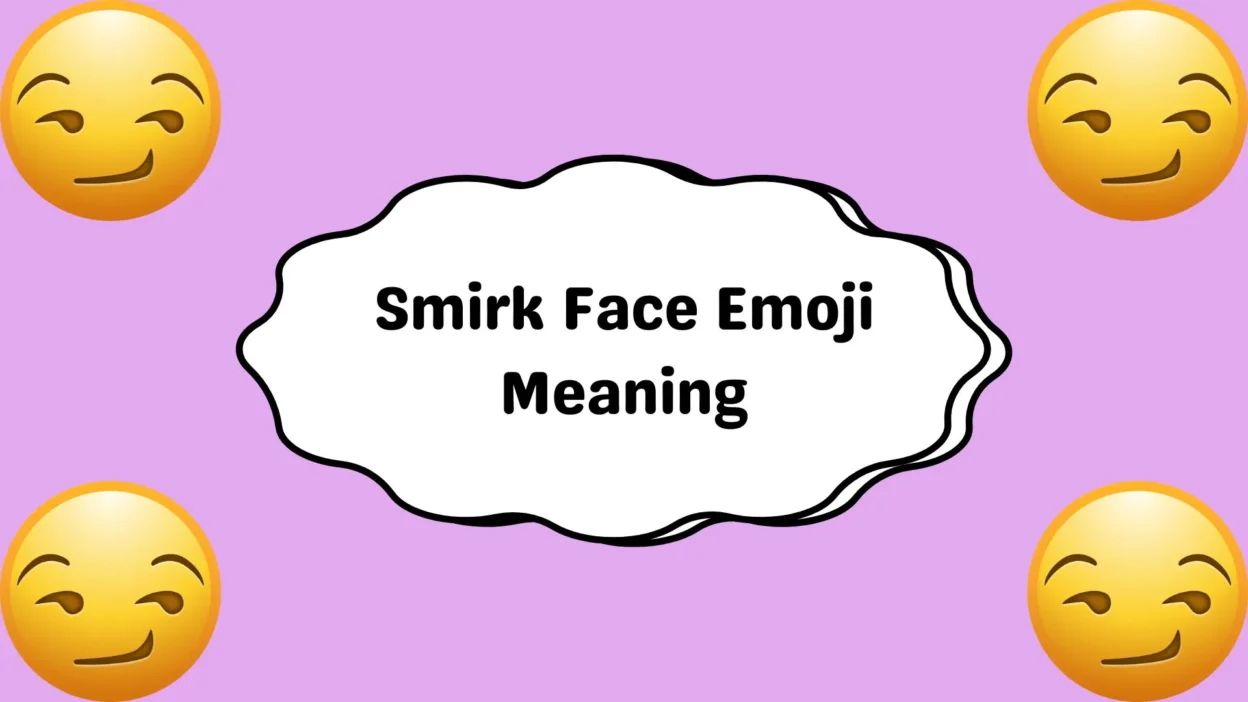
Have you ever received a 😏 emoji and wondered, “Wait… what does that actually mean?” The smirk face emoji meaning can be surprisingly different depending on the conversation, relationship, and tone behind the message.
At first glance, 😏 may look like a simple confident smile, but it can express several emotionsfrom playful teasing and confidence to flirting, sarcasm, or even a little mischief.
That is why understanding the context is important before assuming what someone means.
Meaning & Definition
The smirk face emoji (😏) is officially called “Smirking Face” in the Unicode emoji standard. Its core meaning revolves around suggestive, sly, or self-satisfied energy , think a raised eyebrow paired with a half-smile. It’s the emoji version of someone who knows something you don’t, or who’s teasing you just enough to make you wonder.
Primary meaning: flirtation, playful teasing, or subtle confidence. Secondary/alternative meanings: sarcasm, smugness, mild superiority, or innuendo depending on context.
Example messages:
- “I might have a surprise for you tonight 😏”
- “Guess who got the promotion 😏”
In both cases, the emoji does the emotional heavy lifting , it tells the reader “there’s more to this than the words alone.”
Background & Origin
The smirking face emoji was introduced in Unicode 6.0 (2010) as part of the original wave of emoji standardized for global use, later gaining widespread visibility once Apple and Android rolled out full emoji keyboards around 2011–2013. Its design , asymmetrical mouth, closed or slightly raised eyes , was intentionally built to look different from a standard smile, signaling intent rather than pure happiness.
As texting culture and social media matured, users repurposed the emoji far beyond its literal “smirk” definition. It became shorthand for flirtation in DMs, sarcasm in group chats, and even a meme staple representing “shady” or “knowing” energy. Its popularity grew alongside dating apps and casual online chat culture, where tone is hard to convey through text alone.
Usage in Different Contexts
Texting or chat messages Used to add a flirty or teasing undertone to an otherwise plain sentence.
“You looked good today 😏”
Social media platforms Common in captions, comments, and reactions to imply confidence or a private joke.
Caption: “New haircut, new me 😏”
Professional or technical settings Rarely used professionally due to its flirtatious/sarcastic connotation , generally avoided in workplace chat tools like Slack or email, though occasionally used informally between close coworkers to imply playful confidence about an achievement.
“Finished the project early 😏” (casual team chat only)
Platform-Specific Meanings
| Platform | Common Meaning | Example Use |
| Flirty or teasing tone in personal chats | “Can’t wait to see you 😏” | |
| Confidence, sass, or a “secret” implied in captions/comments | “Guess where I am 😏” | |
| TikTok | Sarcastic or cheeky reaction to a video | Comment: “This you? 😏” |
| Snapchat | Suggestive or playful undertone, often paired with photos | “Wait till you see this 😏” |
| Twitter/X | Smug or sarcastic commentary on news/trends | “Told you so 😏” |
Other Fields Using the Symbol
Outside of casual texting, the smirk face doesn’t have major technical or official-document usage (unlike text abbreviations such as DL), but it does appear in a few adjacent contexts:
- Marketing & branding: used in social copy to add a playful, confident brand voice.
- Meme culture: frequently paired with “side-eye” or “I know something” jokes.
- Customer service chats: occasionally used informally by brands with a cheeky tone of voice.
Common Misconceptions & Mistakes
A common mix-up is confusing the smirk face with the standard grinning face 😁 or the smiling face with smiling eyes 😊 , these convey genuine happiness, not teasing or innuendo. Sending 😏 when you mean simple friendliness can unintentionally come across as flirty or sarcastic.
Another pitfall: assuming intent based on the emoji alone. Because 😏 is so context-dependent, the same emoji from a friend might mean playful sarcasm, while from a crush it might read as flirtation , misreading this can lead to awkward or confusing conversations.
Similar Terms & Alternatives
| Emoji/Term | Meaning | Example Use |
| 😉 Winking Face | Playful, lighthearted flirt or joke | “Nice try 😉” |
| 😈 Smiling Devil | Mischievous or cheeky intent | “I have a plan 😈” |
| 🙃 Upside-Down Face | Sarcasm or irony | “Sure, that’ll work 🙃” |
| 😌 Relieved Face | Quiet satisfaction, less flirtatious | “Finally done 😌” |
How to Respond , Chat Examples
With a friend:
Friend: “Guess who just got tickets to the show 😏” You: “No way, spill everything!”
With a crush:
Crush: “You looked really good today 😏” You: “Oh really? Tell me more 😊”
With a colleague:
Colleague: “I might have already fixed that bug 😏” You: “Nice work , details please!”
Differences from Similar Words
Unlike words such as Secret, Private, or Confidential , which imply information is deliberately withheld , the smirk face emoji doesn’t hide information so much as hint at it. It’s about tone and implication rather than actual secrecy. Where “confidential” signals formal restriction, 😏 signals informal, playful suggestion.
Relevance in Online Conversations & Dating Apps
On dating apps, the smirk face emoji is one of the most-used flirtation signals precisely because it lets users test the waters without saying anything explicit. A simple “Hey 😏” can imply interest while keeping things light and low-pressure.
Example:
“So… are we still on for Friday? 😏”
This kind of subtle cue is common in early-stage dating conversations, where tone matters more than words.
Popularity & Trends Over Time
Search interest and usage of the smirk face emoji have remained consistently high since its emoji-keyboard debut, with regular spikes tied to dating app growth, meme trends, and viral social media challenges. It routinely ranks among the most-used “suggestive” emojis on platforms like Instagram and Twitter/X, and continues to appear in pop culture references and reaction memes.
FAQs
1. What does the smirk face emoji mean from a guy? It often signals flirtation, confidence, or playful teasing , context with the rest of the message matters.
2. Is the smirk face emoji flirty? Yes, it’s commonly used to add a flirty or suggestive tone, though it can also mean sarcasm or smugness depending on the conversation.
3. What’s the difference between 😏 and 😉? 😏 tends to feel more suggestive or sly, while 😉 (winking face) feels lighter and more purely playful.
4. Should I use the smirk face emoji at work? It’s best avoided in formal or professional messages, as it can be misread as flirtatious or sarcastic.
5. Why do people use the smirk face emoji on dating apps? It allows users to express interest or playfulness without being overly direct, keeping the conversation light.
Conclusion
The smirk face emoji 😏 is a small symbol with a lot riding on context , flirty in a dating chat, sarcastic in a group thread, or confidently smug in a caption.
Its meaning shifts with the platform, the relationship, and the words around it, which is exactly what makes it so widely used and so often misunderstood. Next time you see it pop up in your messages, take a second to read the full context before deciding what it really means.