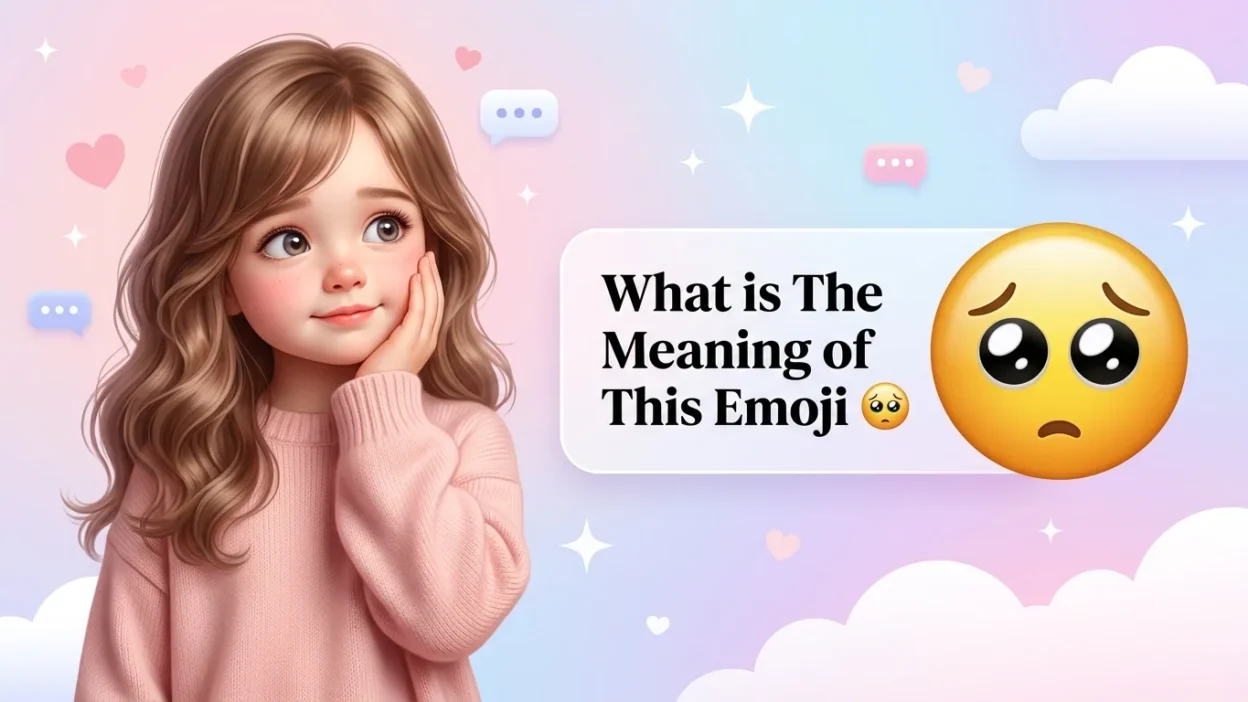
When you see the 🥺 emoji, it often feels soft, emotional, and slightly vulnerable. This emoji is commonly called the pleading face emoji, and people use it to express sadness, affection, innocence, sympathy, shyness, or a strong request. Its exact meaning depends on the conversation and the relationship between the people using it.
The meaning of this emoji 🥺 can be especially interesting in texting. Someone may send it when they want a favor, feel emotionally touched, or are trying to look cute while asking for something. It can also show that a person feels hurt, disappointed, or emotionally overwhelmed. In romantic conversations, 🥺 may add a sweet or affectionate tone to a message.
If you’re searching for what 🥺 means in texting, the surrounding words usually provide the clearest clue. In this guide, we’ll explore the 🥺 emoji meaning, its common uses, emotional interpretations, and examples in friendship, relationships, and everyday chats.
Quick Answer
The 🥺 emoji means pleading, begging, wanting something, or asking for sympathy. It can also express cuteness, affection, shyness, vulnerability, or being emotionally touched. Its exact meaning depends on the message and context.
For example:
“Can you stay a little longer? 🥺”
Here, 🥺 makes the request sound sweet, emotional, and pleading.
“You actually remembered my birthday 🥺”
Here, it can express being touched, emotional, or pleasantly overwhelmed.
What Does “what is the meaning of this emoji 🥺” Mean?
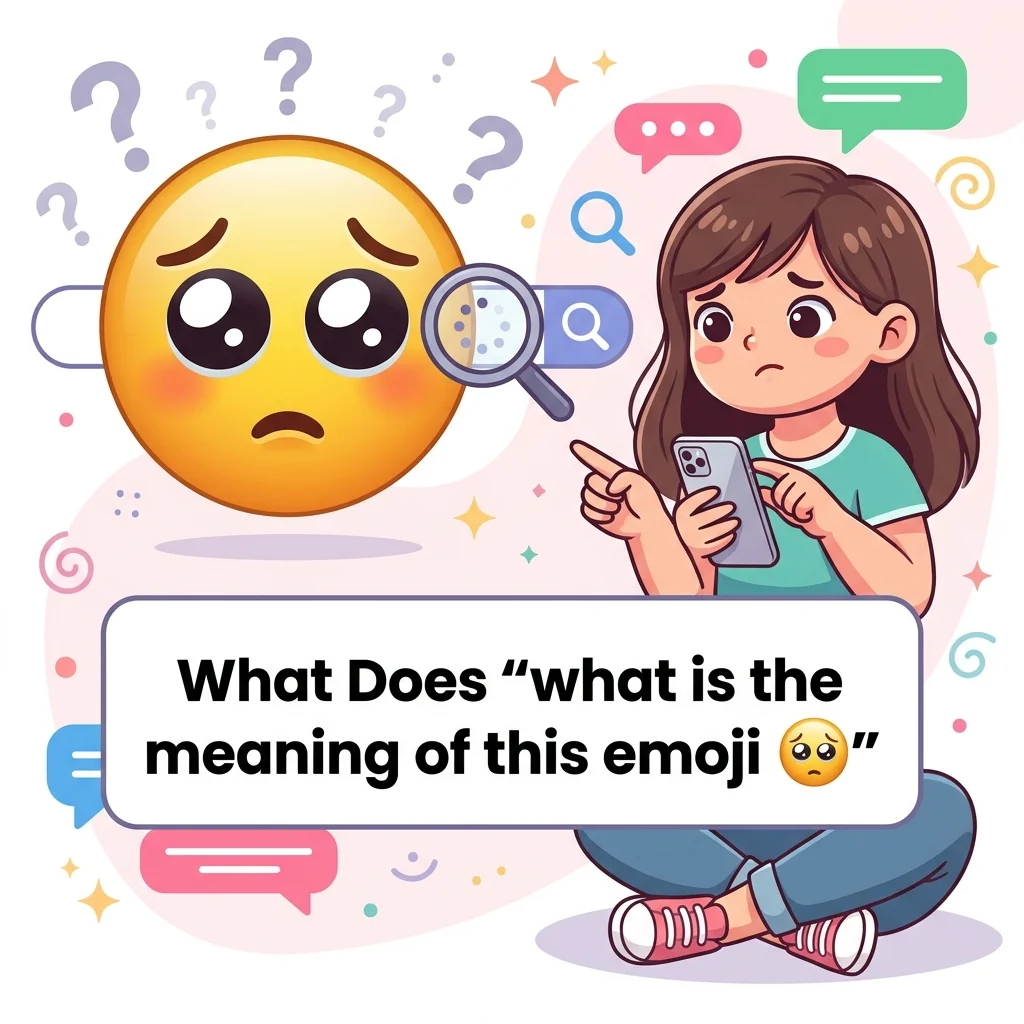
The 🥺 emoji, officially known as Pleading Face, is generally used to show that someone is pleading, begging, asking nicely, feeling vulnerable, or trying to appear cute. Unicode’s emoji data associates it with ideas such as begging, mercy, pleading, and “puppy eyes.” (
The simplest way to understand 🥺 is to imagine someone looking at you with big, innocent eyes while saying, “Please?”
For example:
“Please don’t leave yet 🥺”
The emoji makes the sentence feel softer and more emotional. Without it, the message could sound direct. With 🥺, the sender may sound sweet, needy, playful, or emotionally vulnerable.
The literal visual meaning
The face itself does not have a literal dictionary meaning like a normal word. Instead, its facial expression communicates an emotion.
It has:
- Large, puppy-like eyes
- Raised or furrowed eyebrows
- A small frowning mouth
- A soft, vulnerable expression
Together, these features create the familiar “puppy eyes” effect.
That is why 🥺 is often connected with begging, cuteness, affection, and emotional vulnerability. Emojipedia describes it as a face that can appear to be begging, pleading, or yearning, while also noting that it may express adoration or feeling touched by a loving gesture.
The most common meaning
In everyday texting, 🥺 most often means something like:
“Please.”
“I really want this.”
“Don’t say no.”
“I’m asking nicely.”
“Aww, that’s so sweet.”
“I’m feeling a little emotional.”
However, the exact interpretation depends heavily on what comes before or after the emoji.
Meaning in Different Contexts
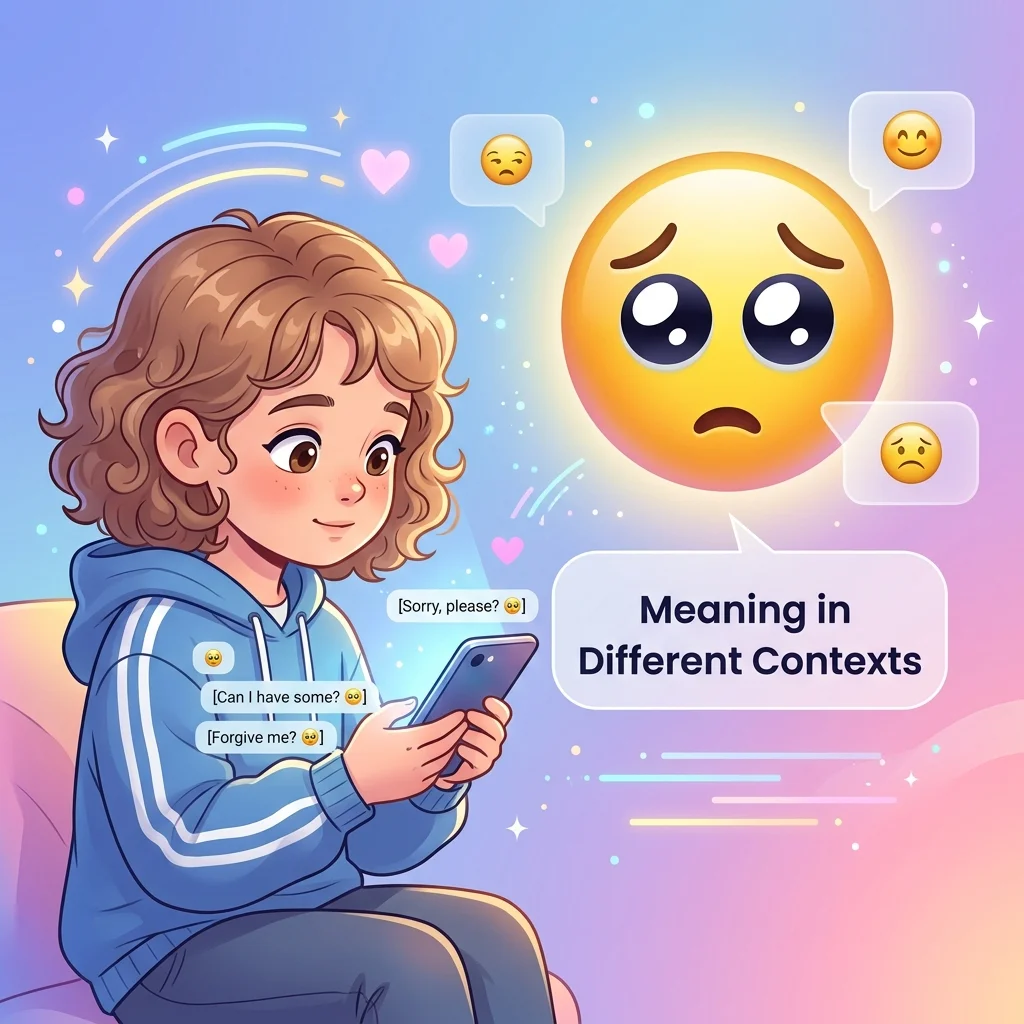
The meaning of 🥺 can change significantly depending on where and how someone uses it. The same emoji can be playful in one message and genuinely emotional in another.
Everyday Conversation
In everyday conversation, 🥺 often makes a request sound softer.
For example:
“Can you help me with this? 🥺”
The sender probably wants help and is making the request in a cute or slightly pleading way.
It can also show vulnerability:
“I just need a hug 🥺”
Here, the emoji suggests that the person may be feeling emotionally sensitive or wants comfort.
Text Messages
In text messages, 🥺 is especially common when someone wants something.
“Can we get pizza tonight? 🥺”
This does not necessarily mean the person is seriously begging. It may simply make the request sound playful and cute.
You may also see:
“Please text me when you get home 🥺”
In this case, 🥺 can make the request feel caring and emotionally warm.
Social Media
On social media, 🥺 can express admiration, affection, cuteness, or emotional reactions.
For example:
“This puppy is too cute 🥺”
Here, the emoji means something close to “This is unbelievably adorable.”
Someone might also comment:
“You look so beautiful 🥺”
That could express genuine admiration or affectionate appreciation.
On WhatsApp, 🥺 is frequently used in personal conversations.
It can appear when someone asks for a favor:
“Can you pick me up? 🥺”
It can also appear during an emotional conversation:
“I miss you so much 🥺”
The emoji adds vulnerability to the sentence.
Snapchat
On Snapchat, 🥺 may appear in captions, snaps, or private chats.
For example:
“Don’t ignore me 🥺”
The sender could be joking, flirting, or genuinely asking for attention.
Because Snapchat conversations are often casual, the surrounding message is important.
On Instagram, people often use 🥺 in comments to show that something is cute, beautiful, touching, or emotionally powerful.
For example:
“Stop, this is too cute 🥺”
The meaning is not necessarily sadness. Instead, it may communicate adoration or being emotionally overwhelmed by something cute.
TikTok
TikTok has helped popularize many expressive emoji combinations, including 🥺👉👈.
The combination 🥺👉👈 is often associated with a shy, bashful, nervous, or cute pose. Emojipedia notes this particular use in connection with a shy or bashful expression, especially on TikTok.
For example:
“Can I have some? 🥺👉👈”
The combination makes the request sound intentionally shy and cute.
Gaming
In gaming chats, 🥺 can make requests playful.
For example:
“Let me join your team 🥺”
Or:
“Please don’t eliminate me 🥺”
The person may be jokingly acting helpless or innocent.
It can also be used after losing:
“I was so close 🥺”
Here, it expresses disappointment in a lighthearted way.
Professional Communication
Using 🥺 in professional communication is usually less appropriate.
For example:
“Can you approve my request? 🥺”
This might sound overly emotional or informal in a workplace.
For professional messages, clearer wording is normally better:
“Could you please approve my request when you have a moment?”
The emoji works best in casual, friendly, personal, or informal conversations.
Internet Slang
🥺 is not technically an abbreviation or slang word. It is an emoji.
However, internet culture has given it several informal uses. People may use it to communicate:
- “Please”
- “I want it”
- “Don’t say no”
- “That’s so cute”
- “I’m shy”
- “I’m touched”
- “I miss you”
- “I’m emotionally vulnerable”
The meaning comes from the visual expression and the context rather than from a fixed slang definition.
Examples of “what is the meaning of this emoji 🥺”
Seeing real examples makes the meaning much easier to understand. Here are several common situations.
Example 1: Asking for a Favor
Sentence:
“Can you give me a ride home? 🥺”
Meaning:
The person is asking for a favor and making the request sound sweet or pleading.
Situation:
A friend needs a ride and wants to make the request feel less demanding.
Example 2: Asking Someone to Stay
Sentence:
“Please don’t go yet 🥺”
Meaning:
The sender wants the other person to stay and is expressing emotional attachment.
Situation:
The conversation is ending, but the sender wants more time together.
Example 3: Showing Cuteness
Sentence:
“Look at this little puppy 🥺”
Meaning:
The person thinks the puppy is extremely cute.
Situation:
Someone shares an adorable animal photo or video.
Here, 🥺 is not really about begging. It is expressing adoration and emotional delight.
Example 4: Feeling Touched
Sentence:
“You remembered my favorite song 🥺”
Meaning:
The sender feels touched, appreciated, or emotionally moved.
Situation:
Someone remembers a small personal detail, and the receiver responds emotionally.
Example 5: Wanting Something
Sentence:
“I really want that hoodie 🥺”
Meaning:
The person strongly wants the hoodie and may be hoping someone will buy it or give it to them.
Situation:
A friend is shopping or discussing something the sender likes.
Example 6: Being Shy
Sentence:
“You really think I look good? 🥺”
Meaning:
The sender may feel shy, flattered, or pleasantly embarrassed.
Situation:
Someone receives a compliment and responds in a soft or bashful way.
Example 7: Missing Someone
Sentence:
“I miss you so much 🥺”
Meaning:
The sender is expressing emotional longing or affection.
Situation:
Two people are separated and one wants to communicate that they miss the other person.
Example 8: Playful Begging
Sentence:
“Just one more episode, please 🥺”
Meaning:
The person is playfully begging for permission to continue watching.
Situation:
Someone is watching a show with a friend or partner.
When Do People Use “what is the meaning of this emoji 🥺”?
People generally use 🥺 when they want to add emotion, softness, vulnerability, or cuteness to a message.
When asking for something
This is probably one of the most recognizable uses.
“Can I have one too? 🥺”
The emoji can make the request sound less demanding.
When feeling vulnerable
Someone may use 🥺 when they want emotional support.
“I just want someone to understand me 🥺”
Here, it suggests vulnerability rather than simple begging.
When reacting to something cute
“That kitten is adorable 🥺”
The emoji expresses affection and emotional reaction.
When someone does something sweet
“You saved one for me? 🥺”
The person may be surprised and touched by the thoughtful action.
When flirting
🥺 can sometimes have a flirty meaning, especially between people who already have a romantic or playful relationship.
For example:
“You really want to see me? 🥺”
Depending on the conversation, this can sound shy and flirtatious.
However, 🥺 by itself does not prove romantic interest. Context and the relationship between the people matter.
Appropriate situations
🥺 is generally suitable for:
- Friends
- Family
- Romantic partners
- Casual conversations
- Social media
- Informal chats
- Playful requests
- Cute reactions
Less appropriate situations
Be more careful using it in:
- Formal emails
- Job applications
- Business proposals
- Academic writing
- Official requests
- Serious professional discussions
The emoji can make a formal message sound too casual or emotionally persuasive.
Different Meanings of “what is the meaning of this emoji 🥺”
Although 🥺 has an official name, people use it in several different ways online.
🥺 Meaning 1: Pleading or Begging
This is the most direct interpretation.
Definition:
The sender is asking for something and wants you to say yes.
Context:
Requests, favors, permission, or negotiations.
Example:
“Please let me come with you 🥺”
The emoji adds a begging or pleading tone.
🥺 Meaning 2: Cuteness
Sometimes 🥺 means “That’s so cute.”
Definition:
The sender feels emotionally affected by something adorable.
Context:
Animals, babies, romantic gestures, sweet messages, or cute videos.
Example:
“Look at your cat 🥺”
This does not necessarily mean the sender wants anything.
🥺 Meaning 3: Shyness
The emoji can represent someone feeling shy or bashful.
Definition:
The sender feels embarrassed, nervous, or hesitant in a cute way.
Context:
Compliments, flirting, romantic conversations, or personal questions.
Example:
“You really like my outfit? 🥺”
The person may be feeling shy because of the compliment.
🥺 Meaning 4: Affection
🥺 can communicate warmth and affection.
Definition:
The sender feels emotionally close to someone or something.
Context:
Romantic messages, friendship, family, pets, and sweet moments.
Example:
“You’re always there for me 🥺”
Here, the emoji can show appreciation and affection.
🥺 Meaning 5: Emotional or Touched
The emoji may indicate that something has touched the sender emotionally.
Definition:
The person feels moved, grateful, or emotionally overwhelmed.
Context:
Compliments, thoughtful gifts, kind actions, memories, and emotional conversations.
Example:
“You remembered that after all these years 🥺”
This suggests the person feels genuinely touched.
🥺 Meaning 6: Disappointment
Sometimes 🥺 expresses mild disappointment.
Definition:
The sender is unhappy about something but is not necessarily seriously upset.
Context:
Plans being canceled, being rejected, losing a game, or not getting what they wanted.
Example:
“You can’t come tonight? 🥺”
The emoji adds a feeling of disappointment.
🥺 Meaning 7: Wanting Attention
A person may use 🥺 when they want someone to notice them or respond.
Definition:
The sender is indirectly asking for attention or affection.
Context:
Romantic chats, friendships, or playful conversations.
Example:
“You haven’t replied all day 🥺”
This may mean, “Please give me some attention.”
What Does 🥺 Mean From a Guy?
When a guy sends 🥺, the emoji can mean different things depending on the conversation.
He might be:
- Asking for something
- Trying to sound cute
- Feeling shy
- Showing affection
- Expressing disappointment
- Flirting
- Asking for sympathy
- Being playful
For example:
“Can I see you tonight? 🥺”
This could be a sweet or flirtatious request.
But:
“Please send me the notes 🥺”
is more likely a simple request for help.
So, 🥺 from a guy does not automatically mean he is flirting. Look at the words, relationship, and conversation around the emoji.
What Does 🥺 Mean From a Girl?
When a girl uses 🥺, it can also have many meanings.
She may be:
- Asking nicely
- Feeling shy
- Being playful
- Showing affection
- Feeling emotional
- Reacting to something cute
- Expressing disappointment
- Flirting
For example:
“You actually bought it for me? 🥺”
This could express surprise and appreciation.
Meanwhile:
“Can we watch another movie? 🥺”
is probably a playful request.
The emoji itself does not establish a specific romantic meaning.
What Does 🥺 Mean From Your Crush?
If your crush sends 🥺, it can feel difficult to interpret because the emoji often appears in affectionate and playful conversations.
For example:
“I wish you were here 🥺”
could express genuine longing.
But:
“Can you send me that picture? 🥺”
could simply be a cute request.
If the conversation already contains flirting, compliments, romantic language, or affectionate messages, 🥺 may add a shy or flirtatious tone.
Still, one emoji is not enough to determine someone’s feelings. Consider the complete conversation instead.
What Does 🥺👉👈 Mean?
The combination 🥺👉👈 usually creates an extra-shy, bashful, or cute expression.
The pointing hands can visually suggest someone nervously playing with their fingers while looking shy.
For example:
“Can I have some? 🥺👉👈”
This often means:
“Please? I’m asking in a cute and shy way.”
The combination became especially recognizable through online youth culture and social platforms. Emojipedia specifically notes its use for a bashful or shy pose, particularly on TikTok.
It can be sincere, playful, ironic, or flirtatious depending on the conversation.
What Does 🥺 Mean in Love?
In romantic conversations, 🥺 can communicate several feelings.
It may mean:
“I miss you.”
“I want to be with you.”
“Please stay.”
“You’re so sweet.”
“I’m feeling shy.”
“I really want your attention.”
For example:
“I wish you were here with me 🥺❤️”
The combination of 🥺 and ❤️ makes the affectionate tone clearer.
However, 🥺 alone does not necessarily mean love. People also use it with friends, family, pets, and even humorous situations.
What Does 🥺 Mean in Texting From a Girl or Guy?
In texting, the meaning usually comes from the sentence surrounding the emoji.
| Message | Likely meaning of 🥺 |
| “Please stay 🥺” | Pleading |
| “That’s so cute 🥺” | Adoration |
| “I miss you 🥺” | Longing |
| “You remembered? 🥺” | Feeling touched |
| “Can I have one? 🥺” | Asking sweetly |
| “Don’t be mad 🥺” | Seeking forgiveness |
| “You look amazing 🥺” | Admiration |
| “I lost again 🥺” | Mild disappointment |
This is why context matters more than trying to assign one permanent definition to the emoji.
Origin of the 🥺 Emoji
The emoji has a relatively recent history compared with older text emoticons such as 🙂 or :(. Unicode identifies 🥺 as U+1F97A and lists its Unicode name as “Face With Pleading Eyes.” (
It was approved as part of Unicode 11.0 in 2018 and included in Emoji 11.0 that same year. Unicode’s emoji release data gives the short name “pleading face” and related keywords including begging, mercy, pleading, and puppy eyes. (
The design was created to visually represent a pleading facial expression. The large eyes are particularly important because they resemble the expression people often call “puppy eyes.”
As smartphones and social platforms made emojis a major part of online communication, expressive emojis such as 🥺 became useful for communicating feelings that can be difficult to show through plain text.
Emojipedia reports that Pleading Face was approved in early 2018 and became available on a majority of phones later that year. It also describes the emoji’s uses beyond begging, including adoration and feeling touched by a loving gesture.
So, there is no evidence that 🥺 began as a particular internet slang word. Its official history starts as a Unicode emoji, while many of its modern social meanings developed through everyday online use.
🥺 vs 🥹: What Is the Difference?
These two emojis are easy to confuse.
🥺 Pleading Face generally has a stronger connection to begging, pleading, puppy eyes, cuteness, and vulnerability.
🥹 Face Holding Back Tears is more closely associated with tears, gratitude, admiration, emotional happiness, and being deeply touched.
For example:
“Please let me go with you 🥺”
This is a request.
But:
“I can’t believe you did that for me 🥹”
This sounds more emotionally touched.
Unicode currently lists 🥺 as pleading face and 🥹 as face holding back tears, giving them distinct official names. (
Similar Words and Alternatives
Several words and emojis can communicate feelings similar to 🥺, but they are not exact replacements.
“Please”
Please is the clearest alternative when 🥺 is being used to make a request.
The word is direct, while 🥺 adds an emotional or cute tone.
“Begging”
Begging is closer to the pleading side of 🥺.
“I’m begging you.”
However, 🥺 often makes the situation less serious and more playful.
“Aww”
Aww can be similar when 🥺 expresses cuteness or affection.
“I miss you”
When 🥺 is used to show longing, “I miss you” may express the same basic feeling more directly.
“So cute”
When 🥺 reacts to something adorable, “so cute” can be a natural text alternative.
“🥹”
This emoji is a close alternative when the main feeling is emotional gratitude or being touched.
“😔”
This emoji is more directly associated with sadness or disappointment. It does not usually carry the same cute or pleading quality as 🥺.
“😭”
😭 generally communicates much stronger crying or emotional intensity. 🥺 is often softer and more vulnerable.
Common Mistakes
Understanding 🥺 becomes easier when you avoid a few common mistakes.
Mistake 1: Assuming 🥺 always means sadness
🥺 can look sad, but sadness is not its only meaning.
It may show cuteness, pleading, affection, shyness, gratitude, or vulnerability.
For example:
“This kitten is adorable 🥺”
The person is probably not sad.
Mistake 2: Assuming it always means flirting
🥺 can be flirtatious, but it is not automatically romantic.
A friend might write:
“Please bring me some fries 🥺”
That does not necessarily contain romantic interest.
Mistake 3: Treating it like a fixed slang abbreviation
🥺 does not stand for a particular phrase in the way “LOL” stands for “laughing out loud.”
Its meaning changes according to context.
Mistake 4: Ignoring the words around it
Consider these two messages:
“Please don’t leave 🥺”
and:
“Your dog is so cute 🥺”
The same emoji appears in both, but the emotions are different.
The first expresses pleading or emotional attachment.
The second expresses adoration.
Mistake 5: Using it everywhere
Because 🥺 is strongly associated with casual internet communication, using it in every message can make your writing seem overly informal.
It is better suited to personal chats than formal communication.
How to Understand 🥺 Correctly
When someone sends 🥺, do not interpret the emoji alone. Instead, use these simple steps.
Look at the sentence
Read the words before and after the emoji.
“Can you help me? 🥺”
is clearly a request.
Consider your relationship
A romantic partner may use 🥺 differently from a coworker or friend.
Look at previous messages
If the conversation has been playful, the emoji may be playful too.
If the conversation has been emotional, it may show genuine vulnerability.
Notice other emojis
For example:
🥺❤️ may suggest affection.
🥺👉👈 often suggests shyness.
🥺🙏 can strongly emphasize pleading or asking.
🥺😂 may suggest that the person is being playful rather than genuinely upset.
Consider the situation
A person asking for a favor is probably using 🥺 differently from someone reacting to an adorable animal.
Context is the key.
Frequently Asked Questions
Is 🥺 a sad emoji?
🥺 can express sadness or disappointment, but its main meaning is broader. It commonly represents pleading, vulnerability, cuteness, affection, or asking for sympathy. The exact meaning depends on the surrounding conversation.
What does 🥺 mean from a girl?
A girl may use 🥺 to ask for something, act cute, show affection, express shyness, seek sympathy, or react emotionally. It can sometimes be flirty, but the emoji alone does not prove romantic interest.
What does 🥺 mean from a guy?
A guy may use 🥺 to make a request sound cute, show vulnerability, express affection, or playfully ask for attention. Its meaning depends on the message and relationship.
Is 🥺 a flirty emoji?
It can be flirty in some conversations, especially when combined with romantic words or other affectionate emojis. However, 🥺 is also extremely common in friendly, humorous, and non-romantic conversations.
What does 🥺👉👈 mean?
🥺👉👈 usually creates a shy, bashful, or cute expression. It can communicate a nervous request or playful embarrassment. The combination is especially associated with internet and social-media communication.
What is the difference between 🥺 and 🥹?
🥺 is officially Pleading Face, while 🥹 is Face Holding Back Tears. 🥺 is more commonly connected with pleading, puppy eyes, and vulnerability. 🥹 more often suggests being deeply touched, grateful, emotional, or close to tears. (
What does 🥺 mean in love?
In romantic conversations, 🥺 may express affection, longing, shyness, vulnerability, or a desire for attention. For example, “I miss you 🥺” can sound emotionally intimate. However, the emoji itself does not automatically indicate love.
Conclusion
The 🥺 emoji, officially called Pleading Face, is one of the most expressive emojis used in modern texting. Its main idea is a pleading or vulnerable expression, similar to making puppy eyes and saying, “Please?” However, people use it for much more than begging. It can show cuteness, affection, shyness, disappointment, emotional warmth, longing, or feeling touched.
The meaning of 🥺 depends heavily on context. A message such as “Please stay 🥺” sounds like a plea, while “Your puppy is adorable 🥺” expresses affection or cuteness. In romantic conversations, it can sometimes sound shy or flirty, but it does not automatically indicate romantic feelings.