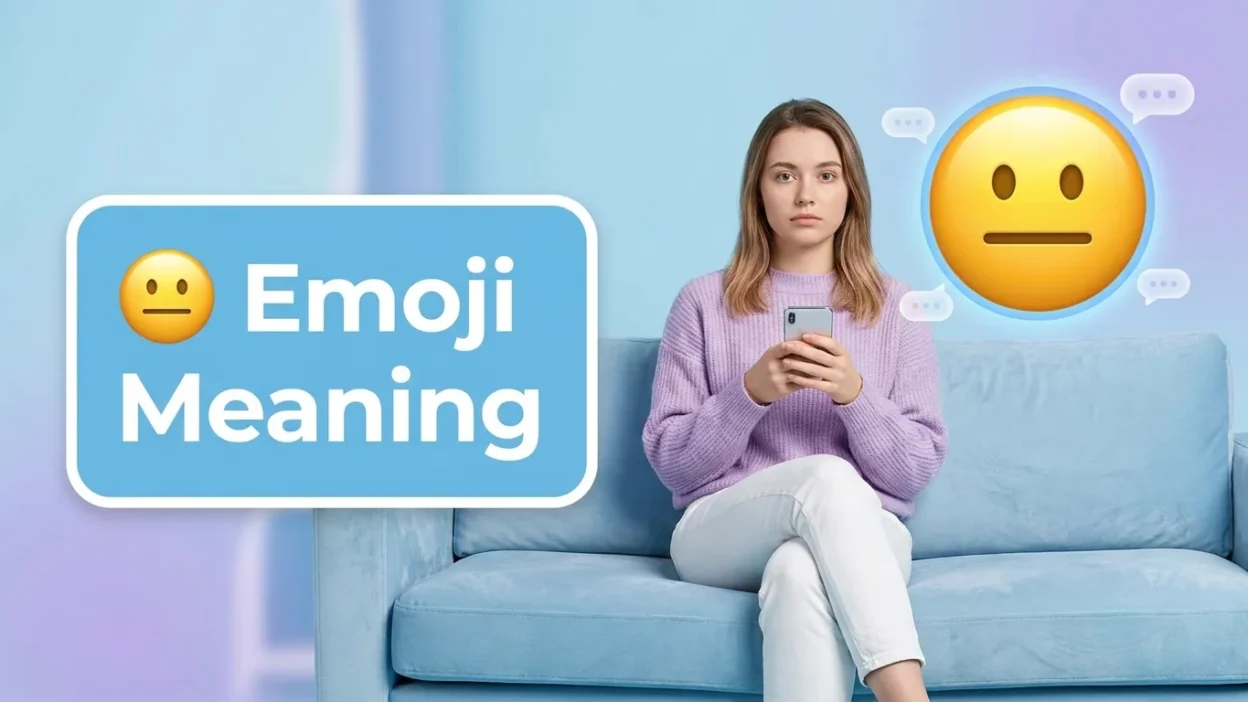
Have you ever received a message that left you speechless, unsure how to react, or simply unimpressed? The 😐 emoji is often the perfect way to express that feeling without writing a long reply.
The 😐 emoji meaning usually relates to neutrality, awkwardness, disappointment, or a lack of strong emotion. Its straight mouth and simple expression can communicate that you have nothing to say, feel uncomfortable, or are not particularly impressed by something.
In everyday texting, people use the neutral face emoji when a conversation becomes awkward, someone makes an unexpected comment, or a situation does not deserve an enthusiastic response.
Quick Answer:
😐 usually means “neutral,” “okay,” “I don’t know what to say,” “I’m unimpressed,” or “this is awkward.” It can show little or no emotion, mild disappointment, boredom, uncertainty, or an uncomfortable reaction.
The exact meaning depends on who sent it, what they said before it, and the situation.
What Does “😐 emoji meaning” Mean?
The 😐 emoji is known as the Neutral Face emoji. It represents a face with a simple, straight mouth and a neutral expression.
Unlike 😀, 😂, or 😍, it does not clearly communicate happiness, laughter, or affection. Instead, it often tells the other person that the sender has a flat, uncertain, or restrained reaction.
In simple English, 😐 can mean:
- “Okay.”
- “I’m not sure.”
- “I have no reaction.”
- “That was awkward.”
- “I’m not impressed.”
- “Seriously?”
- “I don’t know what to say.”
- “That’s neither good nor bad.”
- “I’m staying neutral.”
However, 😐 does not have one fixed meaning. A person may use it simply because they feel neutral, while another person may use it to show irritation or sarcasm.
The literal meaning of 😐
The literal visual meaning is a neutral facial expression. The straight mouth suggests that the person is not openly smiling or frowning.
In digital communication, people often use this expression to replace a facial reaction they might naturally make during an in-person conversation.
For example:
“He really said that in front of everyone 😐”
Here, 😐 might mean, “I honestly don’t know how to react to that.”
The most common meaning of 😐
The most common use of 😐 is to communicate a flat or neutral reaction.
It can also carry a slightly negative tone when someone wants to show that they are unimpressed, uncomfortable, bored, or mildly annoyed.
That is why you should always consider the surrounding message instead of interpreting 😐 by itself.
😐 Emoji Meaning in Different Contexts
The same emoji can communicate different feelings depending on where and how someone uses it.
😐 in Everyday Conversation
In everyday conversation, 😐 often represents a blank or uncertain reaction.
Imagine your friend tells you a strange story. You don’t know whether to laugh, ask a question, or respond seriously. You might send 😐 to show that you are processing what they said.
Example:
“My neighbor started singing at 3 a.m. 😐”
The emoji could mean:
“What am I supposed to say to that?”
It can also signal awkwardness.
😐 in Text Messages
In texting, 😐 is often used when someone wants to give a short, emotionally restrained response.
For example:
“I forgot to tell you that I invited five more people.”
“😐”
The second person may not literally be emotionless. They may actually be thinking, “Are you serious?”
The emoji allows them to communicate that reaction without writing a long message.
😐 on Social Media
On social media, 😐 can appear in comments or replies when someone sees something confusing, disappointing, awkward, or unimpressive.
For example:
“I paid $80 for this tiny sandwich 😐”
Here, the emoji can suggest disappointment or disbelief.
😐 on WhatsApp
On WhatsApp, 😐 is commonly used in personal conversations when someone wants to express a quiet reaction.
It can mean:
- “Okay…”
- “Really?”
- “That’s awkward.”
- “I don’t know what to say.”
- “I’m not happy about that.”
- “I’m not reacting to this.”
The tone depends on the conversation.
If someone sends only 😐, it may feel more serious or noticeable than when the emoji appears alongside other words.
😐 on Snapchat
On Snapchat, 😐 can be used as a reaction to a snap, message, or story.
For example, if someone sends a strange picture with no explanation, replying with 😐 may communicate:
“What am I looking at?”
It can also be playful between friends.
😐 on Instagram
Instagram users may use 😐 in comments, DMs, or replies to show confusion, boredom, disappointment, or awkwardness.
For example:
“He really posted this thinking it was funny 😐”
Here, the emoji adds a dry or unimpressed tone.
😐 on TikTok
On TikTok, 😐 can be used as a reaction to videos that are awkward, unexpected, boring, or strangely relatable.
It may sometimes work as a form of deadpan humor.
For example:
“When your teacher says the test is easy 😐”
The emoji can communicate the joke without directly saying, “I don’t believe you.”
😐 in Gaming
Gamers may use 😐 in chats when something goes wrong or when another player does something unexpected.
For example:
“You used the last health potion? 😐”
Here, 😐 could mean:
“Why would you do that?”
It can express mild frustration without sounding extremely angry.
😐 in Professional Communication
The 😐 emoji should be used carefully in professional conversations.
In a casual workplace chat with people you know well, it might communicate mild confusion or awkwardness. However, in a formal email or serious professional discussion, it can be misunderstood.
For example:
“The meeting has been moved to 7 a.m. 😐”
A coworker might understand this as mild frustration.
But in a formal message to a client, it is usually better to explain your concern clearly rather than rely on the emoji.
Examples of 😐 Emoji Meaning
Here are several realistic examples showing how the meaning can change with context.
Example 1: “Okay, then 😐”
Sentence:
“You don’t want to come with us? Okay, then 😐”
Meaning:
The sender may feel disappointed or slightly annoyed.
Situation:
A friend refuses an invitation, and the sender is trying not to sound openly angry.
Example 2: “He actually said that 😐”
Sentence:
“He actually told the teacher that? 😐”
Meaning:
The emoji shows disbelief, awkwardness, or surprise.
Situation:
Someone has shared an embarrassing or unexpected story.
Example 3: “This is getting weird 😐”
Sentence:
“This conversation is getting weird 😐”
Meaning:
The sender feels uncomfortable or awkward.
Situation:
The discussion has moved into an unusual direction.
Example 4: “Nice job 😐”
Sentence:
“You deleted the whole file. Nice job 😐”
Meaning:
This is probably sarcastic rather than genuinely positive.
Situation:
Someone made a mistake, and the sender is showing mild frustration.
Example 5: “I don’t know 😐”
Sentence:
“Are you going to the party?”
“I don’t know 😐”
Meaning:
The person may genuinely be uncertain or undecided.
Situation:
They have not made up their mind yet.
Example 6: “That was awkward 😐”
Sentence:
“Nobody answered when she asked the question 😐”
Meaning:
The emoji emphasizes the awkward silence.
Situation:
The sender is describing an uncomfortable moment.
Example 7: “You ate my food 😐”
Sentence:
“You ate my leftovers? 😐”
Meaning:
The sender is probably annoyed or disappointed.
Situation:
Someone has taken something without asking.
Example 8: “Cool 😐”
Sentence:
“They canceled the trip. Cool 😐”
Meaning:
This probably does not mean the sender is genuinely happy.
Situation:
“Cool” combined with 😐 may create a sarcastic or disappointed tone.
When Do People Use 😐?
People use 😐 when their emotional reaction is not strongly positive or negative, or when they want to communicate a restrained reaction.
Common situations include:
When something is awkward
If someone says something uncomfortable, 😐 can act like a digital version of an awkward facial expression.
When someone is unimpressed
A person may use 😐 when they expected something better.
For example:
“That was supposed to be the big surprise? 😐”
When someone is mildly annoyed
😐 can show irritation without using a clearly angry emoji such as 😡.
When someone is uncertain
Someone who does not know how they feel about a situation may use 😐.
When someone has no words
Sometimes the best response to an unbelievable message is simply:
“😐”
This can mean:
“I genuinely don’t know what to say.”
When someone is joking
Friends may use 😐 for dry humor or sarcasm.
The person may not actually be upset. They could simply be exaggerating a serious-looking reaction for comedic effect.
Different Meanings of 😐
Although the official idea behind 😐 is a neutral face, people use it in several related ways.
😐 Means “Neutral”
This is the closest meaning to the emoji’s basic design.
Definition:
The sender does not feel strongly positive or negative.
Context:
A normal decision or situation that does not create much emotion.
Example:
“How was the movie?”
“It was okay 😐”
Here, 😐 suggests that the movie was neither excellent nor terrible.
😐 Means “Unimpressed”
Sometimes the sender is not impressed by what happened.
Definition:
“I expected more.”
Context:
A disappointing result, performance, purchase, or event.
Example:
“That was your big surprise? 😐”
The emoji communicates disappointment without directly saying it.
😐 Means “Awkward”
The emoji can also represent an uncomfortable moment.
Definition:
“This is uncomfortable.”
Context:
An unusual conversation, embarrassing situation, or social mistake.
Example:
“He called her by his ex’s name 😐”
The emoji adds an awkward reaction.
😐 Means “I Don’t Know What to Say”
Sometimes a person genuinely has no suitable response.
Definition:
“I have no words.”
Context:
Unexpected, shocking, strange, or confusing information.
Example:
“My brother quit his job and bought a motorcycle yesterday 😐”
The sender may simply be struggling to react.
😐 Means “Mildly Annoyed”
It can also communicate controlled frustration.
Definition:
“I’m annoyed, but I’m not furious.”
Context:
A small mistake, inconvenience, or irritating behavior.
Example:
“You forgot the keys again 😐”
The emoji suggests frustration without intense anger.
😐 Means “Seriously?”
In some conversations, 😐 works like a silent question.
Definition:
“Are you serious right now?”
Context:
Something surprising, unreasonable, or frustrating.
Example:
“He told everyone my secret 😐”
The emoji can mean, “Seriously?”
😐 Means “Deadpan Humor”
People sometimes use 😐 intentionally because its blank expression makes a joke funnier.
Definition:
A deliberately emotionless reaction used for humor.
Context:
Memes, jokes, unexpected situations, or sarcasm.
Example:
“I studied for five hours and still forgot the formula 😐”
The humor comes from the contrast between the serious situation and the blank reaction.
😐 Emoji Meaning From a Guy
If a guy sends 😐, it does not automatically have a romantic or negative meaning.
The emoji usually depends on what happened in the conversation.
A guy might use 😐 to show:
- He is unsure what to say.
- He is mildly annoyed.
- He finds something awkward.
- He is unimpressed.
- He is confused.
- He is joking.
- He has a neutral reaction.
For example:
You: “I accidentally sent the message to the wrong person.”
Him: “😐”
He may simply be reacting to the awkward situation.
If he sends 😐 after you say something serious or emotional, the surrounding conversation becomes especially important. The emoji alone cannot reliably tell you whether he is angry, uninterested, joking, or simply unsure how to respond.
😐 Emoji Meaning From a Girl
A girl may use 😐 for many of the same reasons.
She could be expressing:
- Awkwardness
- Mild annoyance
- Confusion
- Disappointment
- Neutrality
- Sarcasm
- “Seriously?”
- “I have no words.”
For example:
“You forgot my birthday again 😐”
Here, the emoji likely strengthens the feeling of disappointment.
However, you should not assume that 😐 has a special meaning simply because a girl sent it. Context matters more than gender.
😐 Emoji Meaning From a Guy to a Girl
When a guy sends 😐 to a girl, it does not automatically indicate flirting, attraction, anger, or disinterest.
Consider the conversation.
If she says:
“I just embarrassed myself in front of everyone.”
And he replies:
“😐”
He might be joking, showing disbelief, or reacting to the story.
But if she says:
“Are you mad at me?”
And he replies:
“😐”
The emoji could suggest that he does not know how to answer or is intentionally giving a restrained response.
You need the surrounding messages to understand the tone.
😐 Emoji Meaning From a Girl to a Guy
A girl may send 😐 to a guy when she feels confused, unimpressed, awkward, or mildly annoyed.
For example:
Guy: “I forgot we had plans today.”
Girl: “😐”
This may communicate:
“Seriously? You forgot?”
However, it can also be playful between people who know each other’s communication style.
The emoji itself does not prove that she is angry or losing interest.
Is 😐 a Negative Emoji?
Not necessarily.
The basic meaning of 😐 is neutral. However, in everyday texting, it can sometimes carry a negative tone.
For example:
“You ate the last slice 😐”
This likely expresses annoyance.
Compare that with:
“The weather is okay today 😐”
This is more neutral.
So, the emoji can range from neutral to mildly negative, depending on the message around it.
Is 😐 Rude?
The 😐 emoji can sometimes feel rude, especially when it is sent alone.
For example:
“I worked all night to finish this project.”
“😐”
The recipient might interpret that as a cold or dismissive response.
But the sender may simply be unsure how to respond.
If you want to avoid sounding rude, add words that explain your reaction.
Instead of:
“😐”
You could write:
“I honestly don’t know what to say 😐”
That makes your intended tone clearer.
Is 😐 Sarcastic?
Yes, 😐 can be sarcastic.
For example:
“I only missed the bus by 30 seconds 😐”
The sender might use the neutral face to make the situation sound humorously emotionless.
Another example:
“Great. Another meeting at 7 a.m. 😐”
The sender probably isn’t genuinely excited.
The combination of words and emoji creates the sarcastic meaning.
😐 vs 😑
These two emojis are easy to confuse.
😐 Neutral Face generally communicates a neutral, blank, uncertain, awkward, or restrained reaction.
😑 Expressionless Face often feels more tired, irritated, fed up, or emotionally drained.
For example:
“The movie was okay 😐”
This sounds neutral.
“You asked me that for the fifth time 😑”
This sounds more irritated.
In simple terms:
😐 = neutral or unsure
😑 = expressionless, fed up, or annoyed
The difference is subtle, and people may use them differently.
😐 vs 😶
The 😶 emoji is commonly known as Face Without Mouth.
It can suggest silence, speechlessness, secrecy, or having nothing to say.
By comparison:
😐 = neutral or restrained reaction
😶 = silent or speechless
For example:
“What do you think?”
“😐”
This can suggest a neutral opinion.
“What do you think?”
“😶”
This can suggest that the person does not know what to say.
😐 vs 🙄
The 🙄 emoji usually communicates eye-rolling, annoyance, disbelief, or impatience.
The 😐 emoji is generally less openly expressive.
Compare:
“He told the same joke again 😐”
This could mean a quiet, unimpressed reaction.
“He told the same joke again 🙄”
This more clearly suggests irritation or annoyance.
😐 vs 😒
The 😒 emoji usually shows displeasure, annoyance, or dissatisfaction.
😐 is more neutral.
For example:
“The food was okay 😐”
This sounds neutral.
“I can’t believe they served this 😒”
This sounds more clearly negative.
😐 vs 🙂
The difference between 😐 and 🙂 can be important.
🙂 usually communicates a smile, friendliness, politeness, or a positive-looking reaction. Depending on context, it can also be used ironically.
😐 removes the smile and creates a more neutral or emotionally flat tone.
Compare:
“Thanks for helping me 🙂”
This sounds friendly.
“Thanks for helping me 😐”
This can sound cold, awkward, or unimpressed.
When Should You Use 😐?
Use 😐 when you want to communicate a neutral, restrained, awkward, or mildly unimpressed reaction.
It works especially well in casual conversations with friends and people who understand your texting style.
Good situations for 😐
You can use it when:
- You are unsure how to respond.
- Something feels awkward.
- You are mildly disappointed.
- Someone says something strange.
- You want a neutral reaction.
- You are joking in a deadpan way.
- Something is neither good nor bad.
Situations where you should be careful
Avoid relying on 😐 when discussing serious issues, emotional conflicts, or professional matters.
A neutral emoji can be interpreted as:
- Cold
- Uninterested
- Angry
- Dismissive
- Sarcastic
If the conversation is important, words are usually clearer.
Common Mistakes With 😐
Understanding the 😐 emoji can be tricky because people often give it meanings that are too specific.
Mistake 1: Assuming 😐 always means anger
😐 does not automatically mean someone is angry.
It may simply mean that they are neutral, confused, awkward, or unsure.
Better approach: Look at the message before and after the emoji.
Mistake 2: Assuming 😐 means dislike
Someone using 😐 does not necessarily dislike you.
They may dislike a situation rather than the person they are talking to.
For example:
“I don’t like this new update 😐”
The person is criticizing the update, not necessarily the conversation partner.
Mistake 3: Treating the emoji as a fixed code
There is no universal rule saying 😐 always means one specific emotion.
Emoji meanings are influenced by context, relationship, culture, platform, and personal texting habits.
Mistake 4: Ignoring sarcasm
Sometimes the words look positive while 😐 changes the tone.
“Amazing, another two-hour meeting 😐”
The word “amazing” sounds positive, but the emoji suggests sarcasm or frustration.
Mistake 5: Overanalyzing a single emoji
One emoji rarely provides enough information to understand someone’s complete emotional state.
Instead of asking, “What does 😐 always mean?”, ask:
“What does 😐 mean in this particular conversation?”
That approach is much more accurate.
Origin of the 😐 Emoji
The 😐 emoji belongs to the standard collection of digital emoji characters maintained through the Unicode Standard. Its official name is Neutral Face.
Emoji developed from earlier forms of digital emoticons, where people used keyboard characters such as 🙂 and 🙁 to represent facial expressions.
As emoji became standardized across phones and digital platforms, visual facial expressions became easier to send and understand.
The neutral face filled an important gap between strongly positive and strongly negative expressions. Instead of smiling or frowning, it shows a simple, straight expression.
Today, 😐 is widely used across messaging apps, social networks, forums, gaming communities, and other forms of digital communication.
Its meaning has also expanded through everyday internet culture. Although its official concept is neutral, users frequently apply it to awkwardness, disbelief, boredom, mild frustration, sarcasm, and “I have no words” reactions.
That difference between the emoji’s formal name and its informal uses is important.
Similar Words and Alternatives to 😐
Depending on the intended meaning, several words and emojis can communicate a similar reaction.
“Okay…”
This can express a restrained response.
“Okay… 😐”
It may suggest uncertainty or discomfort.
“Seriously?”
This is useful when something seems unbelievable.
“Seriously? 😐”
The words make the intended reaction clearer.
“I don’t know what to say.”
This directly communicates speechlessness.
“I honestly don’t know what to say.”
This is clearer than sending only 😐.
“That’s awkward.”
This works when the situation is uncomfortable.
“I’m not impressed.”
This communicates disappointment more directly.
😑
Often stronger than 😐 and more likely to suggest irritation or being fed up.
😶
More closely connected with silence or having no words.
🙄
More clearly expresses eye-rolling or annoyance.
😒
More clearly communicates dissatisfaction or displeasure.
How to Understand 😐 in a Text
If someone sends 😐 and you aren’t sure what they mean, follow these steps.
Look at the previous message
Ask what they were responding to.
If you said something funny and they replied 😐, they might not have found it funny.
If you shared bad news and they replied 😐, they might be unsure how to respond.
Look at their words
Words often provide more information than the emoji.
Compare:
“That’s fine 😐”
with:
“That’s fine! 😄”
The first may sound reluctant or emotionally flat.
Consider your relationship
A close friend may use 😐 jokingly.
A coworker may use it more literally.
Someone you have just met may use it differently again.
Look for repeated patterns
If a person regularly uses 😐 as a joke, you should interpret it based on their usual texting style.
Personal communication habits matter.
What Does 😐 Mean From Your Crush?
If your crush sends 😐, don’t automatically assume that it means they are annoyed or uninterested.
The emoji itself is too broad to support that conclusion.
For example:
You: “I accidentally wore two different shoes today.”
Crush: “😐😂”
This could be playful teasing.
But:
You: “Do you want to hang out tomorrow?”
Crush: “😐”
This is more ambiguous. They may be unsure, surprised, or uncomfortable.
The best way to understand the message is to consider the full conversation, not just the emoji.
What Does 😐 Mean in a Relationship?
In a relationship, 😐 can communicate anything from mild annoyance to playful humor.
For example:
“You forgot to text me when you got home 😐”
This may show disappointment.
Another example:
“You seriously watched the whole season without me? 😐”
This could be playful annoyance.
Partners often develop their own communication styles, so the same emoji can have a meaning that is specific to their relationship.
What Does 😐 Mean From a Friend?
Between friends, 😐 is often casual and humorous.
A friend might send it when:
- You make a strange comment.
- You tell an unbelievable story.
- You make a silly mistake.
- You say something awkward.
- They are pretending to be annoyed.
- They don’t know how to react.
For example:
“I accidentally ordered 12 pizzas.”
“😐”
The friend may be jokingly asking, “What were you thinking?”
What Does 😐 Mean in Internet Slang?
😐 is not technically an abbreviation or slang word. It is an emoji.
However, internet users often use it alongside slang expressions.
Common combinations include:
- “Bruh 😐”
- “Seriously? 😐”
- “Okay then 😐”
- “Nah 😐”
- “Bro… 😐”
- “What 😐”
- “I can’t 😐”
These combinations can strengthen feelings such as disbelief, awkwardness, mild annoyance, or confusion.
For example:
“Bro 😐 what was that?”
The emoji adds a deadpan reaction to the slang.
How 😐 Changes the Tone of a Sentence
An emoji can change how written words feel.
Consider this sentence:
“Fine.”
It can sound serious or cold.
Now add 😐:
“Fine 😐”
It may sound more restrained, reluctant, or unimpressed.
Compare it with:
“Fine 😂”
Now the sentence feels playful.
Or:
“Fine ❤️”
Now it may feel warmer or more affectionate.
This is why emoji interpretation should focus on the combination of words and visual expression, not the emoji alone.
Is 😐 Flirting?
By itself, 😐 is not normally a clear flirting emoji.
Flirting is more commonly communicated through words, playful messages, relationship context, or emojis that have stronger affectionate meanings.
If someone sends 😐 during a flirtatious conversation, it may simply be part of a joke or teasing style.
For example:
“You really think you’re that handsome? 😐”
This could be playful teasing.
The context determines whether the interaction is flirtatious.
Is 😐 a Cold Response?
It can be.
When someone responds with only 😐 to a message that normally deserves a longer response, the reply may feel cold, distant, or dismissive.
For example:
“I really enjoyed spending time with you today!”
“😐”
The recipient may feel confused because the response does not match the emotional tone of the first message.
However, the sender may have another reason for responding that way. Perhaps they are joking, distracted, or unsure what to say.
Can 😐 Mean “I Don’t Care”?
Sometimes, yes.
In certain conversations, 😐 can communicate emotional detachment or a lack of interest.
For example:
“They canceled the event.”
“😐”
This could mean:
“I don’t really care.”
But it could also mean:
“Okay.”
The surrounding conversation is what separates these meanings.
Why Does 😐 Sometimes Feel Passive-Aggressive?
A passive-aggressive tone can happen when the emoji is paired with words that sound polite but carry a different emotional message.
For example:
“Sure, do whatever you want 😐”
The words appear cooperative, but the emoji can suggest frustration or disagreement.
This does not mean every use of 😐 is passive-aggressive. Tone depends on the speaker and context.
Frequently Asked Questions
What does 😐 mean in texting?
😐 usually means a neutral, blank, awkward, uncertain, or unimpressed reaction. It can also mean “okay,” “seriously?” or “I don’t know what to say,” depending on context.
What is the official name of 😐?
The official Unicode name for 😐 is Neutral Face. Its design represents a face with a straight, expressionless mouth.
Does 😐 mean someone is angry?
Not necessarily. 😐 can show mild annoyance, but it can also express neutrality, uncertainty, awkwardness, boredom, or a lack of words.
What does 😐 mean from a girl?
A girl may use 😐 to show that she is neutral, confused, unimpressed, awkward, mildly annoyed, or unsure how to respond. The surrounding conversation matters more than gender.
What does 😐 mean from a guy?
A guy may use 😐 for the same general reasons. It can communicate a neutral reaction, confusion, awkwardness, mild frustration, disbelief, or dry humor.
Is 😐 a negative emoji?
😐 is officially a neutral expression, but it can carry a negative tone in some conversations. For example, it may suggest disappointment, annoyance, boredom, or being unimpressed.
What is the difference between 😐 and 😑?
😐 generally represents neutrality or a restrained reaction, while 😑 often feels more expressionless, tired, irritated, or fed up. The difference can be subtle.
Conclusion
The 😐 emoji meaning is mainly connected to a neutral, blank, or restrained facial reaction, but its practical meaning can change with context. People use it to express uncertainty, awkwardness, boredom, mild annoyance, disappointment, disbelief, sarcasm, or simply a lack of words.
You may see 😐 in text messages, WhatsApp chats, Instagram comments, Snapchat, TikTok, gaming conversations, and everyday social media interactions. It can sometimes sound cold when used alone, but friends may also use it playfully or sarcastically.