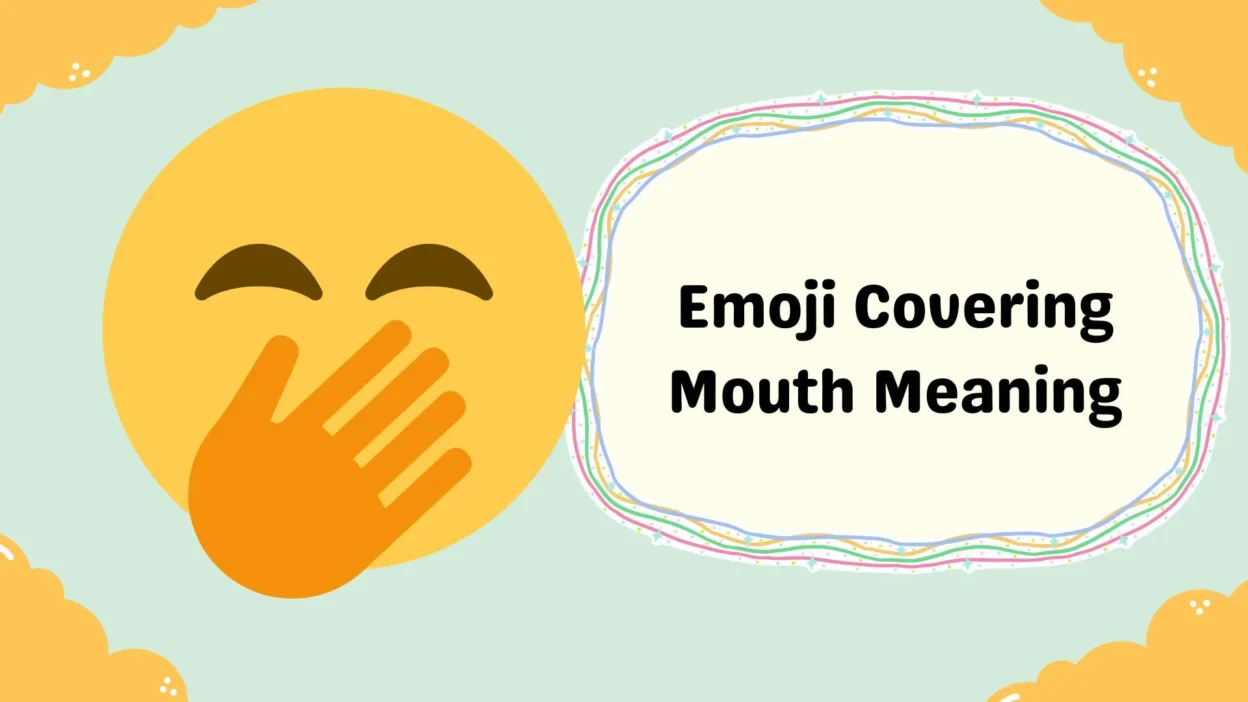
Have you ever received an emoji covering its mouth and wondered what the sender was trying to express? The 🤭 emoji, officially known as the “Face with Hand Over Mouth,” can communicate several emotions depending on the situation.
It is often used to show shyness, embarrassment, surprise, amusement, or a playful reaction to something unexpected.
Sometimes, someone may send 🤭 when they are quietly laughing, teasing you, revealing a little secret, or feeling shy after saying something bold.
Quick answer:
The emoji covering mouth 🤭 usually means someone is giggling quietly, feeling a little embarrassed, being playfully shy, or reacting with mild surprise. It often says “oops,” “teehee,” or “I shouldn’t laugh but I am.” Context decides the exact feeling.
What Does “emoji covering mouth meaning” Mean?
The emoji covering mouth is officially called “Face with Hand Over Mouth.” Its Unicode name is Face with Hand Over Mouth, and it has the code U+1F92D. Most people simply call it the covering mouth emoji or the hand-over-mouth face.
In plain English, it shows a face trying to hide its reaction. The hand covers the mouth the way people do in real life when they laugh too hard, feel shy, or catch themselves saying something they should not.
The most common meaning is a soft, suppressed giggle. Think of the sound “teehee” or a quiet “hehe.” It is lighter than a full laughing face 😂.
It can also mean “oops, I said too much” or “I am a bit embarrassed about this.” Sometimes it signals that the person is keeping a secret or feels mischievous. On some platforms the eyes look more open, which can lean toward mild shock, but the happy version is the one most people use for laughter and shyness today.
Meaning in Different Contexts
The emoji covering mouth meaning shifts a little based on where and how people use it. Here is how it works in everyday places.
Everyday Conversation
In normal chats with friends or family, 🤭 usually shows light amusement or shy laughter. Someone might send it after sharing a funny personal story or reacting to a silly mistake. It softens the message and makes the person seem friendly and approachable.
Text Messages
In one-on-one texting the covering mouth emoji often adds a playful or flirtatious tone. If someone texts “I just spilled coffee all over myself 🤭” it means they feel a bit silly and are laughing at themselves. When it comes after a compliment or teasing remark, it can mean the person is feeling shy or attracted.
Social Media
On platforms like Twitter (X), Facebook, or Reddit, people use 🤭 to react to funny or slightly awkward posts. It can mean “this is hilarious but I shouldn’t laugh too hard” or “I know something you don’t.” It is popular under celebrity drama or funny fails.
WhatsApp chats love this emoji for group reactions. Friends drop 🤭 when someone shares gossip or an embarrassing story. It keeps the mood light and shows the person is in on the joke without being mean.
Snapchat
On Snapchat the covering mouth emoji often appears in streaks or story replies. It can mean the sender is laughing at a funny snap or feeling coy after sending a cute photo. Because Snapchat feels more personal, the emoji often carries a soft, friendly energy.
Instagram comments and DMs use 🤭 for reactions to Reels, Stories, or photos. Someone might comment it under a funny video or after a friend posts something slightly embarrassing. It also shows up in captions when the poster wants to look playful or self-aware.
TikTok
TikTok comments are full of 🤭. Creators and viewers use it for “I shouldn’t be laughing at this” moments, especially under roast videos, fails, or gossip-style content. It signals that the person finds the video funny in a slightly naughty or secretive way.
Gaming
In gaming chats the covering mouth emoji can mean the player is laughing at a funny fail, a clever play, or a teammate’s mistake. It keeps the trash talk light. Sometimes it shows up when someone is about to reveal a strategy but pretends to stay quiet.
Professional Communication
In work emails or formal chats, people rarely use 🤭. When they do, it is usually among close colleagues to soften a small mistake or share a light joke. In more formal settings it can feel too casual, so many skip it.
Internet Slang
Online, especially among younger users, 🤭 has become linked to “spilling tea” (sharing gossip) or reacting to drama with fake innocence. It can also mean the person is being sassy or playfully mean while trying to look cute about it.
Examples of “emoji covering mouth meaning”
Here are five clear real-life examples that show how the emoji covering mouth works in practice.
- Sentence: “I just waved at a stranger thinking it was my friend 🤭”
Meaning: Embarrassed laughter at a silly mistake.
Situation: Texting a friend after an awkward moment in public. - Sentence: “Your secret is safe with me 🤭”
Meaning: Playful promise to keep quiet, with a hint of mischief.
Situation: Friend group chat where someone shared personal news. - Sentence: “I can’t believe I said that out loud 🤭”
Meaning: Mild shock mixed with shy amusement after oversharing.
Situation: Private message after an honest but slightly too-honest comment. - Sentence: “That joke was so bad… but I laughed anyway 🤭”
Meaning: Suppressed or guilty laughter.
Situation: Reacting to a dad joke or bad pun in a group chat. - Sentence: “Maybe we should hang out sometime 🤭”
Meaning: Flirty shyness.
Situation: Messaging a crush after a fun conversation.
These examples show how the same emoji can feel embarrassed, secretive, amused, or flirty depending on the words around it.
When Do People Use “emoji covering mouth meaning”?
People reach for the covering mouth emoji in many everyday situations. The most common ones include:
- Laughing at something funny but not wanting to seem too loud or rude
- Admitting a small mistake or embarrassing moment
- Reacting to surprising but not shocking news
- Softening a teasing or slightly spicy comment
- Showing playful shyness, especially in flirting
- Hinting that they know gossip without fully saying it
- Keeping a light mood after something awkward happened
Who uses it? Almost everyone who texts or posts online, but it is especially popular with teens, young adults, and people who enjoy playful digital communication. Gen Z and millennials use it a lot in group chats and social media.
Why do people use it? Text messages lack tone of voice and facial expressions. The emoji covering mouth adds the missing feeling of a quiet giggle or shy smile. It makes the sender seem warmer and less serious.
Appropriate situations include casual chats with friends, light social media comments, and friendly flirting. It is usually fine in most informal online spaces.
Inappropriate situations include serious conversations, professional emails to clients or bosses, messages about sensitive topics like illness or loss, or any time the other person might feel mocked. If the context is heavy, a different emoji or plain words work better.
Different Meanings of “emoji covering mouth meaning”
The emoji covering mouth can carry several related meanings. Here is a clear breakdown of the main ones.
1. Suppressed or coy laughter
Definition: Quiet giggling that the person is trying to hide.
Context: Funny but slightly inappropriate jokes or personal fails.
Example: “I almost laughed during the quiet meeting 🤭”
2. Mild embarrassment or “oops”
Definition: Feeling a bit silly or awkward about something that happened.
Context: Admitting a small mistake.
Example: “I called my teacher ‘mom’ again 🤭”
3. Playful shyness or flirting
Definition: Soft, cute reaction that shows interest or nervousness.
Context: Compliments, invitations, or teasing between people who like each other.
Example: “You look really nice today 🤭”
4. Mild surprise or realization
Definition: Soft “oh!” reaction that is not full shock.
Context: Hearing unexpected but not dramatic news.
Example: “Wait, you’re moving next month? 🤭”
5. Secret or mischievous feeling
Definition: Hinting that the person knows something or is being a little naughty.
Context: Gossip or playful threats to reveal information.
Example: “I know what you did last weekend 🤭”
Note that the more serious open-eyed version 🫢 is now used for stronger shock or true secrecy. Most people still use 🤭 for the lighter, happier feelings listed above.
Origin of “emoji covering mouth meaning”
The covering mouth emoji was approved as part of Unicode 10.0 in June 2017 and added to Emoji 5.0 the same year. Its original long name was “Smiling Face with Smiling Eyes and Hand Covering Mouth.”
It joined other hand-related face emojis like the hugging face, thinking face, and shushing face. Designers wanted a way to show the common real-life gesture of covering the mouth while laughing or gasping.
At first, different phone companies showed the emoji differently. Some gave it smiling eyes (happy giggle), while others gave it open eyes (more shocked). This caused confusion. In 2022 Apple and Unicode fixed the problem by creating a new separate emoji 🫢 for the open-eyed shocked version. After that update, 🤭 settled into its current role as the smiling, giggling version on most platforms.
Culturally, covering the mouth while laughing has long roots. In many East Asian cultures it is a polite or modest gesture. In Western cultures it often shows someone trying not to laugh out loud or feeling embarrassed. The emoji borrowed both ideas and turned them into a flexible digital expression.
No single person invented it. Like most emojis, it came from the Unicode Consortium’s ongoing work to give people better ways to express feelings online.
Similar Words and Alternatives
Several other emojis and phrases can carry similar feelings to the covering mouth emoji. Here are the closest ones and how they differ.
- 🙊 Speak-No-Evil Monkey: Stronger focus on keeping a secret or “I shouldn’t say this.”
- 🤐 Zipper-Mouth Face: Clearer “my lips are sealed” or forced silence.
- 🤫 Shushing Face: Directly asking someone else to be quiet.
- 🫢 Face with Open Eyes and Hand Over Mouth: More serious shock or true surprise.
- 😅 Grinning Face with Sweat: Nervous laughter or awkward relief.
- 😳 Flushed Face: Stronger pure embarrassment.
- 😏 Smirking Face: More confident or sly amusement.
- 🙈 See-No-Evil Monkey: “I can’t look” or playful avoidance.
Text alternatives include “teehee,” “hehe,” “oops,” “lol but quietly,” or “I shouldn’t laugh.” These words work when emojis are not available, but the covering mouth emoji packs more visual emotion into one character.
Common Mistakes
Many people misread or misuse the covering mouth emoji. Here are the most frequent mix-ups and how to avoid them.
Mistake 1: Thinking it always means pure shock.
Correct: 🤭 is usually light and happy. Use 🫢 for real shock.
Mistake 2: Using it in serious or sad conversations.
Correct: Save it for light, playful moments. A sad face or simple words feel more respectful when the topic is heavy.
Mistake 3: Assuming everyone sees the same design.
Correct: Older phones or different platforms may still show slight variations. When in doubt, add a few words to clarify your tone.
Mistake 4: Overusing it so the meaning becomes unclear.
Correct: One or two 🤭 in a message is plenty. Too many can make the chat feel forced.
Tip to avoid confusion: Always look at the full message and the relationship you have with the person. A 🤭 from a close friend after a joke almost always means shared laughter. The same emoji from a new acquaintance might lean more toward polite shyness. When you are unsure, just ask “what did you mean by that emoji?” Most people are happy to explain.
Frequently Asked Questions
1. What does the covering mouth emoji mean from a girl?
It often shows playful shyness, mild embarrassment, or soft flirting. Many girls use it after compliments or when sharing something cute and personal.
2. What does the covering mouth emoji mean from a guy?
Guys usually send it for the same reasons: laughing at themselves, reacting playfully, or showing light interest. Context and the rest of the message matter more than gender.
3. Is the covering mouth emoji flirty?
It can be. When paired with compliments, invitations, or teasing, 🤭 often carries a flirty or coy feeling. Alone it is more neutral.
4. What is the difference between 🤭 and 🫢?
🤭 has smiling or happy eyes and feels lighter (giggle, oops, shy). 🫢 has open eyes and feels more like real shock or serious surprise.
5. Can I use the covering mouth emoji at work?
Only with close coworkers in casual chats. Avoid it in formal emails or messages to clients. It can look too playful for professional settings.
6. Why do some people use the covering mouth emoji for gossip?
It suggests “I know something but I’m trying not to say it too loudly.” The hand over the mouth creates a secretive, teasing vibe that fits sharing “tea.”
7. Does the covering mouth emoji mean the person is lying?
Not usually. While covering the mouth can be a real-life sign of discomfort, in emoji form it almost always means laughter, embarrassment, or playfulness rather than dishonesty.
Conclusion
The emoji covering mouth 🤭 is a small but powerful way to show quiet laughter, mild embarrassment, playful shyness, or light surprise. Its most common feeling is a soft “teehee” or “oops” that keeps conversations friendly and warm.
You will see it everywhere from private texts to TikTok comments. The exact meaning always depends on the words around it and the relationship between the people talking. A 🤭 after a joke usually means shared amusement. The same emoji after a compliment can feel flirty. In a serious chat it may not fit at all.
Remember that designs once varied across phones, which is why a separate shocked version 🫢 now exists. Stick with 🤭 for the happy, giggly side of the gesture. Next time you see or want to send the covering mouth emoji, pause for a second and think about the full context. That simple habit will help you understand others better and express yourself more clearly. Digital conversations become richer and more human when we treat emojis as the useful tools they are.