What does it really mean when someone sends you the 🙃 emoji? At first glance, the Upside Down Face emoji looks like a simple smile turned on its head, but its meaning can be surprisingly different depending on the situation.
People often use 🙃 to express awkwardness, sarcasm, irony, playful frustration, or a “things are not going as planned” feeling. Sometimes, it can show that someone is joking or trying to make an uncomfortable situation seem lighter.
In other conversations, 🙃 may carry a subtle emotional message, especially when someone says something that sounds positive but actually means the opposite. Its meaning can also change depending on who sends it, such as a friend, a guy, or a girl.
Quick Answer:
The upside down emoji face 🙃 usually means sarcasm, irony, silliness, playful awkwardness, or mild resigned frustration. It signals that the message should not be taken completely seriously or that the sender is smiling through something less than perfect.
What Does “Upside Down Emoji Face Meaning” Mean?
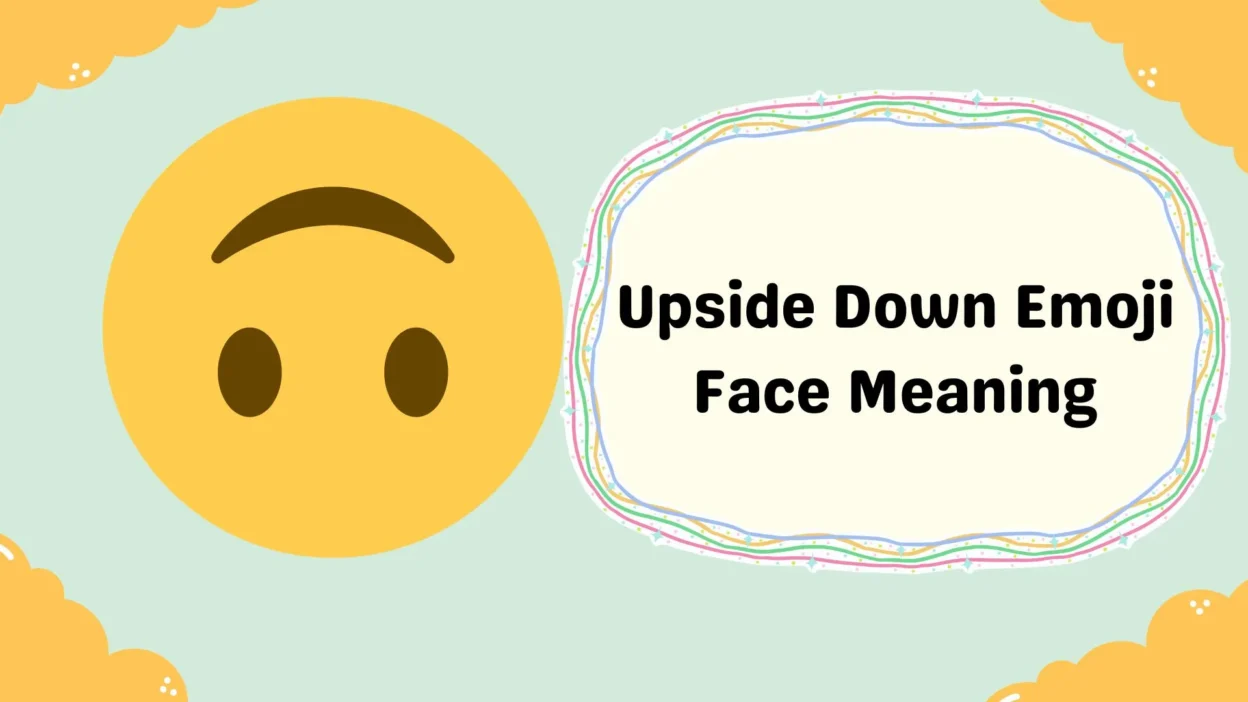
The upside down emoji face is officially named Upside-Down Face. It looks exactly like a regular slightly smiling face that has been flipped 180 degrees. On most phones and apps it appears as a yellow circle with simple eyes and a curved smile, but the entire face is inverted.
In plain English, this emoji tells the reader, “I’m smiling, but not in a straightforward happy way.” The flip itself creates a sense of something being off-kilter or not quite right. That visual twist is why people reach for it when regular smileys feel too sincere or too positive.
The most common meaning is a mix of sarcasm and light humor. It acts like a digital tone marker that softens or flips the literal words that come before it. When someone writes “Great, another meeting” followed by 🙃, the emoji usually means the opposite of “great.” It can also show pure silliness, mild embarrassment, or the feeling of “this is fine” while things feel chaotic.
There is no single rigid dictionary definition because emojis live in context. Still, the core idea stays consistent: the upside down face adds a layer of playfulness, irony, or gentle resignation that a normal smile cannot express.
Meaning in Different Contexts
Context is everything with the upside down emoji face. The same yellow inverted smile can feel funny with friends and slightly passive-aggressive at work. Here is how the meaning typically shifts across everyday digital spaces.
Everyday Conversation
In face-to-face style chats with friends or family, 🙃 often signals lighthearted goofiness or shared frustration. Someone might say “I locked myself out again 🙃” to laugh at their own mistake. The emoji keeps the mood friendly while acknowledging that something went wrong. It works like a verbal shrug mixed with a smile.
Text Messages
Texting is where this emoji shines brightest. Because plain text lacks tone of voice, people use 🙃 to prevent messages from sounding too serious or too harsh. A simple “Sure, I’ll do it 🙃” can mean genuine agreement with a touch of reluctance, or pure sarcasm depending on the conversation history. Close friends usually read the intended meaning easily through shared context.
Social Media
On public platforms the upside down face often softens opinions or adds self-deprecating humor. Captions like “Just living my best life 🙃” after posting a messy photo invite others to laugh along. It also appears under posts about everyday annoyances so the writer does not sound overly negative.
WhatsApp chats tend to be more personal. Here 🙃 frequently appears in group chats when someone shares bad news in a humorous way or teases a friend. It can also mark a polite way to disagree without starting an argument: “I see your point 🙃.” The emoji keeps the conversation light even when the topic is not.
Snapchat
Snapchat’s temporary and playful nature makes 🙃 feel extra casual. People use it on snaps of silly faces, failed attempts at cooking, or awkward moments. It often pairs with captions that admit something went wrong in a fun way. Because snaps disappear, the emoji helps keep the tone carefree.
On Instagram the upside down face appears in Stories, comments, and captions. It is popular for “relatable” content, posts about Monday mornings, diet fails, or social mishaps. Commenters also drop a single 🙃 under a friend’s post to show playful agreement or mild teasing without writing a full sentence.
TikTok
TikTok captions and comments love this emoji for irony. Creators use it under videos that show chaotic situations or self-roasts. Comments like “This is so me 🙃” signal recognition mixed with humor. The fast-paced, meme-heavy culture of TikTok makes the upside down face a quick way to say “I feel this chaos.”
Gaming
Gamers often drop 🙃 after a bad play, a glitch, or a loss. It communicates “that went terribly but I’m still smiling” without sounding salty. In chat it can also mark sarcasm toward teammates or the game itself: “Nice balance patch 🙃.”
Professional Communication
In work settings the upside down emoji face should be used carefully. Among close colleagues it can lighten the mood after a long meeting or a repeated inconvenience. In formal emails or with managers it is usually better to avoid, because it can read as passive-aggressive or unprofessional. When it does appear, it often signals polite resignation rather than open complaint.
Internet Slang
Online, 🙃 functions as a visual version of “jk,” “/s,” or the shruggie ¯_(ツ)_/¯. It belongs to the family of tone indicators that help written text carry emotional nuance. Many people treat it as the modern way to say “I’m only half serious.”
Examples of “Upside Down Emoji Face Meaning”
Seeing the emoji in real sentences makes its range clearer. Here are five everyday examples with explanations.
- Sentence: “Oh wonderful, the printer jammed again 🙃”
Meaning: Sarcasm mixed with mild frustration.
Situation: Someone is dealing with a recurring office problem and wants to complain without sounding angry. - Sentence: “I just waved at a complete stranger who looked like my friend 🙃”
Meaning: Self-deprecating embarrassment and silliness.
Situation: Sharing an awkward social moment with friends to get a laugh. - Sentence: “Sure, I’ll work late again this week 🙃”
Meaning: Reluctant agreement with a hint of passive aggression.
Situation: Responding to a request from a boss or coworker when the person is not happy about it. - Sentence: “My cooking skills are on another level 🙃” (posted under a burnt dinner photo)
Meaning: Playful irony and humor.
Situation: Instagram or TikTok caption that invites others to laugh at the failure. - Sentence: “Everything is totally under control 🙃”
Meaning: Resigned “this is fine” energy while things feel chaotic.
Situation: Texting a friend during a stressful day or after a series of small disasters.
These examples show how the same emoji can shift from funny to slightly pointed depending on the words around it and the relationship between the people talking.
When Do People Use “Upside Down Emoji Face”?
People reach for the upside down face in moments that feel a little off-balance. Common situations include:
- Sharing a minor fail or embarrassing story
- Making a sarcastic comment about work, weather, or plans
- Softening bad news or mild complaints
- Teasing a friend in a gentle way
- Admitting something ridiculous or chaotic without full seriousness
- Responding to an absurd situation with dry humor
Who uses it? Pretty much everyone who texts regularly, teens, young adults, and many older users who have grown comfortable with emojis. Younger users tend to lean toward the silly and ironic side, while some older users use it more for mild frustration.
People choose this emoji because regular smileys can feel too cheerful and angry faces feel too strong. The upside down version sits in the middle: it acknowledges that something is not perfect while keeping the tone light.
Appropriate situations are casual chats with friends, family, or colleagues you know well. Inappropriate situations include formal emails, messages to new clients, serious conversations about important topics, or any time the other person might misread the sarcasm. When in doubt, a plain sentence or a clearer emoji is safer.
Different Meanings of “Upside Down Emoji Face”
The upside down emoji face carries several related but distinct shades of meaning. Here are the main ones.
Sarcasm and Irony
Definition: The words mean the opposite of what they say.
Context: Complaints disguised as compliments or fake enthusiasm.
Example: “I just love waiting in traffic for an hour 🙃”
Silliness and Playfulness
Definition: Pure goofiness or joking around.
Context: Sharing funny mistakes or absurd thoughts.
Example: “I spent ten minutes looking for my glasses while wearing them 🙃”
Mild Frustration or Resignation
Definition: “This is annoying but I’m dealing with it.”
Context: Everyday setbacks that are not worth a big reaction.
Example: “The meeting got moved to 7 a.m. again 🙃”
Awkwardness or Embarrassment
Definition: Softening an uncomfortable moment.
Context: Admitting a social slip or wrong-person text.
Example: “Sorry, that message was meant for someone else 🙃”
Passive-Aggressive Tone
Definition: Polite surface with underlying annoyance.
Context: Responding to repeated problems or unwanted requests.
Example: “No problem at all 🙃” (when it actually is a problem)
Flirty Teasing
Definition: Light playful teasing with a hint of interest.
Context: Casual dating chats or banter.
Example: “You’re impossible 🙃”
Most of the time the emoji blends two or more of these feelings at once. That flexibility is both its strength and the reason people sometimes feel unsure about it.
Origin of “Upside Down Emoji Face”
The upside down face has a relatively clear digital history. It was approved as part of Unicode 8.0 in 2015 and added to the official emoji set the same year. On most platforms it is designed as a direct flip of the Slightly Smiling Face emoji.
Before Unicode standardized it, an upside-down smiley had already appeared in earlier systems. Google included a version in Gmail’s emoji set around 2008. That design was influenced by Japanese mobile phone emoticons and kaomoji that showed faces performing handstands or appearing inverted. Japanese users had long used text-based inverted faces to show playfulness or reverse meaning.
The idea of flipping a smiley to change its tone also echoes older internet culture. People had used upside-down text or the shruggie emoticon for similar ironic effects. Once smartphones made emojis mainstream, the official upside-down face quickly filled the gap for a visual “I’m only half serious” signal.
There is no single inventor or dramatic cultural moment that created it. It simply grew out of the need for more nuanced emotional expression in text. Over the years its usage has settled into the mix of sarcasm, silliness, and mild frustration we see today.
Similar Words and Alternatives
Several other emojis and expressions carry related meanings.
- 🤷 Person Shrugging – closer to pure “whatever” or “I don’t know”
- 😅 Grinning Face with Sweat – nervous or awkward laughter
- 😏 Smirking Face – more smug or flirtatious
- 😂 Face with Tears of Joy – stronger, more open laughter
- ¯_(ツ)_/¯ the classic shruggie – text-based version of resigned acceptance
- “jk” or “/s” – written tone markers for “just kidding” or sarcasm
The upside down face sits between the shrug and the smirk. It feels lighter than an eye-roll emoji and less intense than crying-laughing faces. Choosing among them depends on how strong or gentle you want the tone to be.
Common Mistakes
One frequent mistake is assuming 🙃 always means pure fun. In some conversations it carries real irritation, and reading it as only silly can miss the point.
Another error is using it in professional or serious messages where the other person may not share the same emoji language. What feels playful to you can look dismissive to them.
People also sometimes overuse it. Dropping 🙃 after every sentence can dilute its effect and make the conversation feel unclear.
Tips to avoid confusion:
- Match the emoji to your relationship with the other person
- Pair it with clear words when the tone might be ambiguous
- Notice how the other person uses it and mirror their style
- When the topic is important, skip the emoji and speak more directly
Frequently Asked Questions
What does the upside down emoji face mean from a girl?
It usually means the same things it means from anyone, sarcasm, silliness, or mild frustration. Context and the specific conversation matter more than the sender’s gender.
Is the upside down emoji passive-aggressive?
It can be. When used after polite words that hide annoyance, it often carries a passive-aggressive edge. In purely playful chats it is usually just humorous.
What does 🙃 mean in flirting?
It can add a teasing or mischievous tone. Paired with light compliments or jokes it often signals playful interest rather than serious romance.
Can I use the upside down emoji at work?
Only with colleagues you know well and in informal channels. Avoid it in formal emails or with people who might misread the tone.
Is the upside down face the same as the dizzy emoji?
No. The dizzy face 😵 shows confusion or being overwhelmed. The upside down face 🙃 is specifically the inverted smiley and carries different emotional shades.
Why do people use 🙃 instead of just saying “jk”?
The emoji is faster, more visual, and feels less formal. It also softens the message in a way plain text sometimes cannot.
Does the meaning of 🙃 change on different phones?
The basic design is consistent across major platforms, though small artistic differences exist. The intended meaning stays the same.
Conclusion
The upside down emoji face meaning centers on irony, silliness, mild frustration, and playful awkwardness. It is the emoji people reach for when a regular smile feels too bright and a frown feels too heavy. Whether someone is laughing at their own mistake, gently complaining, or adding a sarcastic twist, 🙃 helps written words carry the right emotional flavor.
Context always decides the exact shade of meaning. The same emoji can feel warm among friends and slightly pointed in other settings. Paying attention to the full message, the relationship, and the situation keeps misunderstandings low.