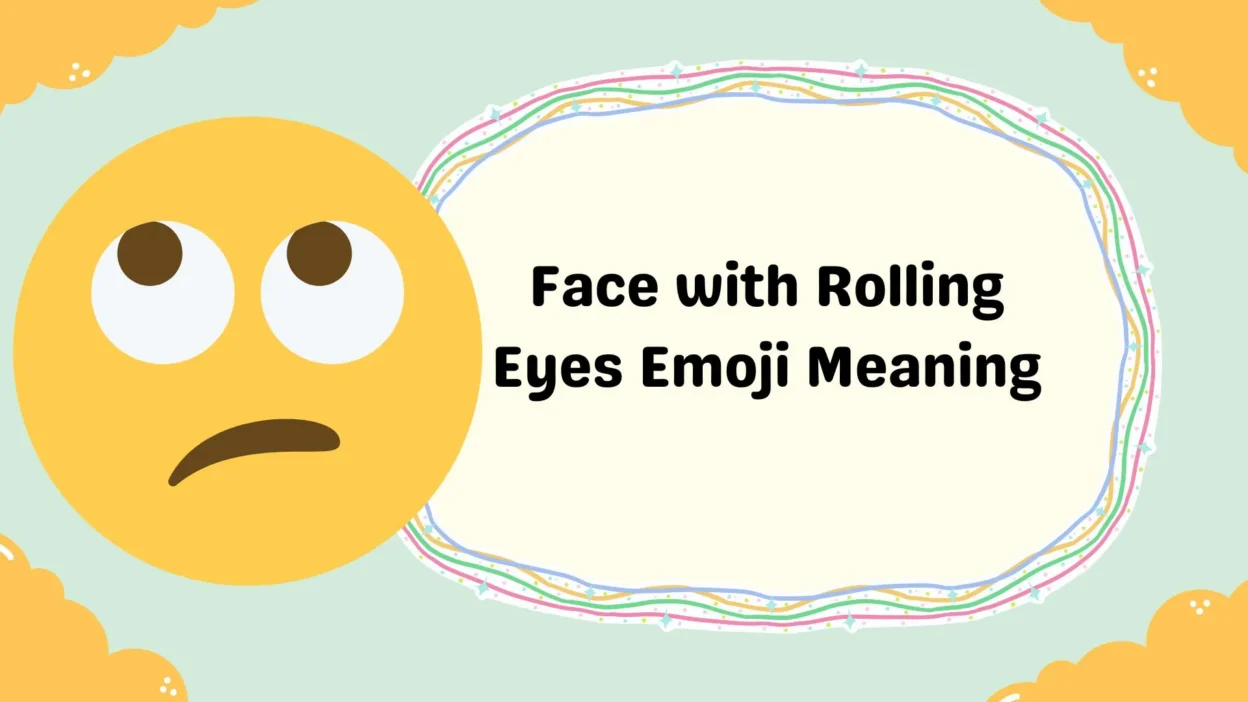
The Face with Rolling Eyes Emoji 🙄 is a popular way to express annoyance, disbelief, sarcasm, boredom, or frustration without saying it directly.
Its exaggerated eye-rolling expression can add a strong emotional tone to a message, especially when someone finds a comment irritating, obvious, repetitive, or ridiculous.
Depending on the conversation, 🙄 may mean “Seriously?”, “Here we go again,” “I can’t believe this,” or simply show that someone is not impressed.
Quick Answer:
The face with rolling eyes emoji (🙄) shows mild annoyance, sarcasm, disbelief, or the feeling that something is obvious, silly, or over-the-top. It is the digital version of literally rolling your eyes at a comment, situation, or person.
What Does “Face with Rolling Eyes Emoji Meaning” Mean?
The face with rolling eyes emoji is an official Unicode emoji that depicts a yellow face looking upward with the eyes rolled toward the top of the head. One eye is usually more visible than the other, giving the clear impression of an exaggerated eye-roll.
In plain English, it means “I’m not impressed,” “Seriously?”, “Oh please,” or “That’s ridiculous.” It is the visual equivalent of the physical gesture people make when they hear something inconsiderate, dramatic, or completely expected.
The most common meaning is mild frustration mixed with sarcasm or disbelief. It is rarely angry in a strong way. Instead it sits in that middle zone of “I can’t believe this” or “Here we go again.” Because the expression is so recognizable, people across different countries and languages understand it quickly even if they speak different native languages.
Meaning in Different Contexts
The face with rolling eyes emoji stays pretty consistent in core meaning, but the exact flavor changes with the platform, the relationship between the people, and the surrounding text.
Everyday Conversation
In casual spoken-style chats between friends or family, the emoji often softens a critical comment. Someone might type “You’re late again 🙄” instead of sounding purely scolding. It keeps the message light while still showing mild irritation.
Text Messages
Texting is where this emoji shines. Without tone of voice or facial expressions, messages can feel flat or harsh. Adding 🙄 signals “I’m teasing” or “I’m annoyed but not furious.” It prevents the other person from reading the message as colder than intended.
Social Media
On public posts and comments, the face with rolling eyes emoji frequently appears under content the user finds pretentious, repetitive, or overhyped. People drop it under influencer posts, political takes they disagree with, or the same viral trend they’ve seen ten times already.
WhatsApp group chats love this emoji. When the group is planning something and one person keeps changing the plan, or when someone shares an obvious “hot take,” 🙄 appears quickly. In one-to-one chats it often means gentle teasing between people who know each other well.
Snapchat
On Snapchat the emoji shows up in replies to stories or in private snaps. Because Snaps disappear, the tone stays playful and temporary. Friends use it when someone posts a dramatic story or a humble-brag.
Instagram comments and DMs use the face with rolling eyes emoji for sarcasm toward captions, outfit choices, or relationship posts that feel performative. In Stories it can appear as a reaction sticker when someone finds the content extra or predictable.
TikTok
TikTok comments are fast and reaction-heavy. The emoji often lands under videos that are trying too hard, repeating the same sound for the hundredth time, or delivering an “obvious” life tip. It works as a quick, silent judgment.
Gaming
In gaming chats and Discord servers, 🙄 appears when a teammate makes a basic mistake, claims something unrealistic, or starts complaining. It is a low-effort way to call out the behavior without typing a full sentence that might start an argument.
Professional Communication
In work chats the face with rolling eyes emoji is risky. Some teams use it lightly among close colleagues when a meeting runs long or a deadline shifts again. In formal channels or with managers it is usually better avoided because it can look unprofessional or passive-aggressive.
Internet Slang
Online, the emoji has become part of broader internet language. It often pairs with phrases like “sure Jan,” “okay then,” or “cool story.” It can also stand alone as a full reaction, replacing the need for words entirely.
Examples of “Face with Rolling Eyes Emoji Meaning”
Here are five realistic examples that show how the emoji works in everyday messages.
- Sentence: “He said he’ll text me back this time 🙄”
Meaning: The speaker does not believe the promise and expects the same pattern to continue.
Situation: A friend talking about someone who has flaked before. - Sentence: “Another meeting that could have been an email 🙄”
Meaning: Mild frustration mixed with the feeling that the situation is unnecessary.
Situation: Workplace chat after a long, unproductive call. - Sentence: “She posted another gym selfie with the same caption 🙄”
Meaning: The poster finds the content repetitive or attention-seeking.
Situation: Comment or private message reacting to an Instagram post. - Sentence: “You’re telling me the Wi-Fi is down again? 🙄”
Meaning: Disbelief and annoyance at a recurring problem.
Situation: Family group chat when the internet fails during an important moment. - Sentence: “Of course the one day I leave early the boss asks for a last-minute report 🙄”
Meaning: Sarcastic acceptance of bad timing.
Situation: Texting a coworker or friend about an unlucky work day.
These examples show the emoji’s flexibility. It can express skepticism, shared frustration, or light judgment without needing a long explanation.
When Do People Use “Face with Rolling Eyes Emoji”?
People reach for the face with rolling eyes emoji in situations that feel mildly irritating, predictable, or over-the-top. Common triggers include broken promises, repeated complaints, obvious statements, dramatic stories, and plans that keep changing.
Who uses it? Almost everyone who texts or uses social media, from teenagers to adults in their thirties and forties. Younger users tend to drop it more casually and frequently. Older users often reserve it for stronger moments of disbelief.
People choose this emoji because it is efficient. One character can replace a whole sentence of “I can’t believe this” or “That is so typical.” It also softens criticism so the message feels less aggressive than pure text would.
Appropriate situations include chats with friends, casual family groups, and informal team channels where the relationship is solid. Inappropriate situations include first messages to strangers, formal work emails, customer service conversations, and any context where the other person might take the eye-roll personally and feel insulted.
Different Meanings of “Face with Rolling Eyes Emoji”
While the core idea stays the same, the emoji can lean in a few slightly different directions.
Mild Annoyance
Definition: Soft irritation without real anger.
Context: Everyday inconveniences.
Example: “Traffic is inexplicable again 🙄”
Sarcasm
Definition: Saying the opposite of what is meant, with a visual cue.
Context: When someone states the obvious or makes a weak excuse.
Example: “Wow, what a surprise 🙄”
Disbelief
Definition: Finding something hard to accept or too convenient.
Context: Unbelievable stories or sudden changes of plan.
Example: “He said the dog ate his homework 🙄”
Exasperation
Definition: Feeling worn out by a repeated issue.
Context: Ongoing problems that keep returning.
Example: “The printer is jammed for the third time today 🙄”
Playful Teasing
Definition: Light-hearted mockery between people who get along.
Context: Friendly banter.
Example: “You finally woke up before noon 🙄”
Most of the time these shades overlap, and the surrounding words decide which one is strongest.
Origin of “Face with Rolling Eyes Emoji”
The face with rolling eyes emoji was approved as part of Unicode 8.0 in 2015 and added to Emoji 1.0 the same year. It joined a wave of facial expression emojis that aimed to capture more nuanced human reactions beyond simple smiles and frowns.
The design was created by the Unicode Consortium with input from major tech companies. Early versions on different platforms looked slightly different—some had more dramatic eyes, others looked calmer—but the upward gaze remained consistent. Over time the designs became more standardized so the meaning stayed clear across iPhone, Android, and web.
The physical eye-roll gesture itself is much older. It has been used in Western cultures for decades as a silent sign of disdain or boredom. Bringing that gesture into digital form simply translated a well-known body language cue into text conversations. No single inventor or viral meme “created” the emoji; it grew naturally from the need to express mild contempt or skepticism online.
Similar Words and Alternatives
Several other emojis and phrases can stand in for the face with rolling eyes emoji, each with a slightly different tone.
- Face with raised eyebrow (🤨) , more suspicion or skepticism, less pure annoyance.
- Unamused face (😒) , stronger displeasure, closer to being genuinely unimpressed.
- Expressionless face (😑) , flatter boredom or “I have no reaction left.”
- Smirking face (😏) , more playful or knowing than irritated.
- “Sure” or “Okay then” , text versions that carry similar sarcasm.
- “Oh please” or “Give me a break” , longer verbal alternatives.
The face with rolling eyes emoji sits between the unamused face and the raised-eyebrow face. It is more active and judgmental than a blank expression, yet usually lighter than pure anger emojis.
Common Mistakes
One frequent mistake is using the face with rolling eyes emoji in professional or first-time conversations. What feels playful to the sender can read as rude or dismissive to the receiver.
Another error is assuming the emoji always means strong dislike. In many friend groups it is closer to affectionate teasing. Context and relationship matter more than the emoji alone.
People also sometimes overuse it. Dropping 🙄 under every single message can make the sender seem constantly negative or hard to please.
Tips to avoid confusion:
- Match the emoji to the relationship.
- Pair it with clarifying words when the tone might be unclear.
- Notice how the other person uses it first and mirror their style.
- When in doubt, choose a softer reaction or just words.
Frequently Asked Questions
What does the face with rolling eyes emoji mean in texting?
It usually signals mild annoyance, sarcasm, or the feeling that something is obvious or ridiculous. The exact tone depends on the conversation and how well the people know each other.
Is the face with rolling eyes emoji rude?
It can feel rude if used with strangers or in formal settings. Among friends it is often taken as playful or lightly critical rather than mean.
When should I avoid using the face with rolling eyes emoji?
Skip it in job-related messages, customer service chats, early dating conversations, and any situation where the other person might take the eye-roll personally.
Does the face with rolling eyes emoji mean the same on every platform?
The core meaning stays the same, but slight design differences exist between Apple, Google, Samsung, and other companies. The upward eye direction is consistent enough that people understand it across devices.
Can the face with rolling eyes emoji be flirtatious?
Rarely. It is not a classic flirting emoji. In very close relationships it might appear during playful teasing, but it is not the go-to choice for showing romantic interest.
What is the difference between 🙄 and 😒?
The face with rolling eyes (🙄) feels more active and dramatic. The unamused face (😒) feels flatter and more genuinely displeased.
Why do people use the face with rolling eyes emoji so much?
It is quick, expressive, and fills the gap left by missing tone of voice and body language in text. One emoji can replace a longer explanation of irritation or disbelief.
Conclusion
The face with rolling eyes emoji is a simple but powerful way to show mild annoyance, sarcasm, disbelief, or the sense that something is over-the-top. Its meaning stays relatively steady across texts, social media, and messaging apps, yet the exact flavor always depends on context and relationship.
You’ve now seen clear definitions, platform differences, real examples, appropriate situations, related emojis, common mistakes, and answers to frequent questions. The next time 🙄 appears in your chat or comments, you’ll understand the intention behind it instead of guessing.