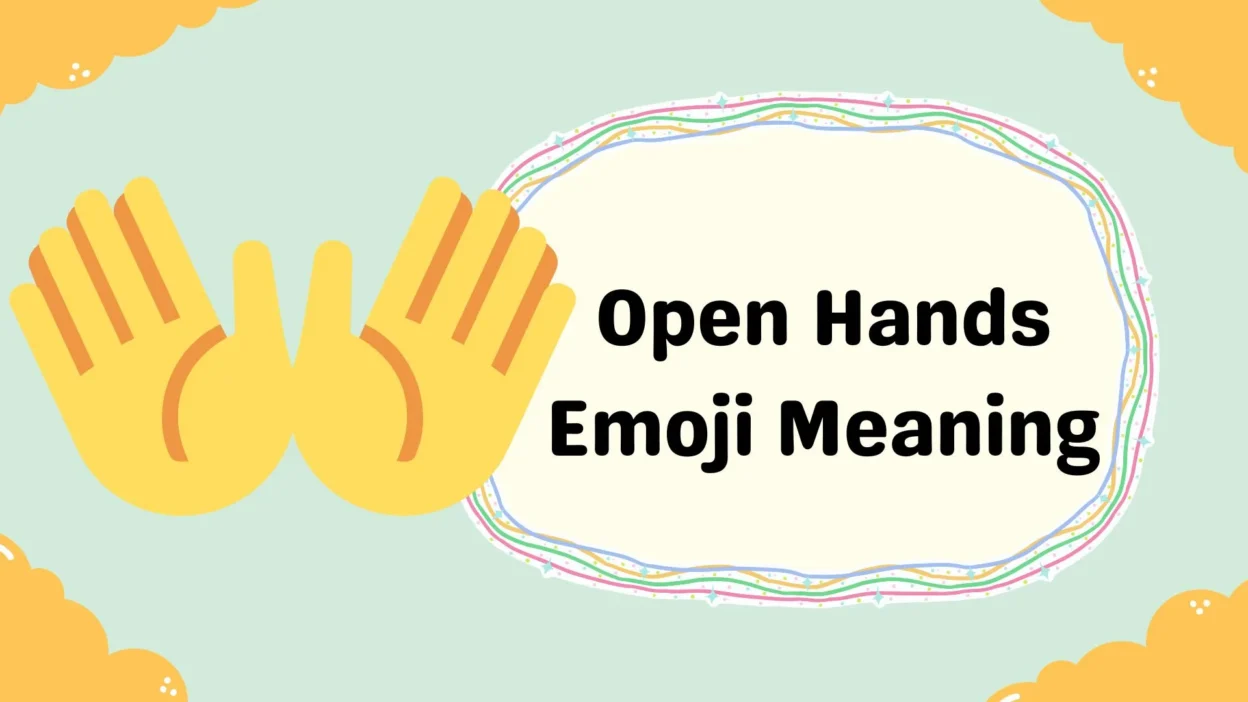
The Open Hands Emoji 👐 is a friendly and expressive symbol that can communicate openness, warmth, support, celebration, or a welcoming attitude.
Its meaning often depends on the conversation and the emotions behind the message. People may use 👐 to show that they are offering a hug, welcoming someone, celebrating good news, or expressing excitement and positivity.
In some contexts, it can also suggest “I’m here for you,” “come here,” or “what can I do?” Because the open palms create a warm and inviting feeling, this emoji is often used casually between friends, family members, and people who feel comfortable with each other.
Meaning & Definition
The open hands emoji (🤲), officially called “Palms Up Together” in the Unicode standard, shows two cupped hands held together with palms facing upward. At its core, it represents giving, receiving, offering, or asking , almost like someone holding out their hands to accept something, offer something, or pray.
Primary meaning: Openness, vulnerability, an offering, or a gesture of prayer/blessing.
Secondary/alternative meanings:
- Requesting or begging (“please” or “I need this”)
- Gratitude or humility in a spiritual sense
- Giving a gift or presenting something (“here, take this”)
- Openness to love or connection, especially in dating contexts
Example messages:
- “Sending you all my positive energy today 🤲” , a gesture of care or blessing.
- “Can you help me out with this project? 🤲” , a soft, polite way of asking for something.
Background & Origin
The 🤲 emoji was added to the Unicode 8.0 standard in 2015 as part of a broader push to expand hand-gesture emojis beyond the classic thumbs-up and clapping hands. It was designed to visually mirror the universal human gesture of cupped, upward-facing palms , a pose found across cultures in prayer, offering, and pleading.
As emoji keyboards became richer and expressive texting exploded on platforms like WhatsApp, Instagram, and Twitter/X, the open hands emoji found its niche among users who wanted a gentler, more spiritual or emotionally open alternative to the folded 🙏 “praying hands” emoji. Over time, it also picked up secondary uses in charity, fundraising, and wellness spaces, where “giving” and “receiving” imagery resonates strongly.
Usage in Different Contexts
Texting or chat messages: Friends often use 🤲 to soften a request or express hope. “Fingers crossed for the interview 🤲”
Social media platforms: On Instagram and TikTok captions, it frequently appears alongside gratitude posts, spiritual content, or manifestation trends. “Grateful for this life 🤲✨”
Professional or technical settings: In fundraising emails, nonprofit newsletters, or donation campaigns, 🤲 is used to visually represent “giving” or “support needed.” “Every contribution helps us reach our goal 🤲”
Platform-Specific Meanings
| Platform | Common Meaning | Example Use |
| Blessing, hope, or asking for help | “Hope you feel better soon 🤲” | |
| Gratitude, spirituality, manifestation | “Manifesting good things 🤲” | |
| TikTok | Prayer, wishing luck, emotional captions | “Wish me luck tomorrow 🤲” |
| Snapchat | Casual affection, support | “Thinking of you 🤲” |
| Twitter/X | Requests, solidarity, charity appeals | “RT if you agree 🤲” |
Other Fields Using the Abbreviation
Beyond texting, 🤲 shows up in several niche spaces:
- Religious and spiritual contexts , representing prayer, surrender, or blessing across multiple faiths.
- Charity and fundraising , symbolizing giving and receiving support.
- Yoga and wellness communities , representing openness, gratitude, and mindfulness.
- Motivational and self-help content , paired with affirmations about “receiving abundance” or “letting go.”
Common Misconceptions & Mistakes
One of the biggest mix-ups is confusing 🤲 (Palms Up Together) with 🙏 (Folded Hands / Praying Hands). While both relate to prayer or gratitude, 🙏 is typically used for “please” or “thank you,” while 🤲 leans more toward “offering” or “receiving.”
People also confuse it with 👐 (Open Hands, two hands spread apart), which more commonly represents a hug or celebration, not prayer or giving.
Common pitfall: Sending 🤲 to imply “I need help” when the receiver interprets it as a spiritual or religious gesture , context always matters.
Similar Terms & Alternatives
| Emoji | Meaning | Example Use |
| 🙏 | Praying hands / please / thank you | “Thank you so much 🙏” |
| 👐 | Open hands / hug / celebration | “Come here! 👐” |
| 🫶 | Heart hands / love and support | “Love you 🫶” |
| 🤗 | Hugging face / warm embrace | “Sending hugs 🤗” |
How to Respond , Chat Examples
With a friend: Friend: “Big exam tomorrow, wish me luck 🤲” You: “You’ve got this! Sending good vibes your way 🤲”
With a crush: Crush: “Hope we get to hang out soon 🤲” You: “Same here, I’d love that 😊”
With a colleague: Colleague: “Hoping the client approves the proposal 🤲” You: “Fingers crossed! Let me know as soon as you hear back.”
Differences from Similar Words
While 🤲 leans toward openness and offering, other related concepts carry different emotional weight:
- Secret implies withholding , the opposite of 🤲’s openness.
- Private suggests boundaries, while 🤲 signals vulnerability and invitation.
- Confidential is formal and restrictive; 🤲 is warm and expressive.
In short, 🤲 is about giving and receiving openly, not concealment.
Relevance in Online Conversations & Dating Apps
On dating apps, 🤲 often signals emotional openness or hopefulness , someone showing they’re receptive to connection without being overly forward. It’s softer than a heart emoji but still conveys warmth.
Example: “Hoping this one works out 🤲” in a bio or opening message suggests optimism and genuine interest without pressure.
Popularity & Trends Over Time
Interest in emoji meanings, including 🤲, tends to spike alongside broader social media trends , manifestation culture, gratitude journaling, and spiritual wellness content have all boosted its usage on Instagram and TikTok in recent years. While it doesn’t trend as heavily as emojis like 😭 or ❤️, it remains a steady favorite in captions related to hope, faith, and personal growth.
FAQs
1. What does the open hands emoji mean in texting? It generally means openness, hope, giving, or a gentle request for help or support.
2. Is 🤲 the same as 🙏? No. 🤲 represents open, upward palms (offering/receiving), while 🙏 represents folded hands (please/thank you/prayer).
3. Can I use 🤲 in a romantic text? Yes , it conveys warmth and openness without being overly intense, making it suitable for early-stage dating conversations.
4. Is the open hands emoji religious? It can carry spiritual or religious connotations, but it’s also widely used in secular, everyday contexts like gratitude or requests.
5. What’s the difference between 🤲 and 👐? 🤲 shows cupped palms together (offering/prayer), while 👐 shows two open hands apart (hug/celebration).
Conclusion
The open hands emoji (🤲) is a small but meaningful symbol of openness, giving, and hope.
Whether it’s used to send good vibes to a friend, express gratitude on social media, or soften a request to a colleague, its meaning shifts subtly with context. The next time you spot 🤲 in a message, take a moment to read the room , because with emojis, tone is everything.