Warm feelings don’t always need a long message, and the 🤗 emoji can say a lot with just one simple expression. The Hugging Emoji Meaning is generally connected with affection, warmth, friendliness, support, comfort, and happiness. People often use it when they want to make a message feel kinder or show someone that they care.
You may notice 🤗 in conversations between friends, family members, couples, or even people who are getting to know each other. It can be used as a virtual hug when someone needs encouragement, after sharing good news, or when saying goodbye. Depending on the context, it may also give a message a sweet, cheerful, or welcoming feeling.
In this guide, you’ll discover the Hugging Emoji Meaning in texting, relationships, friendships, and social media. We’ll explore what 🤗 can mean from a guy or girl, when people commonly use it, and simple examples that make its meaning easy to understand.
Quick answer: The hugging emoji 🤗 means a virtual hug. It shows warmth, support, gratitude, affection, or excitement. Most people use it to say “sending you a hug,” “thank you,” or “I’m happy for you.”
What Does “Hugging Emoji Meaning” Mean?
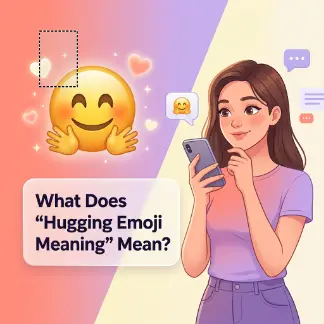
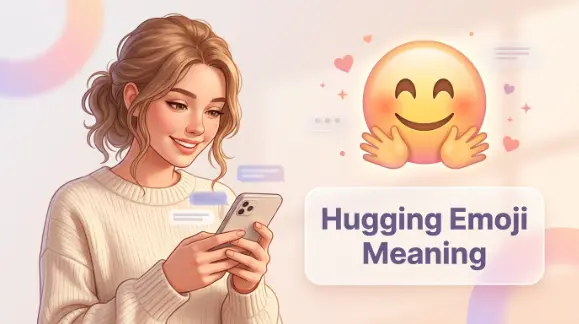
The hugging emoji is a yellow face with a big smile, rosy cheeks, and two open hands reaching out. Officially it is called Smiling Face with Open Hands, though many still call it the Hugging Face emoji. Its Unicode name is HUGGING FACE.
In plain English it means “I want to give you a hug.” The open hands look like someone stretching their arms toward you. The smile makes the gesture friendly and positive.
The most common meaning is a digital hug that brings comfort, shows care, or expresses thanks. It can also mean simple excitement or a cheerful “yay.” Context decides the exact feeling, but the core idea stays the same: warmth and connection without words.
Meaning in Different Contexts
The hugging emoji meaning stays friendly in most places, yet the exact feeling changes with the app, the relationship, and the moment.
Everyday Conversation
In casual talk between friends or family, 🤗 usually means pure affection. Someone might send it after a good conversation or when they miss you. It feels like a soft “I’m glad you’re here.”
Text Messages
In one-to-one texts the hugging emoji often softens a message. After sharing bad news a friend may reply with “That’s rough 🤗.” The emoji turns a simple reply into emotional support. Between couples it can feel gentle and caring without being overly romantic.
Social Media
On platforms like Facebook or X (formerly Twitter) people drop 🤗 under posts that share good news or personal stories. It works as a quick reaction that says “I’m happy for you” or “sending love.”
WhatsApp users love the hugging emoji for family groups and close friends. It appears after “Good night,” after someone shares a photo of their kids, or when someone needs encouragement. In many countries it has become a standard way to show care in chat.
Snapchat
On Snapchat the emoji often shows up in streaks or private snaps. It can mean “I appreciate this streak” or simply “thinking of you.” Because snaps disappear, the warm tone of 🤗 helps keep the conversation light and positive.
Instagram comments and DMs use 🤗 a lot under personal posts, selfies, or life updates. A friend might comment “You look amazing 🤗” or “So proud of you 🤗.” It feels warmer than a simple heart and less intense than heart-eyes.
TikTok
TikTok comments frequently include the hugging emoji under emotional videos or success stories. Creators and viewers use it to show support. Sometimes it appears with the people-hugging emoji 🫂 for extra emphasis.
Gaming
In gaming chats the hugging emoji is less common than celebration or anger symbols, yet players still use it after a hard match or when a teammate needs a boost. It can mean “nice try, we got this next time.”
Professional Communication
In work chats the hugging emoji appears carefully. Close teammates might use it after a successful project or to thank someone for help. In more formal settings people usually avoid it and stick to thumbs-up or simple words.
Internet Slang
Online, 🤗 sometimes stands for “jazz hands” because the open palms look like a theatrical gesture. People use it for playful excitement or even mild sarcasm. In rare cases it can feel slightly awkward if the hands look too grabby on certain devices.
Examples of “Hugging Emoji”
Here are five real-life examples that show how the hugging emoji works in daily messages.
- Sentence: “I got the job today! 🤗”
Meaning: Excitement mixed with gratitude and a desire to share the good news.
Situation: A friend texts the group after a successful interview. - Sentence: “Sorry you’re having a tough day. Sending a big hug 🤗”
Meaning: Comfort and emotional support.
Situation: Someone just shared that they feel stressed or sad. - Sentence: “Thank you so much for helping me move 🤗”
Meaning: Sincere appreciation.
Situation: After a friend spent the afternoon carrying boxes. - Sentence: “Can’t wait to see you this weekend 🤗”
Meaning: Warm anticipation and affection.
Situation: Planning a visit with a close friend or family member. - Sentence: “You did an amazing job on the presentation 🤗”
Meaning: Praise and encouragement.
Situation: A coworker or classmate offering positive feedback.
When Do People Use “Hugging Emoji”?
People reach for the hugging emoji in moments that call for warmth. Common situations include:
- Offering comfort after bad news
- Saying thank you for a favor or kind words
- Celebrating good news with a friend
- Sending a virtual goodbye or good-night
- Softening a message so it feels less abrupt
- Showing support during hard times
Who uses it? Almost everyone who texts or posts online. Teenagers, parents, coworkers, and couples all send 🤗. Younger users may lean toward the clearer 🫂 people-hugging emoji, while many adults still prefer the classic smiling face with open hands.
People choose it because a real hug is impossible through a screen. The emoji fills that gap with a friendly picture. It works best with people you already know well. In professional emails or with strangers it can feel too personal. Avoid it when the conversation is serious and formal, or when someone has clearly said they do not want physical affection language.
Different Meanings of “Hugging Emoji”
The hugging emoji carries a few related but distinct meanings.
1. Virtual hug / affection
Definition: A digital embrace that shows care.
Context: Personal chats, family messages, close friendships.
Example: “Miss you already 🤗”
2. Gratitude and appreciation
Definition: A warm “thank you.”
Context: After someone helps or compliments you.
Example: “Thanks for listening 🤗”
3. Comfort and support
Definition: Emotional backup during tough times.
Context: When a friend shares problems.
Example: “I’m here if you need anything 🤗”
4. Excitement or celebration
Definition: Happy energy, sometimes read as jazz hands.
Context: Good news or playful moments.
Example: “We finally finished the project 🤗”
5. Friendly welcome
Definition: An open invitation or greeting.
Context: New group chats or reunions.
Example: “Welcome to the team 🤗”
In rare cases some people read the open hands as slightly awkward or even ironic. The overall tone remains positive when used with people who understand the emoji.
Origin of “Hugging Emoji”
The hugging emoji first appeared in 2015. Unicode added it under the name HUGGING FACE as part of Unicode 8.0 and Emoji 1.0. Designers wanted a clear way to send a digital hug. Earlier internet culture already used text hugs such as ({) or (hug), and Japanese kaomoji like \(^-^)/ showed similar open-arm excitement.
Platform makers created slightly different versions. On some phones the hands reach outward; on others they curve inward. This small difference led many people to call it the jazz-hands emoji. In 2018 Elon Musk famously tweeted about the connection after his phone suggested 🤗 when he typed “jazz hands.”
Because the original design did not always look like a clear hug, Unicode later approved the People Hugging emoji 🫂 in 2020. That newer symbol shows two figures actually embracing and is often preferred for pure comfort messages. The company Hugging Face, a major open-source AI platform, chose the emoji as its logo, giving 🤗 an extra life in the tech world.
The emoji continues to evolve with culture. What started as a simple hug symbol now carries layers of gratitude, excitement, and online friendliness.
Similar Words and Alternatives
Several emojis and phrases express similar feelings.
- 🫂 People Hugging – a clearer picture of two people embracing; best for deep comfort
- 👐 Open Hands – pure open-arm gesture without a face
- 🙌 Raising Hands – celebration and praise
- 🥰 Smiling Face with Hearts – stronger romantic or deep affection
- 😊 Smiling Face with Smiling Eyes – simple friendliness without the hug
- ❤️ Red Heart – general love or like
- Text alternatives: “sending hugs,” “big hug,” “virtual hug,” or the old-school hugs
The main difference is clarity. 🤗 keeps the friendly face and open hands. 🫂 focuses on the actual embrace. Choose based on how strong or soft you want the message to feel.
Common Mistakes
Many people mix up the hugging emoji with other symbols or misread its tone.
Incorrect: Thinking 🤗 always means romantic interest.
Correct: It usually means friendly care unless the rest of the conversation is clearly flirty.
Incorrect: Using it in very formal work emails.
Correct: Save it for casual team chats with people you know well.
Incorrect: Assuming every platform shows the same design.
Correct: Hands look slightly different on Apple, Android, and other systems, so meaning stays the same even if the picture changes.
Tip: Always look at the full message and your relationship with the sender. If the tone feels unclear, simply ask “Did you mean a virtual hug?” Most people are happy to clarify.
Frequently Asked Questions
1. What does the hugging emoji mean from a girl?
It usually means warmth, support, or friendly affection. Context and the rest of the message decide if any flirting is intended.
2. What does the hugging emoji mean from a guy?
Same core meaning: virtual hug, thanks, or encouragement. Many guys use it simply as a kind closer to a message.
3. Is the hugging emoji the same as jazz hands?
Officially no. It was designed as a hug. Many people still call it jazz hands because of the open palms, especially after the popular 2018 comments.
4. When was the hugging emoji created?
It was approved in 2015 as part of Unicode 8.0 and Emoji 1.0.
5. What is the difference between 🤗 and 🫂?
🤗 shows one smiling face with open hands. 🫂 shows two people actually hugging and feels more like a real embrace.
6. Can the hugging emoji be used at work?
Yes, with close colleagues in casual chats. Avoid it in formal emails or with people you do not know well.
7. Why do some people find the hugging emoji creepy?
The open hands can look a bit grabby on certain designs. Most users still see it as friendly, especially when the message is positive.
Conclusion
The hugging emoji meaning is simple at its heart: a warm virtual hug. It lets people share affection, gratitude, comfort, and excitement across any distance. You will meet 🤗 in everyday texts, social media comments, WhatsApp family groups, and friendly online chats. Its exact feeling depends on context, yet the positive spirit stays constant.
Remember that a newer people-hugging emoji exists when you want an even clearer embrace. Always read the full message and your relationship with the sender before deciding what 🤗 means. With a little attention to context, this cheerful yellow face becomes one of the kindest tools in digital conversation. Next time someone sends you 🤗, you will know exactly how to reply, with understanding and maybe a hug of your own.