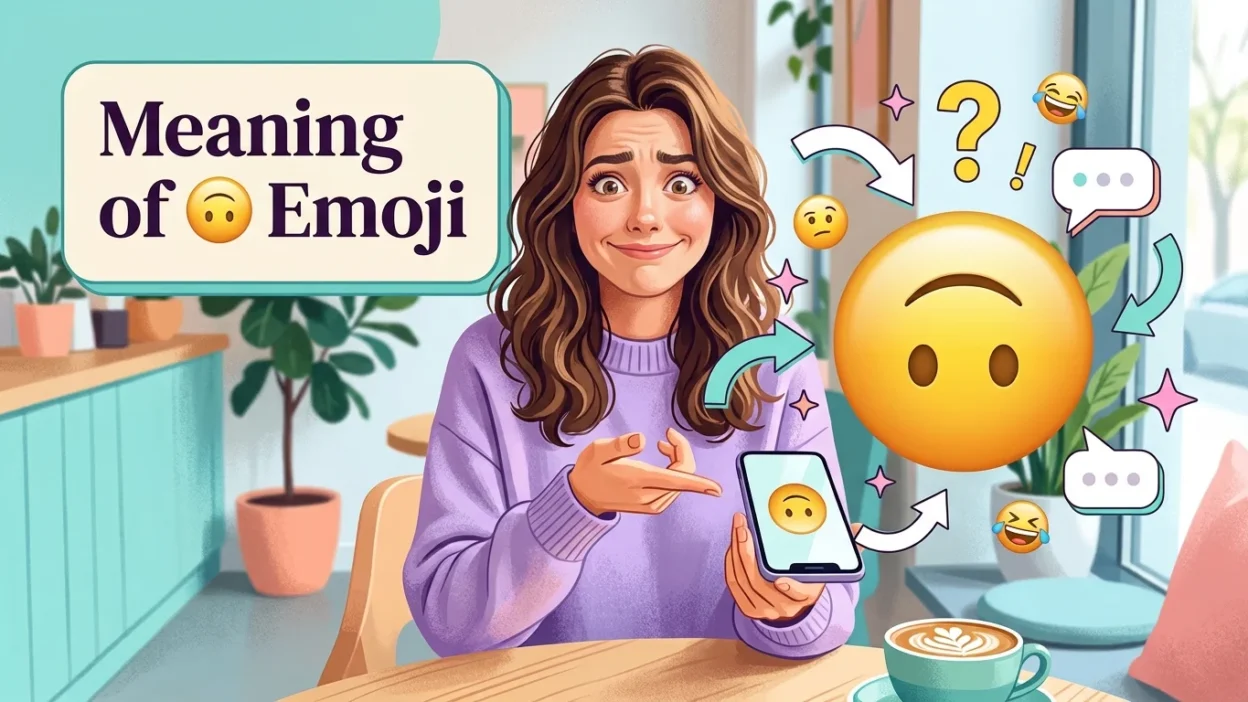
If you have ever received a 🙃 in a text and wondered, “Wait… is this person joking, annoyed, or actually happy?” you are not alone. The meaning of 🙃 emoji can feel confusing because its smile does not always represent simple happiness.
The 🙃 emoji is officially called Upside-Down Face. It shows a smiling face turned upside down, and people commonly use it to add irony, sarcasm, silliness, awkwardness, or mild frustration to a message. Its exact meaning depends heavily on the words around it and the relationship between the people chatting.
You may see this emoji in text messages, WhatsApp chats, Instagram comments, Snapchat conversations, TikTok posts, and everyday social media. Sometimes it means “I’m joking.” At other times, it quietly communicates, “Everything is going wrong, but I’m trying to laugh about it.”
In this guide, you will learn the meaning of 🙃 emoji, its different uses, examples, meanings in texting and social media, its history, common misunderstandings, and how to tell what someone probably means from context.
Quick Answer: What Does 🙃 Mean?
The 🙃 emoji, called Upside-Down Face, usually means sarcasm, irony, silliness, awkwardness, mild frustration, or “oh well.” It can also show that someone is smiling or joking about an uncomfortable or ridiculous situation. The exact meaning depends on the conversation and tone.
What Does “meaning of 🙃 emoji” Mean?
The meaning of 🙃 emoji is not limited to one emotion. It is one of those emojis where the surrounding message matters almost as much as the emoji itself.
The emoji shows a familiar smiling face turned upside down. That unusual position makes the normal smile feel different. Instead of simply saying “I’m happy,” it can suggest that something is strange, ironic, ridiculous, or not going as planned.
Unicode officially identifies 🙃 as U+1F643, UPSIDE-DOWN FACE. Unicode lists it among the smiling-face emojis, while its keyword annotations include terms such as “face,” “hehe,” “smile,” and “upside-down.”
The Most Common Meaning of 🙃
In everyday online communication, 🙃 commonly communicates:
- Sarcasm
- Irony
- Playful humor
- Silliness
- Awkwardness
- Mild frustration
- Resignation
- “Oh well”
- Trying to stay positive when something is going wrong
For example:
“I studied all night and the test was about the one chapter I skipped 🙃”
Here, the emoji probably does not mean the person is genuinely cheerful. Instead, it adds a humorous, slightly frustrated tone.
What Does the Upside-Down Face Literally Mean?
Literally, 🙃 is a smiling face turned upside down.
There is no hidden literal phrase such as “I am sad” or “I am angry.” Its emotional meaning developed through how people use it in digital communication.
This is important because emojis do not always work like dictionary words. Their meaning can change with context, culture, relationships, and online habits.
Meaning of 🙃 Emoji in Different Contexts
The meaning of 🙃 emoji can change depending on where and how someone uses it. A message from a close friend may have a completely different tone from the same emoji used by a coworker.
Everyday Conversation
In everyday conversation, 🙃 often adds a playful or ironic tone.
Someone might say:
“I accidentally sent the message to the wrong person 🙃”
The emoji suggests embarrassment mixed with humor. The person knows the situation is awkward, but they are trying not to take it too seriously.
It can also communicate a simple “Well, that happened” feeling.
Text Messages
In text messages, 🙃 is often used when someone wants to make a statement sound less serious or more sarcastic.
For example:
“You were supposed to remind me about the meeting 🙃”
Depending on the relationship, this could be a playful complaint rather than a serious accusation.
The emoji softens the words while also hinting that the sender is annoyed.
Social Media
On social media, 🙃 is commonly used when people comment on something strange, ironic, embarrassing, or relatable.
For example:
“Me pretending I have my life together 🙃”
Here, the emoji strengthens the joke. The person is openly admitting that things may not be as organized as they appear.
On WhatsApp, 🙃 can have several meanings because people use it in both casual and serious conversations.
A friend might send:
“My internet stopped working during my online exam 🙃”
The emoji can mean frustration, disbelief, and humor at the same time.
In WhatsApp conversations, the best way to understand it is to read the entire message rather than interpreting 🙃 alone.
Snapchat
On Snapchat, 🙃 can signal awkward humor, teasing, or a funny situation.
For example:
“I told my mom I was sleeping and she just walked in 🙃”
The emoji adds a “Well… this is awkward” feeling.
On Instagram, people often use 🙃 in comments, captions, Stories, and direct messages.
A caption such as:
“Another Monday morning 🙃”
usually communicates mild frustration or reluctant acceptance rather than genuine excitement.
TikTok
TikTok users may use 🙃 when reacting to relatable or ridiculous situations.
For example:
“When you spend two hours getting ready and your plans get canceled 🙃”
Here, the emoji reinforces the irony of the situation.
Gaming
In gaming conversations, 🙃 can express frustration in a humorous way.
For example:
“My teammate disconnected right before the final round 🙃”
The player may be annoyed, but the emoji makes the complaint sound more playful.
Professional Communication
Be more careful with 🙃 at work.
A close colleague may understand it as harmless humor. However, a manager, client, or new coworker may interpret it as sarcasm, passive aggression, or irritation.
For example:
“The report was changed again 🙃”
A friend may laugh at this. In a professional email, however, it could sound annoyed or unprofessional.
When communication is formal, clear words are usually safer than relying on an ambiguous emoji.
Examples of “meaning of 🙃 emoji”
Seeing real examples makes the meaning of 🙃 emoji much easier to understand.
Example 1: Something Went Wrong
Sentence:
“I forgot my umbrella and it started raining 🙃”
Meaning:
The person is frustrated but trying to laugh about the situation.
Situation:
Something inconvenient happened, but the person does not want to sound overly negative.
Example 2: Sarcasm
Sentence:
“Yeah, because getting three hours of sleep is exactly what I needed 🙃”
Meaning:
The person probably means the opposite of the literal words.
Situation:
They are using sarcasm to joke about being tired.
Example 3: Awkward Moment
Sentence:
“I waved back at someone who wasn’t waving at me 🙃”
Meaning:
The person feels embarrassed and finds the situation funny.
Situation:
An awkward social moment happened.
Example 4: Resignation
Sentence:
“The train is delayed again 🙃”
Meaning:
The person is saying something like, “Of course this happened again.”
Situation:
They are disappointed or mildly frustrated but have accepted that there is not much they can do.
Example 5: Self-Deprecating Humor
Sentence:
“I accidentally deleted the file I worked on all day 🙃”
Meaning:
The person is frustrated with themselves but is presenting the mistake humorously.
Situation:
They made an annoying mistake and are trying to laugh about it.
Example 6: Playful Teasing
Sentence:
“You remembered my birthday one day late 🙃”
Meaning:
This could be a playful complaint.
Situation:
A friend forgot an important date, and the sender is teasing them.
Example 7: “Oh Well”
Sentence:
“I missed the last bus 🙃”
Meaning:
The emoji can communicate, “Well, that’s unfortunate. What can I do?”
Situation:
The person has accepted an inconvenient situation.
Example 8: Pretending Everything Is Fine
Sentence:
“Everything is completely under control 🙃”
Meaning:
The person may actually mean that things are definitely not under control.
Situation:
The emoji creates an ironic contrast between the words and the actual situation.
When Do People Use 🙃?
People use 🙃 when they want to communicate an emotion that sits somewhere between a normal smile and a negative reaction.
It is especially useful when plain words do not capture the tone.
When Something Is Ridiculous
If a situation makes little sense, 🙃 can communicate disbelief mixed with humor.
“They canceled the event five minutes before it started 🙃”
The emoji says, in effect, “Seriously?”
When Something Is Awkward
🙃 works well after an embarrassing moment.
“I called my teacher ‘Mom’ today 🙃”
The sender is embarrassed but can laugh at the mistake.
When Someone Is Mildly Frustrated
The emoji can soften a complaint.
“My phone died at 99% 🙃”
The sender is probably annoyed, but the message remains casual.
When Someone Is Being Sarcastic
🙃 is often used to signal that the literal words should not be taken completely seriously.
“I absolutely love waiting two hours for customer service 🙃”
The sender almost certainly does not mean that waiting is enjoyable.
When Someone Is Being Silly
Not every use is negative.
Someone may use 🙃 simply because they are being goofy or playful.
“Look at me trying to cook without reading the recipe 🙃”
The emoji can make the message feel lighthearted.
Appropriate Situations
🙃 is generally suitable for:
- Casual conversations
- Friend groups
- Social media
- Memes
- Informal texting
- Playful conversations
- Light complaints
- Jokes and teasing
Situations Where You Should Be Careful
Use it carefully in:
- Job applications
- Formal emails
- Customer complaints
- Serious discussions
- Business communication
- Sensitive conversations
- Conversations with people who may not understand your humor
An emoji can change the perceived tone of a message. A playful 🙃 to one person may look passive-aggressive to another.
Different Meanings of 🙃 Emoji
Although the official name is simply Upside-Down Face, users have developed several common interpretations.
🙃 Meaning: Sarcasm
One of the most common uses is sarcasm.
Definition:
Saying something that sounds positive while actually meaning something different.
Context:
The situation is clearly not as good as the words suggest.
Example:
“Fantastic. Another meeting that could have been an email 🙃”
The emoji helps signal that “fantastic” is sarcastic.
🙃 Meaning: Irony
🙃 can highlight an ironic situation.
Definition:
A situation where the outcome is very different from what would normally be expected.
Context:
Something happens that feels almost absurd.
Example:
“I bought a waterproof phone case and then lost my phone in the ocean 🙃”
The emoji emphasizes the irony.
🙃 Meaning: Awkwardness
Sometimes 🙃 means, “This is embarrassing.”
Definition:
A playful way to acknowledge an uncomfortable social moment.
Context:
You made a mistake or experienced an awkward situation.
Example:
“I said goodbye and then walked in the same direction as them for five minutes 🙃”
🙃 Meaning: Mild Frustration
The emoji can express annoyance without sounding extremely angry.
Definition:
A humorous way to show that something went wrong.
Context:
A small inconvenience or disappointing event.
Example:
“The website crashed right before I finished the form 🙃”
🙃 Meaning: “Oh Well”
Sometimes the emoji expresses resignation.
Definition:
Accepting something disappointing because there is little you can do about it.
Context:
Plans fail or something unexpected happens.
Example:
“I missed the movie by five minutes 🙃”
The hidden message may be, “Oh well, it happens.”
🙃 Meaning: Pretending Everything Is Fine
This is one of the most recognizable modern uses.
Definition:
Acting cheerful while acknowledging that something is actually going badly.
Context:
The person knows the situation is difficult or ridiculous.
Example:
“My computer crashed after I forgot to save the project 🙃”
The smile is intentionally out of place.
🙃 Meaning: Playfulness
Sometimes there is no serious frustration at all.
Definition:
A silly or goofy expression.
Context:
Friends are joking around.
Example:
“I wore my shirt backward all day 🙃”
The sender is simply laughing at themselves.
🙃 Meaning From a Girl
The meaning of 🙃 from a girl cannot be determined simply from her gender.
A girl may use 🙃 to express sarcasm, awkwardness, frustration, humor, teasing, or resignation, just like anyone else.
For example:
“He said he would be here at 7. It’s 8:30 🙃”
This may communicate mild annoyance.
But:
“I just ate the whole cake 🙃”
could simply be playful self-deprecating humor.
The surrounding words, previous messages, and relationship matter more than gender.
🙃 Meaning From a Guy
The meaning of 🙃 from a guy also depends on context rather than gender.
A guy might use it after making a silly mistake:
“I locked my keys inside the car 🙃”
He may be laughing at himself.
He could also use it sarcastically:
“Sure, I’ll do all the work again 🙃”
That may indicate frustration.
Therefore, do not automatically assume that 🙃 means flirting, attraction, anger, or romantic interest when a guy sends it.
Does 🙃 Mean Flirting?
Not necessarily.
🙃 is not specifically a flirting emoji. It can appear in flirtatious conversations, but the emoji itself does not prove romantic interest.
For example:
“You really think you’re funny 🙃”
In a playful conversation, this could be teasing.
However:
“I forgot to send the document 🙃”
has no obvious romantic meaning.
If you want to understand whether someone is flirting, look at the whole conversation, not just one emoji.
Does 🙃 Mean “I’m Fine”?
Sometimes, but usually with a twist.
When someone says:
“I’m totally fine 🙃”
the upside-down face may suggest that they are not actually fine.
It can communicate:
“I’m fine… technically.”
or:
“I’m trying to act fine, but this situation is ridiculous.”
The emoji creates contrast between the cheerful words and the uncomfortable reality.
🙃 vs 🙂: What’s the Difference?
These two emojis look closely related, but their tone can be very different.
| Emoji | Common meaning |
| 🙂 | Mild happiness, friendliness, politeness |
| 🙃 | Irony, sarcasm, awkwardness, silliness, mild frustration |
For example:
“Okay 🙂”
can sound calm, friendly, or polite.
“Okay 🙃”
may sound more like, “Okay… sure,” especially after something frustrating.
However, neither emoji has one universal emotional meaning. The surrounding conversation remains important.
🙃 vs 🫠: What’s the Difference?
🙃 and 🫠 can both appear when something is going badly, but they often communicate different feelings.
🙃 Upside-Down Face usually suggests irony, sarcasm, awkwardness, or “I’m smiling even though this is ridiculous.”
🫠 Melting Face often communicates embarrassment, exhaustion, discomfort, overwhelm, or feeling like you are mentally melting.
For example:
“I sent the private message to the group chat 🙃”
could emphasize awkward irony.
“I have been working for 14 hours 🫠”
better communicates exhaustion or being overwhelmed.
🙃 vs 😅: What’s the Difference?
😅 usually communicates nervous laughter, relief, embarrassment, or an awkward situation.
🙃 more often adds irony, sarcasm, resignation, or absurd humor.
Compare:
“I almost missed my flight 😅”
This suggests nervous relief.
“I got to the airport two hours early and somehow still missed my flight 🙃”
This emphasizes the ridiculousness of the situation.
Origin of 🙃 Emoji
The official name of 🙃 is Upside-Down Face, and its Unicode code point is U+1F643. Unicode approved it as part of Unicode 8.0 in 2015, and it was also included in Emoji 1.0 that year.
However, the idea of an upside-down smiley existed before its official Unicode standardization.
According to Emojipedia’s historical research, Google introduced an upside-down face among a group of emojis for Gmail in 2008. Those designs were influenced by earlier Japanese mobile-phone emoji sets.
Emojipedia also connects Google’s earlier upside-down face to Japanese emoji and kaomoji history. One relevant Japanese term discussed in its research is 逆立ち (sakadachi), associated with being upside down, a handstand, or a headstand.
Eventually, the upside-down face became part of Unicode as U+1F643. This standardization allowed the character to be represented consistently across modern digital systems, although the visual design can differ slightly between platforms.
Unicode currently lists 🙃 under the Smileys & Emotion category with the short name upside-down face.
Its modern online use expanded beyond the literal idea of being upside down. People began using it for sarcasm, awkwardness, frustration, irony, silliness, and the feeling of pretending everything was fine.
So, while the emoji has an official name, its everyday emotional meaning comes largely from how people use it in real conversations.
Similar Words and Alternatives to 🙃
Sometimes you may want to express the same idea without using an emoji.
“Oh well”
This is a close alternative when 🙃 means resignation.
“I missed the bus. Oh well.”
It communicates acceptance without much emotional intensity.
“Seriously?”
This works when 🙃 expresses disbelief.
“They canceled the event again. Seriously?”
It sounds more direct.
“Well, that happened”
This phrase is useful after something awkward or unexpected.
“I called the wrong person. Well, that happened.”
It has a similar humorous resignation.
“I can’t even”
This is more dramatic and often used when something is extremely frustrating or ridiculous.
“The app deleted my order. I can’t even.”
“LOL”
LOL can indicate that something is funny, but it does not necessarily communicate the irony or resignation that 🙃 can.
“Haha”
“Haha” is usually a straightforward marker of laughter. 🙃 can communicate a more complicated emotion.
🤦 Face Palm
🤦 often shows embarrassment, frustration, or disbelief.
Compared with 🙃, it is usually more direct and stronger.
😬 Grimacing Face
😬 can represent awkwardness or discomfort.
It is useful when the main feeling is “This is uncomfortable.”
😏 Smirking Face
😏 can suggest smugness, confidence, teasing, or flirtation.
It should not automatically be treated as equivalent to 🙃.
Common Mistakes When Using 🙃
Because 🙃 is so flexible, people sometimes misunderstand it.
Mistake 1: Assuming It Always Means Happiness
The face is smiling, but that does not mean the sender is simply happy.
A message such as:
“My flight got canceled 🙃”
probably does not mean the person is delighted.
The smile may be ironic.
Mistake 2: Assuming It Always Means Sarcasm
Sarcasm is common, but it is not the only use.
Someone may use 🙃 to show silliness, awkwardness, self-deprecating humor, or simple playfulness.
Mistake 3: Treating It as a Flirting Emoji
🙃 is not inherently romantic.
If someone sends it during a flirtatious conversation, the surrounding conversation determines whether the message is actually flirtatious.
Mistake 4: Reading Too Much Into One Emoji
One emoji rarely provides enough information to understand someone’s full emotion.
Consider:
- What did they say before it?
- What happened in the conversation?
- Are they joking?
- How do they normally text?
- What is your relationship with them?
These clues provide much more information than the emoji alone.
Mistake 5: Using It in Serious Professional Messages
A sarcastic-looking emoji can create confusion at work.
Instead of:
“The client changed everything again 🙃”
a professional message could say:
“The client has requested several additional changes.”
The second version is clearer and less likely to be misunderstood.
Mistake 6: Assuming Every Platform Uses the Same Design
The basic character is the same Unicode emoji, but its visual appearance can vary between platforms and vendors.
Unicode identifies the character as U+1F643, while individual platforms may render it differently.
How to Understand 🙃 in a Text
If someone sends you 🙃 and you are unsure what they mean, do not immediately assume they are angry or flirting.
Use a simple context-checking approach.
Look at the Words
Read the sentence before the emoji.
“I forgot my wallet 🙃”
This probably indicates frustration or embarrassment.
“You’re finally here 🙃”
This could be teasing or mild annoyance.
Look at the Situation
If something went wrong, 🙃 often adds humorous frustration.
If the conversation is playful, it may simply make the message sillier.
Look at the Relationship
A close friend may use 🙃 in dozens of ways because you already understand their humor.
Someone you barely know may use it more cautiously.
Look at the Other Emojis
Emoji combinations can add clues.
For example:
🙃😂
Often makes the situation clearly humorous.
🙃😭
May suggest humorous frustration or emotional overwhelm.
🙃😅
Can emphasize awkwardness or embarrassment.
🙃❤️
Could be playful or affectionate, but the heart does not automatically make the message romantic.
Frequently Asked Questions
What is the meaning of 🙃 emoji?
The meaning of 🙃 emoji usually involves irony, sarcasm, silliness, awkwardness, mild frustration, or resignation. It can also mean “oh well” or “I’m trying to laugh about this.”
What does 🙃 mean in texting?
In texting, 🙃 often adds a humorous or ironic tone. It may mean that something is awkward, frustrating, ridiculous, or not going according to plan.
Is 🙃 a negative emoji?
Not necessarily. 🙃 can express mild frustration or awkwardness, but it can also be playful, silly, or humorous. Context determines whether the feeling is positive, negative, or somewhere in between.
Does 🙃 mean sarcasm?
Often, yes. 🙃 is commonly used to signal sarcasm or irony, especially when the literal words sound more positive than the actual situation.
What does 🙃 mean from a girl?
There is no special universal meaning of 🙃 from a girl. She could be expressing sarcasm, awkwardness, frustration, humor, teasing, or resignation. Her message and the conversation provide the real context.
What does 🙃 mean from a guy?
A guy may use 🙃 to show sarcasm, awkwardness, humor, mild frustration, or resignation. The emoji itself does not prove flirting, attraction, or anger.
Is 🙃 a flirting emoji?
Not by itself. 🙃 can appear in flirtatious conversations, but it is not specifically a romantic or flirting emoji. You need to consider the complete conversation and relationship.
Conclusion
The meaning of 🙃 emoji is more complicated than its simple smile suggests. Officially called Upside-Down Face, 🙃 commonly adds irony, sarcasm, silliness, awkwardness, mild frustration, or resignation to a message. People may use it when something goes wrong, when they are joking about themselves, or when they want to say “oh well” without sounding too serious.
The emoji does not have one fixed emotional meaning. A message like “I missed the bus 🙃” can show frustration, while “I wore my shirt backward all day 🙃” may simply express playful embarrassment. The same emoji can also sound different depending on the relationship between the people chatting.