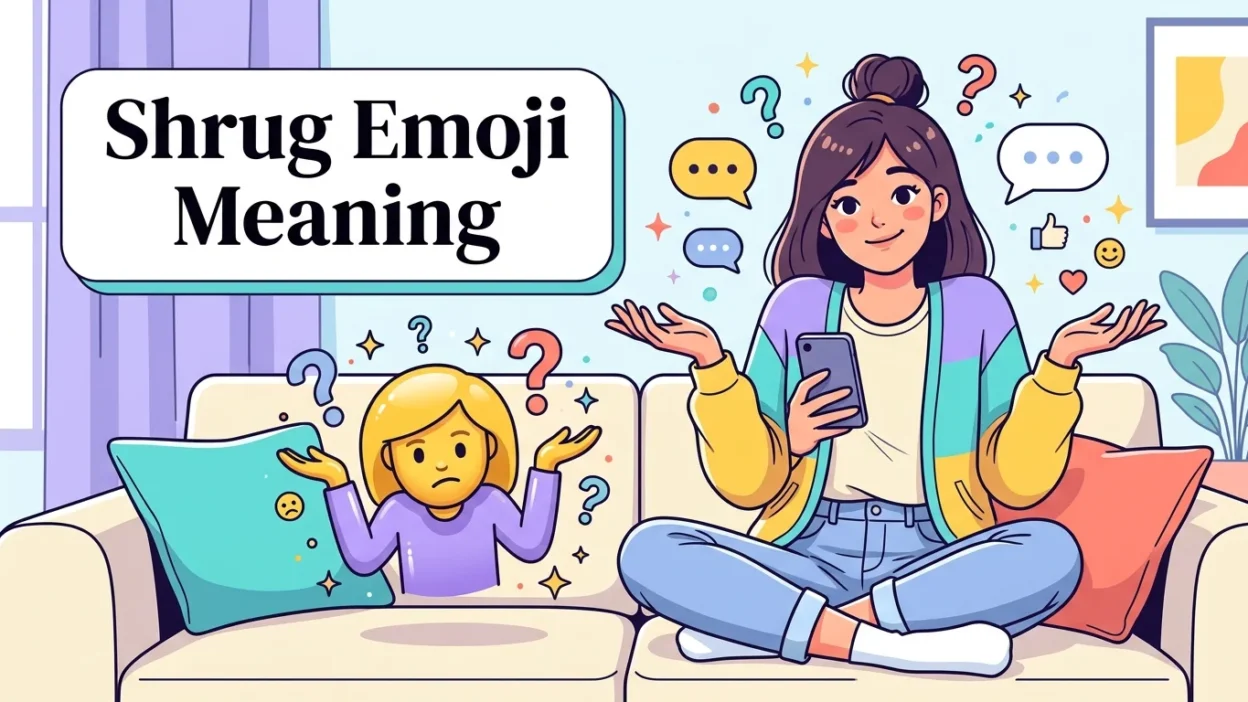
A simple shrug can say a lot without using many words, and the same is true in texting. The Shrug Emoji Meaning usually expresses uncertainty, indifference, confusion, or a casual “I don’t know” feeling. People often use it when they don’t have an answer or don’t want to take something too seriously.
In everyday conversations, the shrug emoji can make a message sound more relaxed and less formal. Depending on the situation, it might show that someone is unsure about what happened, doesn’t have an opinion, or simply doesn’t care much about the outcome. It can also be used humorously when someone makes a playful or unexpected comment.
If you’re searching for the Shrug Emoji Meaning, this guide will explain what it means in texting, social media, friendships, and different conversations. You’ll also find simple examples to help you understand when and how to use it naturally.
Quick Answer:
The shrug emoji 🤷 usually means “I don’t know,” “Who knows?”, “I’m not sure,” “Whatever,” or “I don’t really care.” It represents a person shrugging their shoulders to show uncertainty, doubt, lack of knowledge, or indifference.
The exact meaning depends on the surrounding words and the tone of the conversation.
Example:
“I have no idea what happened 🤷” = “I don’t know what happened.”
What Does “Shrug Emoji Meaning” Mean?
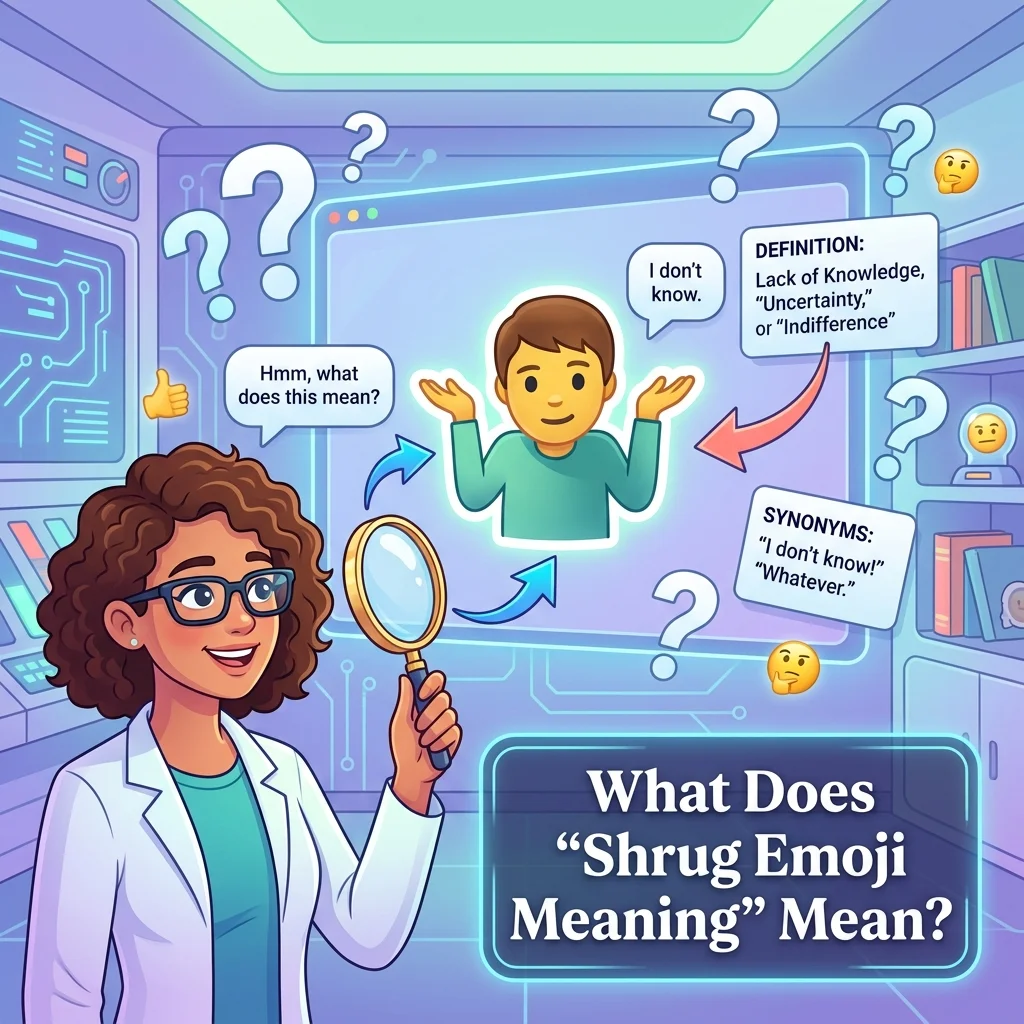
The shrug emoji 🤷 represents a person shrugging their shoulders. A shoulder shrug is a common body gesture used when someone does not know an answer, feels uncertain, or does not consider something important enough to worry about.
In digital communication, 🤷 turns that physical gesture into a quick visual response.
The most common meanings include:
- I don’t know.
- I’m not sure.
- Who knows?
- I have no idea.
- Maybe.
- Whatever.
- It is what it is.
- I don’t really care.
- What can I do?
- I’m just guessing.
Unicode officially lists the emoji as “person shrugging.” Its associated keywords include ideas such as doubt, “dunno,” guess, “IDK,” ignorance, indifference, maybe, shrugging, whatever, and “who.”
The Literal Meaning of 🤷
Literally, 🤷 shows a person making a shrugging gesture.
When people shrug in real life, they may raise their shoulders, lift their hands, and make a facial expression that suggests uncertainty. The emoji copies that familiar gesture.
For example:
“Where did Sarah go? 🤷”
Here, the emoji can mean:
“I don’t know.”
The Most Common Meaning
The most common interpretation of 🤷 is uncertainty or not knowing.
However, it can also express indifference. That is why context matters.
Compare these:
“I don’t know what time the movie starts 🤷”
→ The person genuinely does not know.
“They don’t like my decision 🤷”
→ The person may mean, “I don’t really care.”
The emoji itself does not tell you exactly which meaning is intended. The words around it provide the missing context.
Meaning of the Shrug Emoji in Different Contexts
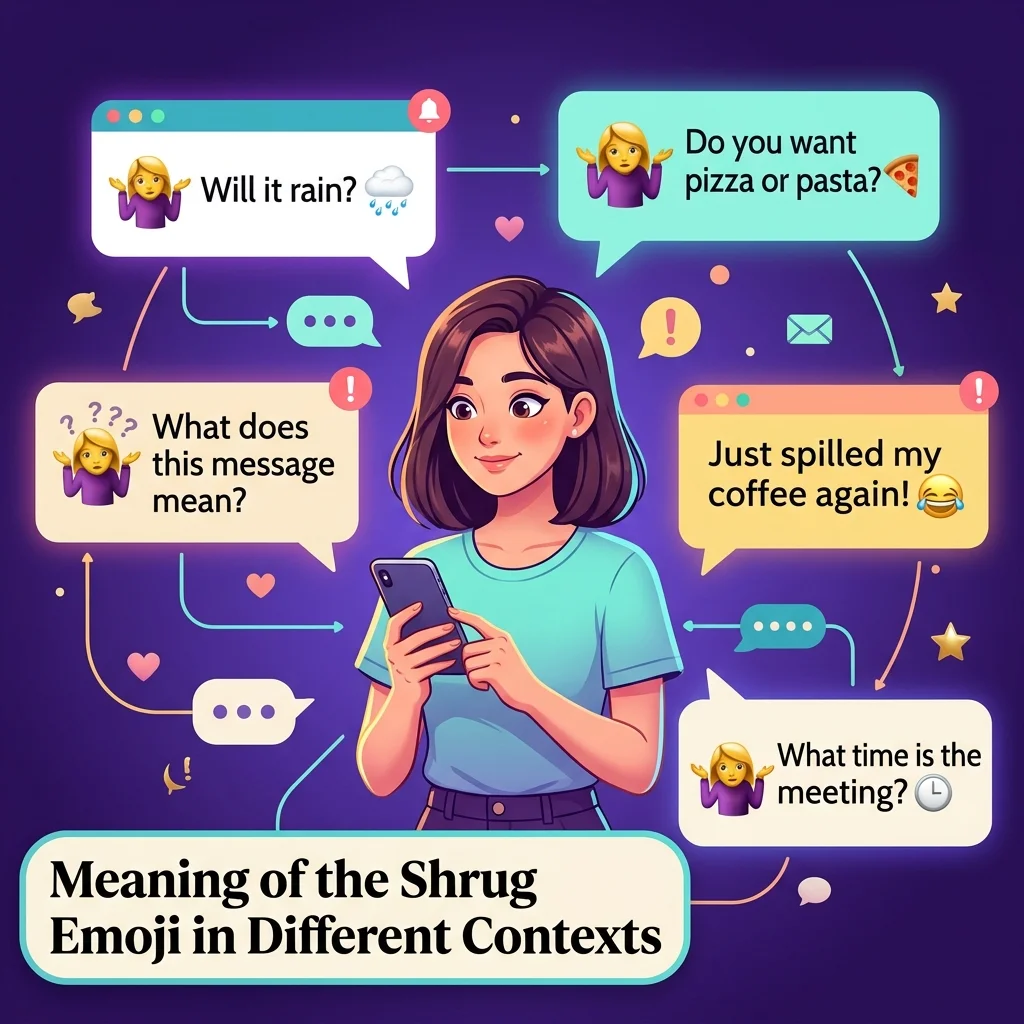
The shrug emoji meaning can change slightly depending on where and how someone uses it. The same 🤷 can sound friendly in one conversation and dismissive in another.
Everyday Conversation
In everyday conversation, 🤷 usually represents a normal shoulder shrug.
Someone might use it after saying:
“I honestly have no idea 🤷”
Here, the emoji makes the message feel more natural and casual.
It can also soften an uncertain answer:
“Maybe we’ll go tomorrow 🤷”
This suggests that the person is unsure about the plan.
Text Messages
In text messages, 🤷 is often used as a replacement for a short phrase such as “I don’t know” or “Who knows?”
For example:
“Why did he leave the group chat?”
“No idea 🤷”
It can also communicate that the sender does not have enough information to answer.
Because text messages do not include facial expressions or body language, emojis help communicate emotional tone.
Social Media
On social media, people often use 🤷 when commenting on opinions, situations, trends, or personal experiences.
For example:
“Everyone has a different opinion 🤷”
In this case, the emoji can suggest acceptance rather than confusion.
It may communicate:
“That’s just how things are.”
On WhatsApp, 🤷 is commonly used in casual conversations with friends, family members, classmates, and coworkers.
For example:
“Are you coming tonight?”
“I might 🤷”
The emoji makes the answer sound uncertain.
Another example:
“Why didn’t they invite me?”
“I don’t know 🤷”
Here, the emoji reinforces the idea that the sender does not know the reason.
Snapchat
On Snapchat, 🤷 can be used as a quick reaction to a message or story.
For example:
“I might delete this later 🤷”
The sender may be expressing uncertainty or showing that they are not too concerned about what happens next.
On Instagram, 🤷 frequently appears in comments and captions.
Someone might write:
“Apparently this is the new trend 🤷”
This can suggest mild disbelief, uncertainty, or indifference.
The tone can range from playful to sarcastic depending on the rest of the caption.
TikTok
TikTok users may use 🤷 when discussing trends, opinions, relationships, or unexpected situations.
For example:
“People either love it or hate it 🤷”
Here, the emoji can mean:
“I don’t know what to tell you.”
It can also add a casual or humorous tone to a caption.
Gaming
Gamers may use 🤷 when they do not know why something happened during a game.
For example:
“Why did our teammate leave?”
“No clue 🤷”
It can also be used when someone does not know how an opponent performed a particular move.
Professional Communication
The shrug emoji is more context-dependent in professional communication.
Using 🤷 with close coworkers may be acceptable in an informal workplace chat. However, it can appear careless or dismissive in a formal email, business proposal, customer message, or serious workplace discussion.
Instead of:
“I don’t know 🤷”
a professional message might be:
“I’m not sure, but I’ll check and get back to you.”
The emoji is not inherently unprofessional. The situation, relationship, and workplace culture determine whether it fits.
Examples of the Shrug Emoji 🤷
Here are some realistic examples showing how shrug emoji meaning changes with context.
Example 1: “I don’t know 🤷”
Sentence:
“I don’t know where he went 🤷.”
Meaning:
The sender genuinely does not know where the person went.
Situation:
A friend asks where someone is, but you do not have the answer.
Example 2: “Maybe tomorrow 🤷”
Sentence:
“Are you going to the party?”
“Maybe tomorrow 🤷.”
Meaning:
The person is uncertain about the plan.
Situation:
Someone has not decided whether they will attend an event.
Example 3: “Who knows? 🤷”
Sentence:
“Who knows? 🤷 Maybe they will change their mind.”
Meaning:
The future is uncertain.
Situation:
You are discussing something that nobody can predict.
Example 4: “It is what it is 🤷”
Sentence:
“The tickets are sold out 🤷.”
Meaning:
The sender accepts the situation and does not think there is much they can do.
Situation:
Something disappointing has happened, but the person has decided to move on.
Example 5: “Whatever 🤷”
Sentence:
“If they don’t want to come, whatever 🤷.”
Meaning:
The sender is showing indifference.
Situation:
Someone has decided not to attend, and the speaker is saying that the decision does not matter much to them.
Example 6: “I’m just guessing 🤷”
Sentence:
“I think the answer is B 🤷.”
Meaning:
The sender is not confident about their answer.
Situation:
Someone is answering a question without knowing for sure.
Example 7: “Why did she block me? 🤷”
Sentence:
“Why did she block me? 🤷 I honestly don’t know.”
Meaning:
The sender has no explanation for the person’s action.
Situation:
Someone is discussing an unexpected social media situation.
When Do People Use the Shrug Emoji?
People usually use 🤷 when they want to communicate something that would normally be expressed with a shoulder shrug.
Common situations include:
When They Don’t Know Something
This is probably the most common use.
“What time does the store close? 🤷”
Meaning:
“I don’t know.”
When They Are Unsure
Someone may use 🤷 when they have not made a decision.
“Should I buy it? 🤷”
This suggests uncertainty.
When They Are Guessing
The emoji can show that an answer is only a guess.
“I think he is around 30 🤷.”
The sender is making it clear that they are not certain.
When They Don’t Care Much
🤷 can also express indifference.
“They don’t like the way I dress 🤷.”
The hidden message may be:
“That’s their problem. I don’t really care.”
When They Accept a Situation
Sometimes the emoji communicates acceptance.
“The plan didn’t work out 🤷.”
This can mean:
“It didn’t work, but there’s nothing we can do about it.”
When They Want to Sound Casual
A short answer such as “I don’t know” can sound blunt in a text.
Adding 🤷 can make it feel more conversational:
“I don’t know 🤷”
The emoji adds the feeling of a real-life shrug.
Different Meanings of the Shrug Emoji
Although 🤷 has one basic visual idea, it can communicate several related meanings.
1. “I Don’t Know”
Definition:
The sender does not know the answer.
Context:
Questions, explanations, facts, or situations where the sender lacks information.
Example:
“Where is Mike?”
“I’m not sure 🤷.”
2. “Who Knows?”
Definition:
The answer is unknown or impossible to predict.
Context:
Future events, uncertain situations, or unanswered questions.
Example:
“Maybe they will come back. Who knows? 🤷”
3. “I’m Not Sure”
Definition:
The sender has an opinion but lacks confidence.
Context:
Guesses, decisions, predictions, and uncertain answers.
Example:
“I think that’s the right answer 🤷.”
4. “Whatever”
Definition:
The sender is showing that something does not matter much to them.
Context:
Arguments, disagreements, minor problems, or personal choices.
Example:
“If he doesn’t agree, whatever 🤷.”
5. “I Don’t Care”
Definition:
The sender is expressing indifference.
Context:
Situations where the outcome is not important to the sender.
Example:
“They can say whatever they want 🤷.”
Be careful with this interpretation because “I don’t care” can sound stronger or colder than the emoji itself.
6. “It Is What It Is”
Definition:
The sender accepts something they cannot change.
Context:
Disappointments, mistakes, delays, or unexpected outcomes.
Example:
“We missed the bus 🤷.”
This can suggest:
“We missed it, and there isn’t much we can do now.”
7. “What Can I Do?”
Definition:
The sender feels that they have limited control over a situation.
Context:
Problems that are difficult or impossible to change.
Example:
“I tried calling them, but they didn’t answer 🤷.”
The implied meaning may be:
“I tried. What else can I do?”
What Does 🤷 Mean From a Guy?
When a guy sends 🤷, it does not automatically have a romantic meaning.
In most conversations, it simply means “I don’t know,” “I’m unsure,” “Who knows?”, or “Whatever.”
For example:
“Are you coming tonight?”
“Not sure 🤷.”
That usually expresses uncertainty rather than flirting.
In a relationship conversation, however, the surrounding message matters.
For example:
“Do you still like her?”
“I don’t know 🤷.”
This could show uncertainty, avoidance, or unwillingness to give a clear answer. The emoji alone cannot tell you what the person’s feelings are.
What Does 🤷 Mean From a Girl?
When a girl sends 🤷, the basic meaning is also usually uncertainty, doubt, indifference, or “I don’t know.”
For example:
“Are you going to talk to him?”
“Maybe 🤷.”
The emoji makes the response sound casual and uncertain.
It should not automatically be interpreted as flirting, annoyance, or romantic interest. Those meanings depend on the complete conversation.
What Does 🤷 Mean in a Relationship?
In relationship conversations, 🤷 can have several meanings.
It may mean:
- “I don’t know how I feel.”
- “I’m not sure.”
- “Who knows what will happen?”
- “I don’t want to argue about this.”
- “It doesn’t matter to me.”
- “What can I do?”
- “I’m not going to explain further.”
For example:
“Do you think we’ll work things out? 🤷”
This could communicate uncertainty about the future.
However, you should not interpret one emoji as proof of someone’s feelings. Look at the words, previous messages, and overall communication style.
Is the Shrug Emoji Rude?
Not necessarily. The shrug emoji can be completely harmless and friendly.
For example:
“I don’t know 🤷”
usually sounds casual.
However, 🤷 can sound dismissive when it follows a serious complaint or emotional message.
For example:
“I worked all day on this project.”
“Whatever 🤷.”
In this situation, the emoji may make the response sound uncaring.
The difference comes from context and tone, not from the emoji alone.
Is 🤷 a Positive or Negative Emoji?
The shrug emoji is generally neutral, but its emotional tone can change.
It can be:
- Neutral when someone does not know something.
- Playful when someone is joking.
- Casual when someone is uncertain.
- Indifferent when someone does not care.
- Slightly dismissive during an argument.
- Sarcastic when used with certain statements.
For example:
“I have no idea 🤷”
is neutral.
But:
“You don’t like my decision? 🤷”
may sound dismissive.
🤷 vs ¯_(ツ)_/¯
The emoji 🤷 and the text-based shrug ¯_(ツ)_/¯ express a very similar idea.
Both can mean:
- I don’t know.
- Who knows?
- Whatever.
- It is what it is.
- I don’t care.
- What can I do?
The difference is mostly in format.
🤷 is a standard emoji.
¯_(ツ)_/¯ is a text-based emoticon often called a “shruggie.” Emojipedia notes that the text shrug is associated with the same gesture and meaning as the person-shrugging emoji.
The text version can feel more internet-style or playful, while 🤷 is easier to type on modern phones.
🤷 vs 🤦
These two emojis are easy to confuse, but their meanings are different.
🤷 Person Shrugging usually means:
“I don’t know,” “Whatever,” or “Who knows?”
🤦 Person Facepalming usually expresses frustration, disbelief, embarrassment, or exasperation. Unicode lists terms such as disbelief, exasperation, and “SMH” among its associated keywords for 🤦.
Compare:
“Where did he go? 🤷”
“Why would he do that? 🤦”
The first shows uncertainty. The second shows frustration or disbelief.
🤷 vs 😐
The neutral face 😐 generally communicates a blank, neutral, or unimpressed reaction.
The shrug 🤷 communicates an action: the person is shrugging because they may not know, may be uncertain, or may not care.
For example:
“I don’t know 🤷”
makes sense because the shrug reinforces uncertainty.
Meanwhile:
“Okay 😐”
may suggest a flat or unimpressed reaction.
🤷 vs 🤔
The thinking face 🤔 usually suggests thinking, considering, questioning, or trying to understand something.
The shrug 🤷 more often suggests uncertainty or lack of knowledge.
Compare:
“Let me think 🤔.”
This means the person is considering an answer.
“I have no idea 🤷.”
This means the person does not know.
Origin of the Shrug Emoji
The modern shrug emoji has roots in the much older human gesture of shrugging the shoulders.
People have long used a shoulder shrug as a nonverbal way to communicate uncertainty, lack of knowledge, indifference, or limited responsibility. Digital communication later represented this gesture through text emoticons and, eventually, a dedicated emoji.
The text version ¯_(ツ)_/¯ became particularly recognizable in internet culture. It is often called the “shruggie.”
The Unicode emoji 🤷 Person Shrugging was approved in Unicode 9.0 in 2016 under the name “Shrug” and added to Emoji 3.0 that same year.
Gender-specific versions, including 🤷♂️ Man Shrugging and 🤷♀️ Woman Shrugging, were also introduced in 2016. They are constructed using the person-shrugging emoji together with a gender symbol through a Zero Width Joiner sequence.
Today, the standard 🤷 is known as Person Shrugging, and Unicode’s current emoji data associates it with keywords such as “doubt,” “dunno,” “guess,” “IDK,” “ignorance,” “indifference,” “maybe,” “whatever,” and “who.”
Why the Emoji May Look Different
The design of 🤷 can vary between Apple, Google, Microsoft, Samsung, and other platforms.
The basic gesture stays recognizable, but the person’s face, hair, clothing, skin tone, hand position, and other visual details may differ.
That means two people can send the same emoji and see slightly different artwork on their devices. The underlying Unicode character remains the same.
Similar Words and Alternatives
Several words and expressions can communicate an idea similar to 🤷.
“I Don’t Know”
This is the clearest alternative.
“I don’t know 🤷.”
Use it when you genuinely do not have an answer.
“Who Knows?”
This is useful when the answer is uncertain or impossible to predict.
“Who knows? 🤷”
“No Idea”
This is a casual alternative to “I don’t know.”
“No idea 🤷.”
“Maybe”
This works when the sender is uncertain.
“Maybe I’ll go 🤷.”
“Whatever”
This can express indifference.
“Whatever 🤷.”
Be careful because “whatever” can sound dismissive.
“It Is What It Is”
This expression communicates acceptance of a situation that cannot easily be changed.
“The event was canceled. It is what it is 🤷.”
“IDK”
IDK means “I don’t know.”
It is often used in text messages and online conversations.
“IDK 🤷.”
Using both together strongly emphasizes uncertainty.
“Not Sure”
This is a direct alternative when someone does not have a definite answer.
“Not sure 🤷.”
Common Mistakes With the Shrug Emoji
Understanding the shrug emoji meaning is easy, but people sometimes misinterpret its tone.
Mistake 1: Assuming It Always Means “I Don’t Care”
🤷 does not always mean “I don’t care.”
It often means “I don’t know.”
For example:
“What happened to the package? 🤷”
This probably means:
“I don’t know what happened.”
The surrounding sentence determines whether the emoji expresses uncertainty or indifference.
Mistake 2: Assuming It Is Always Sarcastic
Some people use 🤷 sarcastically, but sarcasm is not its only meaning.
For example:
“I don’t know the answer 🤷.”
There is no obvious sarcasm here.
Mistake 3: Treating It as a Romantic Signal
The shrug emoji is not automatically a flirting emoji.
If someone sends 🤷 in a romantic conversation, you should interpret it alongside their actual words and behavior.
Mistake 4: Using It in Every Professional Message
Although emojis can be acceptable in informal workplace chats, 🤷 may appear dismissive in a serious business conversation.
Instead of:
“I don’t know 🤷”
you may want to write:
“I’m not sure, but I’ll confirm that for you.”
Mistake 5: Ignoring the Words Around It
An emoji should not be interpreted in isolation when the surrounding message provides useful context.
Compare:
“Maybe we can fix it 🤷.”
with:
“Do whatever you want 🤷.”
The first sounds uncertain. The second can sound indifferent or dismissive.
How to Understand 🤷 in a Text Message
If someone sends you 🤷 and you are unsure what they mean, look at three things.
Look at the Words
The words before or after the emoji often reveal the intended meaning.
“I don’t know 🤷”
“Whatever 🤷”
“Maybe 🤷”
Each has a slightly different tone.
Look at the Conversation
Think about what you were discussing.
If you asked a factual question, 🤷 probably means “I don’t know.”
If you were arguing, it may communicate “I don’t care” or “What can I do?”
Look at the Person’s Normal Style
Some people use emojis frequently and casually. Others use them only when they want to emphasize a particular emotion.
Knowing someone’s usual texting style can help you understand their intention.
Shrug Emoji Meaning in Internet Slang
In online conversations, 🤷 often works alongside slang such as:
- IDK , I don’t know
- IDC , I don’t care
- TBH , To be honest
- IMO , In my opinion
- SMH , Shaking my head
- LOL , Laughing out loud
For example:
“IDK what they’re thinking 🤷.”
Here, IDK + 🤷 strongly reinforces uncertainty.
Another example:
“IDC what they say 🤷.”
Here, the message communicates indifference.
However, the emoji itself does not mean “IDC.” It can support that meaning when the surrounding text already expresses it.
When Should You Avoid the Shrug Emoji?
There are situations where using 🤷 may create the wrong impression.
Avoid it when someone is sharing serious emotional information and you want to show genuine support.
For example, if someone says:
“I’m really upset about what happened.”
Replying:
“I don’t know 🤷”
could sound cold or dismissive.
A more supportive response would be:
“I’m sorry you’re dealing with that. Do you want to talk about it?”
You should also be careful when communicating with customers, managers, clients, teachers, or other people in formal situations.
The goal is not to avoid emojis completely. Instead, make sure the emoji matches the seriousness of the conversation.
Frequently Asked Questions
What does the shrug emoji 🤷 mean?
The shrug emoji 🤷 usually means “I don’t know,” “I’m not sure,” “Who knows?”, “Whatever,” or “I don’t really care.” Its exact meaning depends on the surrounding message and conversation.
What does 🤷 mean from a guy?
When a guy sends 🤷, it usually means he is uncertain, does not know something, is guessing, or does not care much about the situation. It is not automatically a romantic or flirting signal.
What does 🤷 mean from a girl?
When a girl sends 🤷, it generally has the same basic meanings: uncertainty, doubt, lack of knowledge, indifference, or “Who knows?” The context determines the intended tone.
Is 🤷 a rude emoji?
🤷 is not inherently rude. It can sound casual and harmless when someone says “I don’t know 🤷,” but it may sound dismissive when used during a serious conversation or argument.
Does 🤷 mean “I don’t care”?
Sometimes. The shrug emoji can express indifference, but it does not always mean “I don’t care.” It can simply mean “I don’t know,” “I’m not sure,” or “Who knows?”
What is the difference between 🤷 and 🤔?
🤷 usually expresses uncertainty, lack of knowledge, or indifference. 🤔 generally shows that someone is thinking, considering something, or trying to find an answer.
What does 🤷 mean in texting?
In texting, 🤷 commonly means “I don’t know,” “No idea,” “Maybe,” “Who knows?”, “Whatever,” or “It is what it is.” The words around the emoji help determine the exact meaning.
Conclusion
The shrug emoji 🤷 is a simple but flexible way to communicate uncertainty, doubt, lack of knowledge, or indifference. Most commonly, it means “I don’t know,” “I’m not sure,” “Who knows?”, or “Whatever.” It can also express acceptance when someone feels that there is little they can do about a situation.
The emoji comes from the familiar real-life gesture of shrugging the shoulders. It became part of the Unicode emoji standard in 2016 and is now widely used across messaging apps and social media.