Some emojis can express an entire feeling without needing a single word, and the 🥺 emoji is a perfect example. The pleading face emoji is often used to show vulnerability, sweetness, sadness, or a strong emotional request. Its meaning can change depending on the conversation and the person using it.
If you’re searching for the Pleading Face Emoji Meaning, this guide will help you understand how 🥺 is commonly used in texting, chats, comments, and social media. Someone might send it when they are asking for a favor, feeling emotional, trying to look cute, or hoping someone will say yes. It can also express affection, disappointment, or a desire for comfort.
Whether you received 🥺 from a friend, partner, or someone you like, the surrounding message can provide important clues. Let’s explore the common meanings, examples, and different situations where people use the pleading face emoji.
Quick Answer: What Does 🥺 Mean?
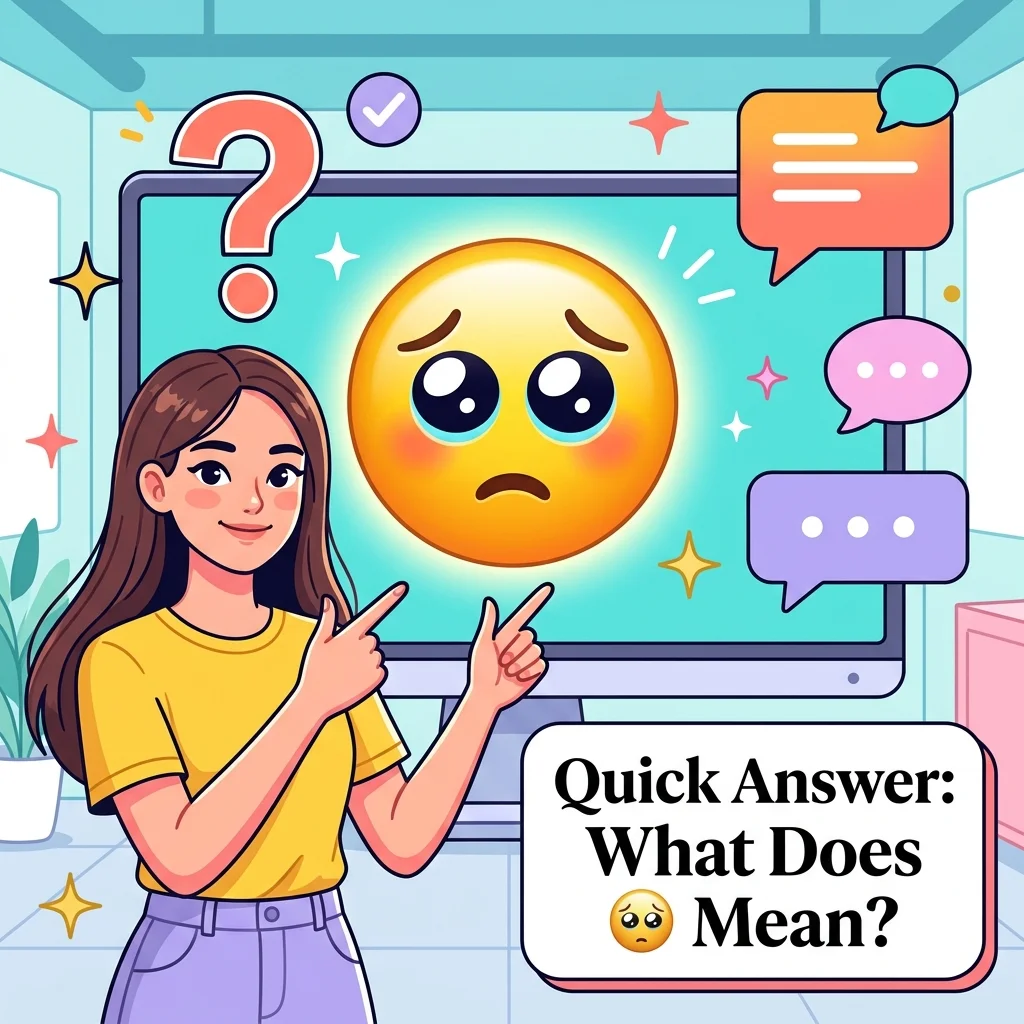
The pleading face emoji 🥺 usually means pleading, begging, asking nicely, vulnerability, affection, or wanting something badly. It can communicate a feeling like “please,” “I really want it,” “aww,” or “don’t say no.”
The exact meaning depends on the message and relationship between the people using it.
For example:
- “Can we stay five more minutes? 🥺” = Please, can we?
- “You’re so sweet 🥺” = That touched me / I feel emotional.
- “I miss you 🥺” = I miss you in a soft or vulnerable way.
- “Send me the picture 🥺” = Please send it.
- “You actually remembered 🥺” = That means a lot to me.
What Does “Pleading Face Emoji Meaning” Mean?
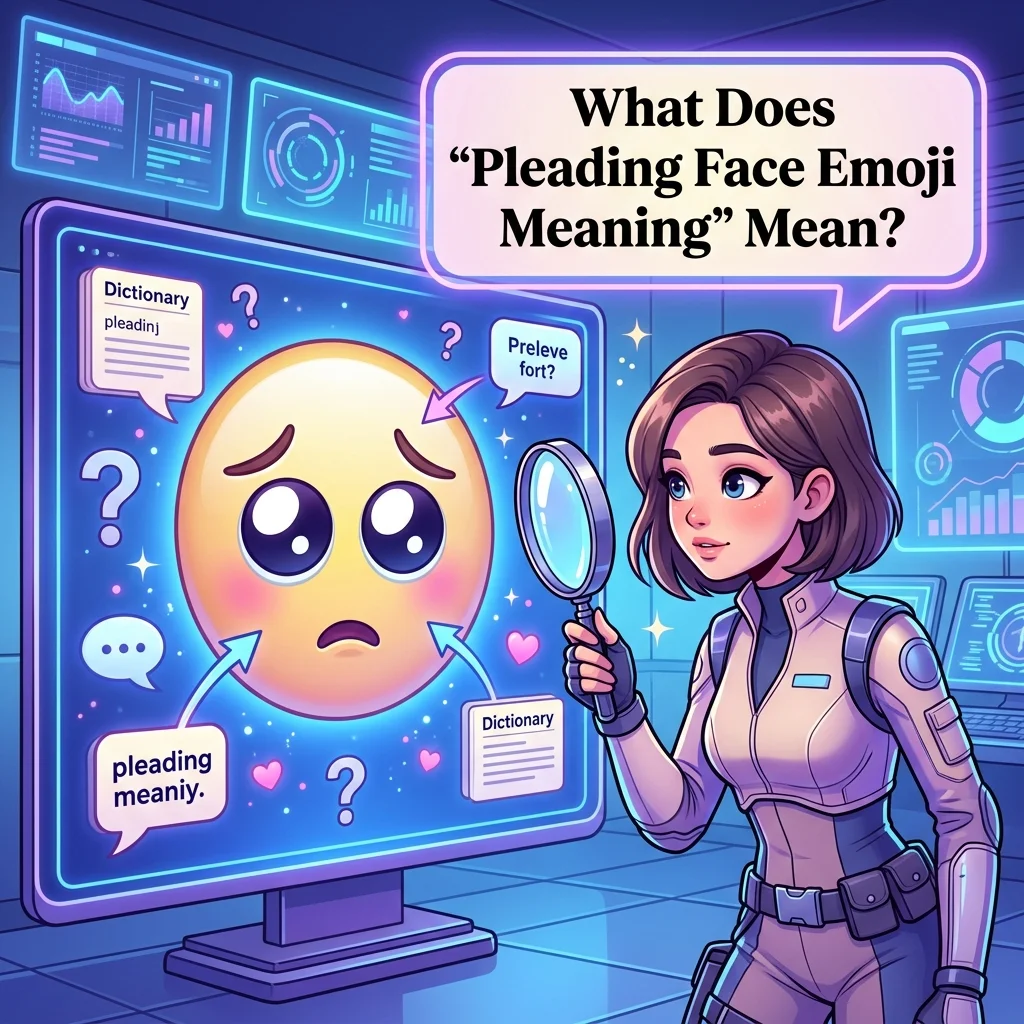
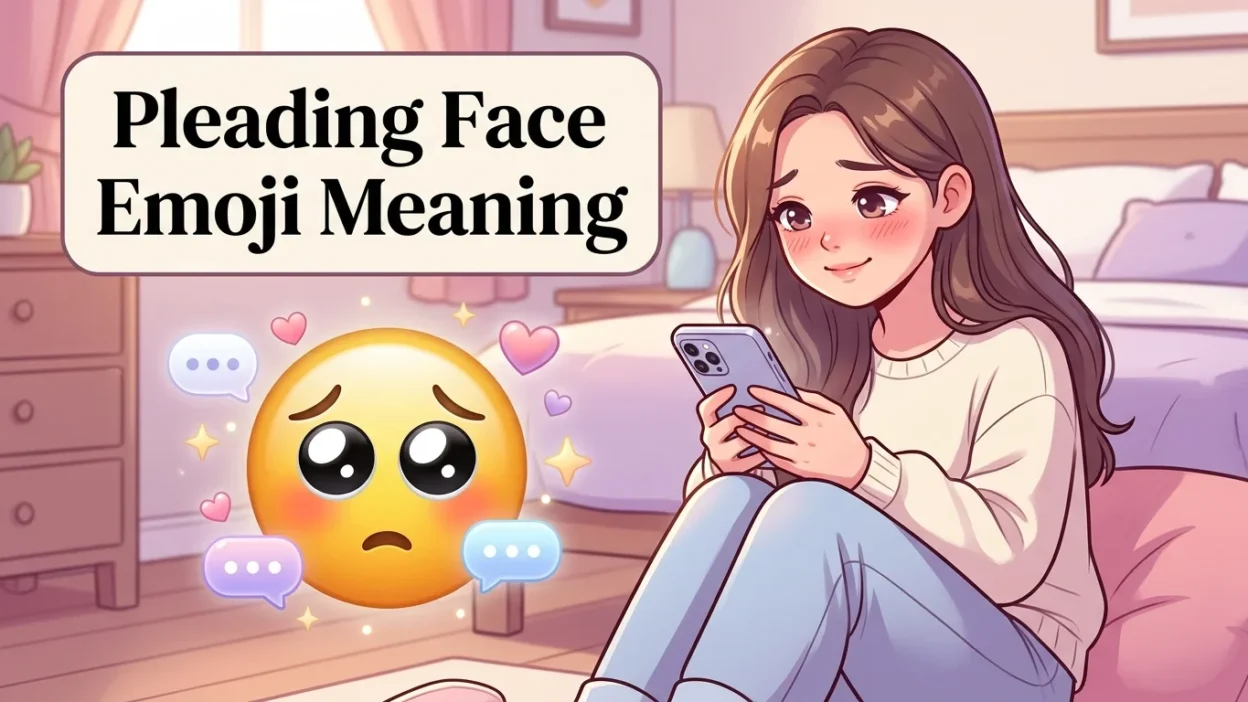
The pleading face emoji 🥺 represents a face with large, puppy-like eyes, raised or furrowed eyebrows, and a small frown. Its official Unicode name is “pleading face,” while its Unicode character is U+1F97A.
In simple English, 🥺 looks like someone who is asking for mercy, making a request, feeling vulnerable, or trying to look especially cute and emotional.
The most common meaning is connected to pleading or asking nicely. Imagine someone looking at you with big puppy eyes and saying, “Please?” That is the basic emotional idea behind the emoji.
However, modern internet communication has expanded its meaning. People do not only use 🥺 when they literally want something. They can also use it to show:
- Affection
- Shyness
- Sweetness
- Vulnerability
- Appreciation
- Emotional sensitivity
- Longing
- A cute request
- Mild sadness
- Romantic interest
- Playful begging
- Being touched by something
The emoji does not automatically mean serious sadness. In many conversations, it is deliberately exaggerated for a cute or playful effect.
Literal Meaning of 🥺
Literally, the emoji represents a face with pleading eyes.
The visual design gives the impression of someone looking at another person with big, emotional eyes. That is why the expression is often compared to puppy eyes.
For example:
“Can I have one more cookie? 🥺”
Here, 🥺 makes the request sound softer and more pleading.
Without the emoji:
“Can I have one more cookie?”
With the emoji:
“Can I have one more cookie? 🥺”
The second version feels more emotional and playful.
The Most Common Meaning
The most common interpretation of 🥺 is “please” or “I really want this.”
But context matters.
If someone says:
“Please don’t go 🥺”
the emoji can express sadness and vulnerability.
If someone says:
“You look so cute today 🥺”
it can show affection or admiration.
If someone says:
“Can you buy me pizza? 🥺”
it is probably playful begging.
So, the emoji has one central idea—pleading or emotional vulnerability—but people use that idea in several different ways.
Meaning in Different Contexts
The same emoji can communicate different emotions depending on where and how it appears.
🥺 in Everyday Conversation
In everyday conversation, 🥺 usually softens a request or adds emotion to a statement.
For example:
“Can you wait for me? 🥺”
This sounds less demanding than simply saying, “Wait for me.”
It can also show that someone feels emotionally touched:
“You remembered my birthday 🥺”
Here, the person is probably not begging. They are showing that the gesture made them feel emotional or appreciated.
🥺 in Text Messages
In texting, 🥺 often acts like an emotional tone marker.
Text messages can sound cold because they do not include facial expressions or voice tone. Adding 🥺 can make the message feel softer.
For example:
“Don’t be mad at me 🥺”
This can communicate an apologetic or vulnerable tone.
Another example:
“Can I call you tonight? 🥺”
The emoji can make the request sound affectionate or shy.
🥺 on Social Media
On social media, 🥺 is frequently used in captions, comments, replies, and posts.
People may use it after receiving a compliment, seeing something adorable, or talking about someone they care about.
For example:
“Look at this little puppy 🥺”
Here, the emoji expresses affection and cuteness rather than begging.
A person might also comment:
“You two are adorable 🥺”
In this case, it communicates warm affection or being emotionally touched.
🥺 on WhatsApp
On WhatsApp, the pleading face emoji is common in personal conversations.
It may appear when someone wants a favor:
“Please call me when you’re free 🥺”
It can also appear in romantic conversations:
“I miss you 🥺”
Or in playful conversations:
“You ate without me? 🥺”
The relationship between the people matters a lot. Between close friends, 🥺 can be humorous. Between romantic partners, it may sound more affectionate.
🥺 on Snapchat
On Snapchat, 🥺 can be used in chats, captions, and replies.
A person might send it after receiving a cute photo:
“Stop, you’re too cute 🥺”
It can also accompany a request:
“Send another snap 🥺”
The emoji makes the request sound playful rather than demanding.
🥺 on Instagram
Instagram users often use 🥺 in comments and captions to express admiration, affection, or emotional reactions.
For example:
“This is the cutest thing ever 🥺”
Here, it means something like “This is so adorable that I feel emotional.”
It can also appear under photos:
“You look amazing 🥺”
Depending on the relationship, this could simply be affectionate or could carry a romantic tone.
🥺 on TikTok
The pleading face emoji became especially recognizable in online youth culture and social media communication.
You may see it in comments such as:
“Please don’t make me cry 🥺”
or:
“I need this immediately 🥺”
It is also commonly associated with the 🥺👉👈 combination, which can suggest shyness, bashfulness, nervousness, or a cute way of asking for something.
The meaning is usually playful rather than literal.
🥺 in Gaming
Gamers can use 🥺 when asking teammates for help, items, another chance, or a favor.
For example:
“Revive me please 🥺”
or:
“Can you give me that skin? 🥺”
The emoji can make the request humorous and less serious.
🥺 in Professional Communication
The pleading face emoji is generally more appropriate in informal professional conversations than formal business communication.
For example, coworkers who know each other well might jokingly write:
“Can you cover my shift tomorrow? 🥺”
However, you would usually avoid using 🥺 in a formal email to a manager, client, professor, or business contact unless you already have a very casual relationship.
In professional settings, clarity and appropriate tone matter more than playful emotional expression.
Examples of the Pleading Face Emoji
Here are several realistic examples showing how the meaning can change with context.
Example 1: Asking for a Favor
Sentence:
“Can you pick me up after work? 🥺”
Meaning:
The person is politely asking for a favor.
Situation:
A friend needs a ride and wants to make the request sound sweet rather than demanding.
Example 2: Wanting Something
Sentence:
“Please let me get this one 🥺”
Meaning:
“I really want this, so please say yes.”
Situation:
Someone wants permission to buy or have something.
Example 3: Missing Someone
Sentence:
“I really miss you 🥺”
Meaning:
The person feels emotionally vulnerable and wants to express that they miss someone.
Situation:
A romantic partner or close friend is away.
Example 4: Showing Appreciation
Sentence:
“You actually remembered 🥺”
Meaning:
“That means so much to me.”
Situation:
Someone remembered an important detail, birthday, favorite food, or personal preference.
Example 5: Flirting
Sentence:
“You’re making me blush 🥺”
Meaning:
The person may be feeling shy, flattered, or romantically interested.
Situation:
Someone receives a sweet or flirtatious compliment.
Example 6: Playful Begging
Sentence:
“Give me one bite 🥺”
Meaning:
“Please share your food with me.”
Situation:
A friend is jokingly asking for some food.
Example 7: Feeling Sorry
Sentence:
“I’m sorry, don’t be mad 🥺”
Meaning:
The person is apologizing and trying to show vulnerability.
Situation:
Someone thinks they have upset another person.
Example 8: Reacting to Something Cute
Sentence:
“Look at that kitten 🥺”
Meaning:
“That kitten is incredibly cute.”
Situation:
The person is reacting emotionally to an adorable animal.
When Do People Use 🥺?
People use the pleading face emoji in many different situations, but most uses share one idea: the person wants to make their emotion feel softer, sweeter, or more vulnerable.
When Asking Nicely
This is one of the clearest uses.
“Can I have another piece? 🥺”
The emoji works almost like the spoken word please.
When Begging Playfully
Someone might use 🥺 when they are not seriously begging but want to exaggerate their request for humor.
“Please give me the last slice 🥺”
The person may be joking.
When Feeling Vulnerable
The emoji can communicate emotional openness.
“I just want you here 🥺”
This feels softer and more vulnerable than the same sentence without an emoji.
When Showing Affection
People also use 🥺 when they feel warmth toward someone.
“You’re so sweet 🥺”
It can communicate affection, appreciation, or emotional warmth.
When Something Is Adorable
The emoji has become strongly connected with cute reactions.
“That baby is so adorable 🥺”
In this context, it does not necessarily mean “please.” Instead, it expresses an emotional reaction to cuteness.
When Flirting
In romantic or flirtatious conversations, 🥺 can make a message sound shy and affectionate.
For example:
“Are you really coming to see me? 🥺”
The emoji can suggest excitement, shyness, or longing.
However, 🥺 by itself does not prove romantic interest. The surrounding conversation matters.
Different Meanings of the Pleading Face Emoji
Although the emoji has a central meaning, several interpretations are common.
Pleading or Begging
Definition: Asking strongly or sweetly for something.
Context: Requests, favors, permission, or another chance.
Example:
“Please don’t leave yet 🥺”
This is probably the closest meaning to the emoji’s official concept.
Saying “Please”
Definition: Making a request sound softer.
Context: Casual texting and conversations.
Example:
“Can you send it to me? 🥺”
Here, 🥺 functions almost like an emotional version of “please.”
Vulnerability
Definition: Showing that you feel emotionally exposed, sensitive, or in need of comfort.
Context: Personal or emotional conversations.
Example:
“I just need a hug 🥺”
The emoji emphasizes the person’s emotional state.
Affection
Definition: Showing warmth, fondness, or emotional attachment.
Context: Friends, family, romantic partners, and social media.
Example:
“You remembered my favorite song 🥺”
The person may feel touched by the gesture.
Cuteness
Definition: Reacting to something adorable or sweet.
Context: Animals, babies, romantic moments, gifts, or kind gestures.
Example:
“That puppy is too cute 🥺”
The emoji communicates an emotional “aww.”
Shyness
Definition: Showing bashfulness or a soft, hesitant reaction.
Context: Compliments, flirting, romantic conversations, and embarrassing moments.
Example:
“You really think I’m cute? 🥺”
It can make the message feel shy and vulnerable.
Longing
Definition: Wanting someone or something strongly.
Context: Relationships, distance, memories, or desires.
Example:
“I wish you were here 🥺”
The emoji emphasizes the emotional desire.
Playful Sadness
Definition: Pretending to be sad to make a situation funny or persuasive.
Context: Friends, memes, casual chats, and social media.
Example:
“You went without me? 🥺”
The person may not actually be hurt. They may simply be joking.
What Does 🥺 Mean From a Girl?
When a girl sends 🥺, it can mean please, affection, shyness, vulnerability, cuteness, or playful begging.
For example:
“Can you stay a little longer? 🥺”
This may simply mean she really wants you to stay.
If she says:
“You’re so sweet 🥺”
she may be expressing genuine appreciation.
In a romantic conversation, 🥺 can sometimes make a message feel softer or flirtier. However, you should not assume that the emoji alone means she likes you romantically.
Look at the full conversation, her words, and the established relationship.
What Does 🥺 Mean From a Guy?
A guy may use 🥺 for many of the same reasons.
For example:
“Bro, please help me 🥺”
This could simply be playful begging between friends.
In a romantic conversation:
“I miss you 🥺”
may express affection or vulnerability.
A guy can also use it sarcastically or humorously:
“You ate the last burger? 🥺”
Here, the emoji exaggerates disappointment for comedic effect.
The important point is that 🥺 does not belong to one gender. Anyone can use it to create a softer, more emotional, or playful tone.
What Does 🥺 Mean From a Guy to a Girl?
When a guy sends 🥺 to a girl, the meaning depends heavily on what he says around it.
For example:
“Can I see you tomorrow? 🥺”
This may sound shy, affectionate, or slightly flirtatious.
Another example:
“Please don’t be mad at me 🥺”
This is more likely apologetic or vulnerable.
If he says:
“You looked so pretty today 🥺”
the emoji can add tenderness or admiration.
Still, it is better to interpret the whole message and relationship rather than treating one emoji as proof of romantic interest.
What Does 🥺 Mean From a Girl to a Guy?
A girl may send 🥺 to a guy when she wants to ask for something, show affection, react to a sweet message, or appear playful and shy.
For example:
“Can you call me tonight? 🥺”
This may communicate that she really wants to talk.
Another example:
“Stop making me blush 🥺”
can suggest that she feels shy or flattered.
However, context remains important. The same emoji can be friendly, romantic, joking, or simply cute.
What Does 🥺 Mean in Flirting?
In flirting, 🥺 often adds a soft, shy, cute, or vulnerable tone.
For example:
“Will you take me on a date? 🥺”
The emoji makes the question sound playful and less direct.
Another example:
“You really missed me? 🥺”
Here, the emoji can make the response feel emotionally intimate.
The combination 🥺👉👈 is also commonly associated with bashfulness or shy behavior online. It can communicate something like “I’m shy to ask, but…”
Still, context is essential. Emoji meanings are flexible, and one emoji cannot establish someone’s intentions by itself.
🥺 vs. 😢
The pleading face 🥺 and crying face 😢 can both appear in emotional conversations, but they are not identical.
🥺 usually suggests:
- Pleading
- Vulnerability
- Cute sadness
- Shyness
- Wanting something
- Affection
😢 usually suggests:
- Sadness
- Disappointment
- Crying
- Emotional pain
Compare:
“Please don’t go 🥺”
This sounds like a plea.
“You left without saying goodbye 😢”
This focuses more directly on sadness.
🥺 vs. 🥹
The pleading face 🥺 is often associated with asking, vulnerability, puppy eyes, and wanting something.
The face holding back tears 🥹 is more strongly connected with being emotionally moved, grateful, proud, or trying not to cry.
For example:
“Can I have one? 🥺”
sounds like a request.
“You did all this for me 🥹”
sounds more like emotional gratitude.
They can overlap, but the emotional focus differs.
🥺 vs. 😭
The loudly crying face 😭 generally communicates much stronger crying or emotional intensity.
For example:
“I miss you 🥺”
sounds soft and vulnerable.
“I miss you 😭”
sounds much more intensely emotional.
However, internet users also use 😭 humorously. Someone might write:
“This pizza is so good 😭”
without actually crying.
Therefore, context matters for both emojis.
🥺 vs. 🙏
The folded hands emoji 🙏 can represent prayer, gratitude, respect, thanks, or a request.
For example:
“Please help me 🙏”
sounds like a straightforward or serious request.
“Please help me 🥺”
sounds more emotional, cute, vulnerable, or pleading.
The two can also appear together:
“Please say yes 🥺🙏”
This strongly emphasizes the request.
Common Mistakes With 🥺
Understanding the common mistakes can help you avoid misreading someone’s message.
Mistake 1: Assuming 🥺 Always Means Sadness
The emoji can look sad, but sadness is only one possible interpretation.
Someone might use it because something is cute, romantic, funny, or emotionally touching.
Mistake 2: Assuming It Always Means Flirting
People often use 🥺 in romantic conversations, but it is also extremely common between friends and family members.
For example:
“Give me some fries 🥺”
is not necessarily flirtatious.
Mistake 3: Treating the Emoji as a Complete Message
An emoji does not always have a fixed meaning.
Compare:
“Please don’t leave 🥺”
with:
“That puppy is adorable 🥺”
The first is a plea. The second is a reaction to cuteness.
Mistake 4: Ignoring the Relationship
The same emoji can feel different depending on who sends it.
A message from your best friend may be playful. The same message from a romantic partner may feel affectionate.
Mistake 5: Using It in Every Situation
Because 🥺 has a casual and emotional tone, it may not fit formal communication.
A business email saying:
“Please send the report today 🥺”
could sound overly casual or childish.
A clearer professional sentence would usually be better.
How to Reply to 🥺
Your response should depend on what the person is communicating.
If They Are Asking for Something
You can answer directly:
“Okay, you convinced me 😂”
or:
“Sure, no problem.”
If They Are Being Cute
You could respond:
“Aww 😂”
or:
“How can I say no to that?”
If They Are Flirting
If you are comfortable with the tone, you can respond playfully:
“You know exactly how to get your way, don’t you? 😏”
If They Are Actually Upset
A more caring response may be appropriate:
“Hey, what’s wrong?”
or:
“I’m here if you want to talk.”
The emoji gives you a clue, but the surrounding message tells you what response makes sense.
Origin of the Pleading Face Emoji
The history of 🥺 is closely connected to the Unicode and emoji standardization process.
The character has the Unicode code point U+1F97A and is officially listed as PLEADING FACE in the modern Unicode emoji charts. Unicode’s emoji documentation includes keywords such as begging, mercy, pleading, and puppy eyes, which reflect the central idea behind the emoji.
The emoji was approved as part of Unicode 11.0 in 2018 under the name “Face With Pleading Eyes.” It was also included in Emoji 11.0.
The original naming history is interesting because an earlier proposal name was “Face With Glistening Eyes.” Unicode working-group documentation records the change to “Face With Pleading Eyes.”
Once the emoji became available across major platforms, users began applying it beyond literal begging. Social media helped expand its uses into affection, shyness, vulnerability, cute reactions, and playful internet communication.
Different platforms may also display the emoji slightly differently. The basic concept remains recognizable because the central visual idea is the same: large pleading eyes and a small frown.
Emojipedia also notes that 🥺 became especially popular online and was frequently associated with cute or bashful expressions.
Similar Words and Alternatives
Several words and expressions can communicate ideas similar to 🥺.
Please
“Please” is the simplest verbal alternative.
“Can you help me, please?”
The emoji can add an emotional or playful version of the same request.
Pretty Please
“Pretty please” often sounds cute or persuasive.
“Can I have some? Pretty please? 🥺”
This is very close to the emotional effect of the emoji.
Begging
“Begging” is stronger than simply asking.
“I’m begging you, don’t tell anyone.”
The 🥺 emoji can suggest playful begging without making the request sound completely serious.
Puppy Eyes
“Puppy eyes” describes the visual and emotional idea behind 🥺.
“Don’t give me those puppy eyes.”
This expression is closely related to the emoji’s appearance.
Aww
“Aww” is often used when something feels cute or touching.
It is especially relevant when 🥺 expresses affection rather than a request.
I Miss You
When 🥺 appears after “I miss you,” it can add vulnerability and emotional warmth.
“I miss you 🥺”
The emoji intensifies the soft emotional tone.
Don’t Be Mad
The phrase “don’t be mad” can appear with 🥺 when someone is apologizing or asking for forgiveness.
“Don’t be mad at me 🥺”
The emoji makes the apology sound more vulnerable.
Is 🥺 a Romantic Emoji?
The pleading face emoji can be romantic, but it is not automatically romantic.
In a relationship, someone might use it to express affection, longing, shyness, or a cute request.
For example:
“I wish you were here 🥺❤️”
This combination has a clearly affectionate tone.
However:
“Can I have your fries? 🥺”
could simply be a joke between friends.
The surrounding words, relationship, and conversation history matter more than the emoji by itself.
Is 🥺 a Sad Emoji?
Yes, 🥺 can communicate sadness, but sadness is not its only meaning.
It is better described as an emotional and pleading emoji.
It can represent:
- Mild sadness
- Vulnerability
- Wanting comfort
- Pleading
- Affection
- Shyness
- Cuteness
- Longing
- Playful begging
This broad range explains why people use it in many different conversations.
Is 🥺 Flirty?
The pleading face emoji can sound flirty in the right context.
For example:
“Can I get a kiss? 🥺”
is clearly more flirtatious than:
“Can you send me the homework? 🥺”
The emoji itself does not create the flirtation. The words and relationship create most of the meaning, while 🥺 adds a soft or vulnerable tone.
What Does 🥺👉👈 Mean?
The combination 🥺👉👈 is commonly used online to express shyness, bashfulness, nervousness, or a cute way of asking for something.
The pointing hands visually suggest hesitation or shyness.
For example:
“Can I ask you something? 🥺👉👈”
This can mean:
“I’m a little shy to ask, but…”
The combination is especially common in casual internet culture, memes, TikTok comments, and playful conversations.
It can also be used ironically, so context still matters.
Common Phrases With 🥺
Here are some common phrases that naturally appear with the pleading face emoji:
- “Please 🥺”
- “Pretty please? 🥺”
- “Can you help me? 🥺”
- “Don’t leave me 🥺”
- “I miss you 🥺”
- “I want one too 🥺”
- “Can we go? 🥺”
- “Don’t be mad 🥺”
- “You’re so sweet 🥺”
- “That’s so cute 🥺”
- “I need a hug 🥺”
- “Can I have another chance? 🥺”
- “Come back 🥺”
- “Why would you do that? 🥺”
- “You remembered 🥺”
Each phrase gives the emoji a slightly different emotional meaning.
Frequently Asked Questions
What does 🥺 mean in texting?
In texting, 🥺 usually means pleading, asking nicely, vulnerability, affection, or wanting something badly. It often works like an emotional version of “please.”
What does 🥺 mean from a girl?
From a girl, 🥺 can mean “please,” “I really want this,” “I’m shy,” “I miss you,” or “that’s so sweet.” It can be friendly or romantic depending on context.
What does 🥺 mean from a guy?
From a guy, 🥺 can show playful begging, affection, vulnerability, shyness, or sadness. It does not have a special male-only meaning.
Is 🥺 a flirting emoji?
It can be used for flirting because it creates a soft, shy, and vulnerable tone. However, 🥺 alone does not prove that someone is flirting.
What does 🥺 mean in a relationship?
In a relationship, 🥺 can express affection, longing, vulnerability, a cute request, missing someone, or wanting reassurance. The exact meaning depends on the message.
What does 🥺👉👈 mean?
🥺👉👈 commonly represents shyness, bashfulness, hesitation, or a cute way of asking for something. It can also be used humorously or ironically online.
Is 🥺 the same as 😢?
No. 🥺 focuses more on pleading, vulnerability, puppy eyes, affection, and cute emotional expression. 😢 more directly represents sadness or crying.
Conclusion
The pleading face emoji 🥺 is mainly used to express pleading, begging, vulnerability, affection, shyness, or a strong desire for something. Its big eyes and small frown give it the appearance of someone making a cute or emotional request.
In texting and social media, however, 🥺 has developed beyond its basic meaning. Someone may use it to say “please,” show that they feel touched, react to something adorable, express that they miss someone, or add a shy tone to a romantic message.